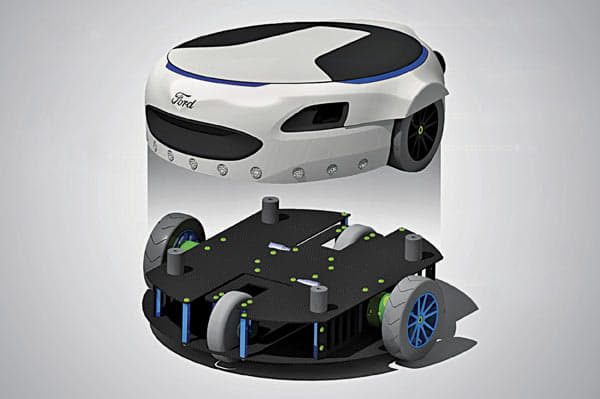
Automotive conferences don’t usually have a professor of psychology and behavioural economics to deliver the opening speech. But the sixth annual ‘Further with Ford’ conference had just that, which also indicates how different the future at Ford Motor Co really is. With liberal doses of humour and psychology, Dan Ariely of Duke University provoked the audience into thinking how they could do things in the present to make the future better. In a way, he was linking it with Ford’s plans to build autonomous cars for commercial operations such as ride sharing. “We are moving from owning cars to sharing them. Ford is looking at mobility through a new lens,” Ford chief executive Mark Fields said at the meet.
With an investment upwards of $4.5 billion, leasing the fourth floor of Michigan University’s new robotics lab, doubling the headcount at its own Palo Alto, California research labs, and buying into Chariot – a crowdsourced shuttle service, Ford is geared to produce fully autonomous cars in volumes by 2021. The Tesla Model 3, it seems, was a big wake-up call.
The automaker from Dearborn, Michigan has come a long way since 2004, when it first participated in the DARPA Grand Challenge – a driverless car competition funded by the US Department of Defense. Among the finalists from 2005 to 2007, Ford has made driverless cars its main focus. 2008 onwards, it continued to build the technology, launching a fleet of 10 Fusion Hybrid autonomous vehicles in 2013, and advancing into engineering from testing in 2015. Ford now says it will have an initial fleet ready for ride-sharing operations by 2018, and a mass-produced, fully autonomous SAE Level 4 vehicle without a steering wheel or accelerator pedals by 2021. That is not too far off, is it?
PROOF OF CONCEPT
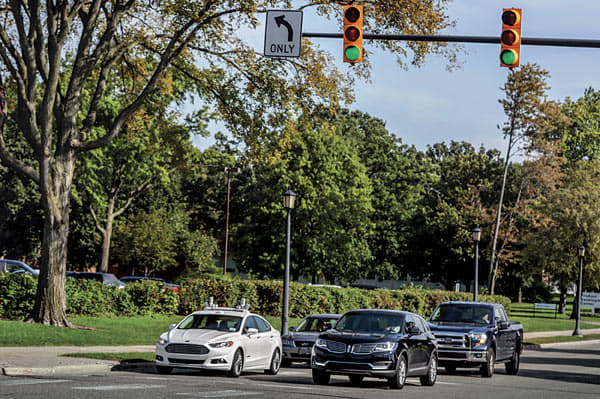
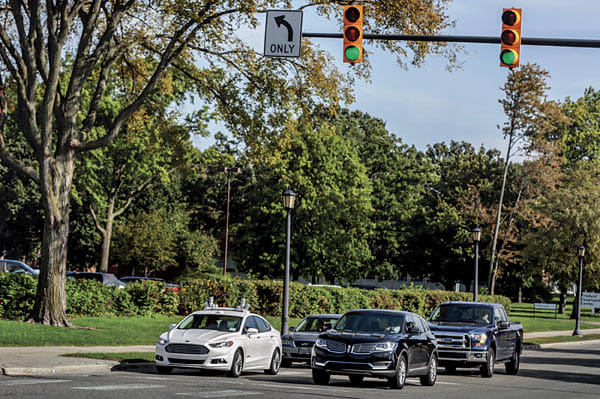
It was time to travel in a Ford autonomous test vehicle. Having ridden in a Bosch test mule a couple of years ago, I wasn’t expecting a radically different experience. On the road, a Ford self-drive doesn’t take directions from the normal GPS mapping – its own system overlays the existing maps in real time for accuracy down to a centimetre. This is done by LiDAR – laser-based scanners, which constantly collect data, sweeping a range of 80-100 metres – a radius Ford plans to expand by the time the final production cars roll out. It will also use Velodyne’s advanced Solid-State Hybrid Ultra ‘Puck’ Auto sensor for precise, real-time 3D models of the surrounding environment which will help the autonomous car handle a broader range of driving scenarios.

 Uday Singh
 Glenn Noronha
 Dipan Sur