After moving a step closer to acquiring SsangYong, Mahindra & Mahindra (M&M) is taking a hard look at the Korean automaker’s portfolio to identify which of its models could work in India.
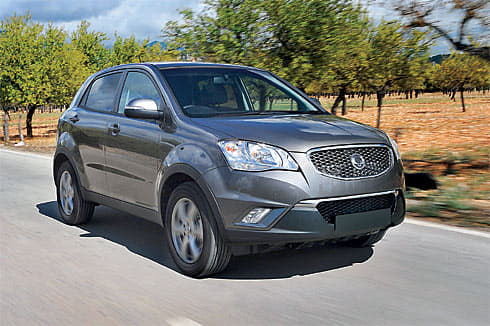
The newly launched Korando is poised to be the game-changer for SsangYong and M&M is planning to introduce this soft-roader into our market. It is the first monocoque vehicle SsangYong has ever produced in its 56-year history and the beleaguered Korean company is betting all its chips on the Korando. Ssangyong also managed to rope in Italdesign, the legendary Italian styling firm, to pen a shape that would easily blend into any market around the world. The result is a pretty generic-looking SUV but a welcome move away from anything SsangYong has produced so far.
We managed to get our hands on a freshly minted example at the test track in SsangYong’s Pyeongtaek factory. The initial impression is that the Korando is pretty small and it doesn’t have the sheer size or bulk an SUV buyer in India would expect, despite its 2650mm wheelbase. However, going in the Korando’s favour is the sporting stance of the car and a design that bears strong SUV cues. The muscular flanks, flared wheel arches that enclose 225/60 R17 tyres and a high beltline deliver a dose of aggression but the small headlights, undersized grille and a chin that ducks under the body, give the nose a tame look. In fact, the Scorpio has a more aggressive nose than the Korando’s and from what we hear, Mahindra’s all-new global SUV due in around six months will make SsangYong’s best look outdated!
The Korando’s interiors are far better than anything that’s come out of the Mahindra stable and clearly, the Korean company can teach Mahindra a thing or two when it comes to interior quality and fit and finish. The dashboard is pretty straightforward with the controls logically laid out and within easy reach but the design is pretty uninspiring and the interiors don’t quite have the levels of plushness of, say, the Fortuner.
The Korando is strictly a five-seater and the luggage capacity of only 486-litres with the seats up is woefully inadequate, especially for large Indian families. However, passenger space is very competitive particularly in the back where legroom is quite generous. This will be a big plus in India. The front seats are also generous with enough adjustment for tall drivers. Visibility outside is good except for the fat rear pillars which makes parking tricky.
A couple of laps around the test track weren’t enough to arrive at a firm opinion but the first impressions after firing the 173bhp 2.0-litre turbo-diesel is that it is noisy from outside but inside the well insulated cabin it is reasonably quiet. Driving at cruising speeds, engine noise doesn’t intrude but at high revs it does sound gruff. The problem with this engine is the uneven power delivery, which is significantly peaky for a modern common-rail turbo-diesel. Peak power is produced at a lofty 4000rpm and maximum torque of 36.7kgm at 2000-3000rpm.
Accentuating the problem is the six-speed automatic fitted on our test car. The gearshifts were sluggish and had a reluctance to shift with urgency. Incidentally, the Korando’s auto ’box is made by DSI, the same Australian firm that supplies the gearbox for the Scorpio auto. The India-spec Korando will, in all probability, come with a six-speed manual which is a good thing.
The handful of corners on the test track were enough to give a good first impression of the Korando’s dynamics. The steering isn’t particularly accurate and there’s a mushy area around the straight-ahead position. The Korando rolls quite a bit too and though the test track surface was too smooth to assess the ride, we don’t expect the SUV to set new standards for ride comfort on Indian roads.
The introduction of the Korando hinges on a number of factors. First, there is the job of completing the acquisition of SsangYong, a process that is in its final stages. Then there is the dilemma of branding the Korando — will it wear a Mahindra badge or will it continue to be a SsangYong? To be cost-competitive in the Indian market, the Korando will have to be locally assembled and the lead time for setting up a CKD operation is considerable and can only start after Mahindra officially takes over. Also, where will it be positioned?
The Korando won’t get to Indian shores before 2012 and our guess is that it will sport a Mahindra badge. Besides, the Korando will sit way above the Scorpio, leaving a gap for Mahindra’s own all-new SUV (W201) to slot in below. There is no talk of price at this moment but our guess is that the base version of the Korando could start at around Rs 15lakh and undercut rivals like the Captiva, Fortuner and Santa Fe.
The newly launched Korando is poised to be the game-changer for SsangYong and M&M is planning to introduce this soft-roader into our market. It is the first monocoque vehicle SsangYong has ever produced in its 56-year history and the beleaguered Korean company is betting all its chips on the Korando. Ssangyong also managed to rope in Italdesign, the legendary Italian styling firm, to pen a shape that would easily blend into any market around the world. The result is a pretty generic-looking SUV but a welcome move away from anything SsangYong has produced so far.
We managed to get our hands on a freshly minted example at the test track in SsangYong’s Pyeongtaek factory. The initial impression is that the Korando is pretty small and it doesn’t have the sheer size or bulk an SUV buyer in India would expect, despite its 2650mm wheelbase. However, going in the Korando’s favour is the sporting stance of the car and a design that bears strong SUV cues. The muscular flanks, flared wheel arches that enclose 225/60 R17 tyres and a high beltline deliver a dose of aggression but the small headlights, undersized grille and a chin that ducks under the body, give the nose a tame look. In fact, the Scorpio has a more aggressive nose than the Korando’s and from what we hear, Mahindra’s all-new global SUV due in around six months will make SsangYong’s best look outdated!
The Korando’s interiors are far better than anything that’s come out of the Mahindra stable and clearly, the Korean company can teach Mahindra a thing or two when it comes to interior quality and fit and finish. The dashboard is pretty straightforward with the controls logically laid out and within easy reach but the design is pretty uninspiring and the interiors don’t quite have the levels of plushness of, say, the Fortuner.
The Korando is strictly a five-seater and the luggage capacity of only 486-litres with the seats up is woefully inadequate, especially for large Indian families. However, passenger space is very competitive particularly in the back where legroom is quite generous. This will be a big plus in India. The front seats are also generous with enough adjustment for tall drivers. Visibility outside is good except for the fat rear pillars which makes parking tricky.
A couple of laps around the test track weren’t enough to arrive at a firm opinion but the first impressions after firing the 173bhp 2.0-litre turbo-diesel is that it is noisy from outside but inside the well insulated cabin it is reasonably quiet. Driving at cruising speeds, engine noise doesn’t intrude but at high revs it does sound gruff. The problem with this engine is the uneven power delivery, which is significantly peaky for a modern common-rail turbo-diesel. Peak power is produced at a lofty 4000rpm and maximum torque of 36.7kgm at 2000-3000rpm.
Accentuating the problem is the six-speed automatic fitted on our test car. The gearshifts were sluggish and had a reluctance to shift with urgency. Incidentally, the Korando’s auto ’box is made by DSI, the same Australian firm that supplies the gearbox for the Scorpio auto. The India-spec Korando will, in all probability, come with a six-speed manual which is a good thing.
The handful of corners on the test track were enough to give a good first impression of the Korando’s dynamics. The steering isn’t particularly accurate and there’s a mushy area around the straight-ahead position. The Korando rolls quite a bit too and though the test track surface was too smooth to assess the ride, we don’t expect the SUV to set new standards for ride comfort on Indian roads.
The introduction of the Korando hinges on a number of factors. First, there is the job of completing the acquisition of SsangYong, a process that is in its final stages. Then there is the dilemma of branding the Korando — will it wear a Mahindra badge or will it continue to be a SsangYong? To be cost-competitive in the Indian market, the Korando will have to be locally assembled and the lead time for setting up a CKD operation is considerable and can only start after Mahindra officially takes over. Also, where will it be positioned?
The Korando won’t get to Indian shores before 2012 and our guess is that it will sport a Mahindra badge. Besides, the Korando will sit way above the Scorpio, leaving a gap for Mahindra’s own all-new SUV (W201) to slot in below. There is no talk of price at this moment but our guess is that the base version of the Korando could start at around Rs 15lakh and undercut rivals like the Captiva, Fortuner and Santa Fe.
 Viraaj Bhatnagar
 Dipan Sur
 Dhruv Dhaka