Over the last decade, CNG has gone from being a niche fuel used mainly by taxis to becoming the most popular alternative fuel in the Indian passenger vehicle market. Though driven mainly by rising fuel prices, an increasing choice of models with factory-fitted systems has also made CNG a mainstream choice. But what exactly is CNG?
What is CNG?
CNG, or Compressed Natural Gas, is composed primarily of methane (CH4) – typically between 85 and 98 percent. The rest consists of minor amounts of other hydrocarbons like ethane and butane, as well as trace amounts of nitrogen and carbon dioxide. Instead of being stored as a liquid, CNG is kept in a gaseous state.
Why is CNG compressed?
CNG’s volumetric energy density (energy/litre) is significantly less than petrol’s, so an amount sufficient for a decent driving range would take up way too much space. However, by compressing the gas to around 200 to 250 bar, its volume reduces roughly 250 times, thus enabling a manageable tank size.
Where do we get CNG from?
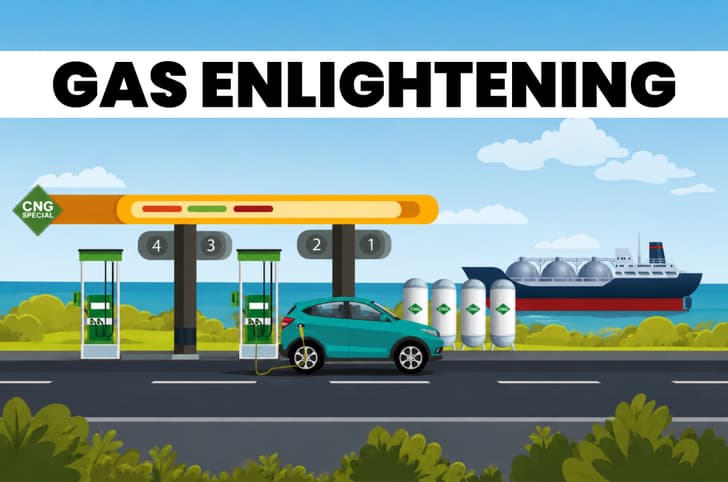
India gets its CNG from a roughly even mix of domestic natural gas production and imported liquefied natural gas (LNG). LNG is essentially CNG super-cooled to -162deg C and stored as a liquid, making it highly dense for easy transportation. Additionally, India also produces CNG from organic matter like food waste, sewage and cattle dung, though for now it is in small amounts. The methane derived from these sources is compressed into Bio-CNG.
How is CNG distributed?
CNG moves through gas distribution pipelines and into refuelling stations. These stations that are connected directly to the pipeline are called online stations and are common in major cities. In areas without a pipeline connection, CNG is supplied via mobile cylinder banks (called cascades) that are filled from a mother station and delivered by truck; the receiving station is referred to as a daughter station.
Is CNG safe?
Modern automotive CNG systems are very safe. The cylinders are designed to withstand pressures well beyond normal operating levels and are equipped with pressure relief and automatic shut-off valves. Methane is lighter than air, thus if a leak occurs, it disperses upward quickly, and while methane is an odourless gas, it is mixed with a chemical to give it a pungent aroma, so you can detect a leak. That said, because CNG is stored at very high pressure, cylinders require periodic inspection and testing as specified by the manufacturer.
What are the advantages of CNG?
1. Lower running costs
CNG’s significantly lower price means the cost per kilometre of running a vehicle on the gas is typically 30-50 percent lower than petrol by today’s fuel prices. The lower cost is, quite simply, the largest contributor to the fuel’s popularity. However, there are other benefits too.
2. Cleaner emissions
CNG burns cleaner with lower CO2 emissions and minimal particulate matter. The formation of sulphur oxides (SOX) and nitrogen oxides (NOX) is also lower with CNG. Thus, it is considered to be a clean or environmentally friendly fuel. When compared to diesel fuel, the reduction in particulate matter is even more significant.
3. Cleaner engine internals
CNG mixes very uniformly with air and leaves almost no carbon deposits when burned. Thus, an engine running CNG generally stays cleaner than when running on petrol. This can be seen on the spark plugs that stay cleaner. However, the higher combustion temperatures that CNG engines typically run at put extra thermal stress on the plugs. On the whole, though, they tend to last a bit longer and stay cleaner too.
What are the disadvantages
1. Lower range
Despite being compressed, CNG still stores much less energy per litre than liquid fuels. Thus, the range-to-volume ratio is lower with CNG than with petrol or diesel fuel.
2.Longer refueling
CNG stations are concentrated around major cities and highways, and given the rising popularity of CNG, there are long queues. Furthermore, filling pressure depends on the pump’s pressure and the number of vehicles, so it can take longer to fill than liquid fuels when the station is full.
3.Reduced power
Petrol enters a cylinder as a fine mist, taking up little space. However, CNG, being a gas, occupies more space, leaving less room for air (oxygen). CNG’s lower volumetric energy density also means the air-CNG mix simply holds less energy than an air-petrol mix. Thus, an engine makes less power when running on CNG. Interestingly, CNG has a higher octane rating than petrol – typically above 120 RON, so a CNG-only engine can run a higher compression ratio to produce more power. But since passenger cars are bi-fuel, a lower ratio that’s suitable for petrol is used.

 Uday Singh

 Dipan Sur


 Glenn Noronha