Pretty much all the information about a tyre can be read right from the tyre itself. It’s all embossed on the sidewall, however, it’s not really straightforward and a lot of it is in code. So here’s a handy guide on reading a tyre right.
Tyre size
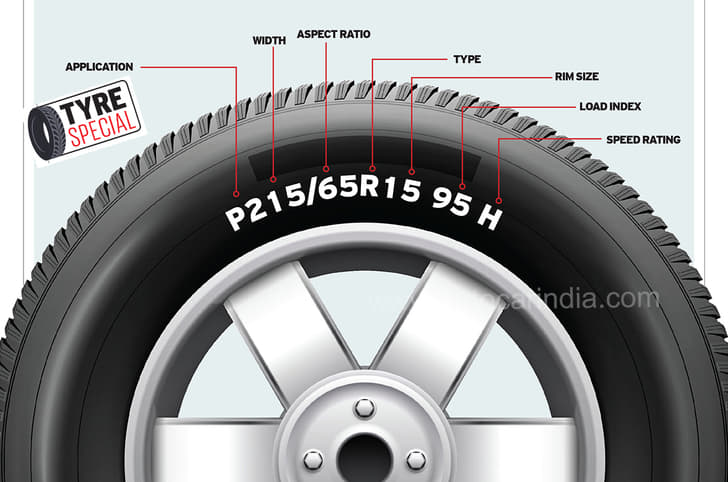
Let’s start with the most often read piece of information – tyre size. It will be represented in a number code, for instance: P215/65 R16 95H.
P: Here, the first character stands for the tyre type. In this case, it’s P for a passenger vehicle. Likewise, LT is meant for light trucks.
215: This number is the width in millimetres of the tyre when measured from sidewall to sidewall.
65: The number following the slash is the aspect ratio of the tyre. It represents the percentage of the height of the sidewalls in relation to a tyre’s width. Thus, in this case, it means that the sidewall height is 65 percent of the tyre’s width. A higher sidewall or profile delivers a comfortable ride, but at the cost of vehicle handling.
R: Stands for Radial. If there is a B instead of an R, it would mean it’s a Bias type of tyre.
15: The last number represents the diameter of the rim in inches.
Other important markings
95: This number denotes the load index of the tyre. The load index is quite complex because it has many considerations and does not actually tell you the precise weight the tyre can carry by itself. Instead, it corresponds to a specific load capacity listed in a manufacturer’s index. To get an idea about the specific load-carrying capacity of the tyre, you will have to check the manufacturer’s table.
H: Is the speed rating. The letter corresponds to a maximum speed that the tyre is certified for. An H-rated tyre is certified for a maximum speed of 210kph.
PSI or Inflation Pressure: To help your vehicle achieve performance efficiency, tyres must be inflated correctly. PSI indicates the correct number for that.
Temperature: Tyres also have a temperature rating showing how they will perform in high-speed situations and are expressed as A, B or C. Tyres with a rating of A will be able to perform at speeds above 185kph, while tyres with a B rating can perform safely between 160 to 185kph, and grade C tyres can perform between 136 to 160kph.
Directional Arrows: A crucial marking but at times overlooked is the tyre’s directional arrow. This indicates the direction the tyre should rotate in and it’s found on unidirectional tyres. Asymmetrical tyres too have a particular fitment position and this is indicated by ‘in’ and ‘out’ markers on them.

 Uday Singh

 Glenn Noronha
 Dipan Sur