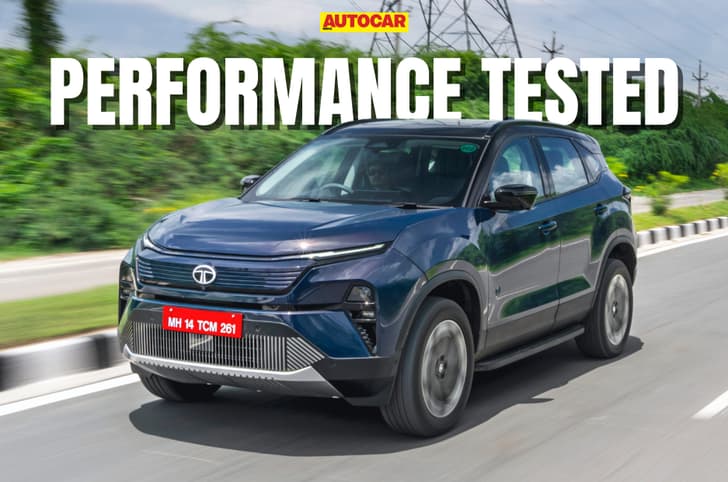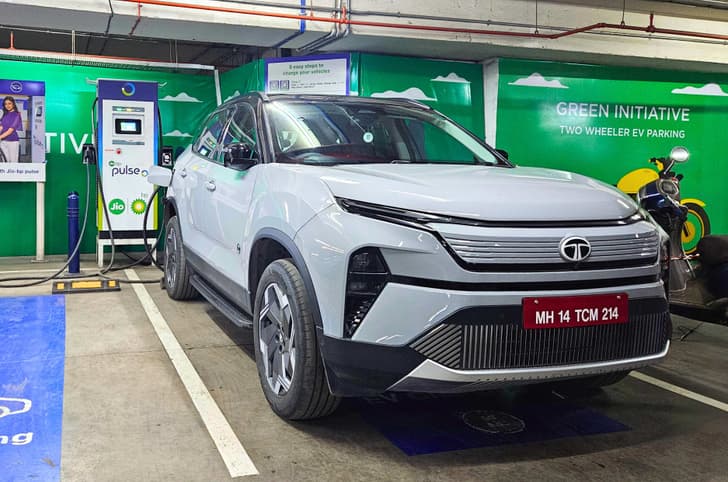
Tata has launched the Harrier EV with two battery pack options – 65kWh and 75kWh – both paired with a rear-wheel-drive (single-motor) setup, though the larger pack is also available with an all-wheel-drive (dual-motor) configuration. According to Tata, the smaller battery variant can deliver up to 538km on a single charge, while the larger pack is rated at 627km in single-motor form and 622km with dual motors. We put the bigger battery, AWD version through our real-world range test to see how closely it matches the company’s claim.
- Harrier EV’s claimed range is up to 622km
- Gets Eco drive mode, Eco air-con setting
- AWD variant weighs 2,317-2,335kg
Tata Harrier EV real world range
The Tata Harrier Electric AWD’s dual motors, one on each axle, produce a combined 504Nm of torque and draw power from a 74.61kWh battery. This top-spec variant is 98kg heavier than the equivalent rear-wheel-drive single-motor model, tipping the scales at 2,335kg (as tested).
In our real-world range test, the Harrier EV was driven exclusively in Eco mode. In the city, with regenerative braking set to Level 3 (high) and an average speed of 18.6kph, it returned 5.45km/kWh. On the highway, with regen dialled down to Level 1 (low) and an average speed of 55kph, efficiency stood at 5.24km/kWh.
.png?w=700&c=0)
Extrapolated, these figures translate to an overall range of 401km on a full charge – an impressive result given the Harrier’s performance and heft, though still well short of the company’s 622km claim.
Autocar India’s range testing
Before our real-world range test, the battery of our test car was fully charged, and we maintained tyre pressures in accordance with the manufacturer’s recommendation. The car was driven in Navi Mumbai city and on the adjoining state highway, in a fixed loop and on a weekday, and we maintained the set average speeds. At the end of each cycle, we calculated the range based on the percentage charge consumed.
Throughout our test, the climate control was set to 22deg C in the full-auto setting, and other electricals, like the audio system, indicators and ventilated front seats, were used when required, just like how a regular user would. We take pride in our testing data, which isn’t merely consistent but also gives users an accurate indication of what they can expect in the real world.

 Uday Singh
 Glenn Noronha
 Dipan Sur