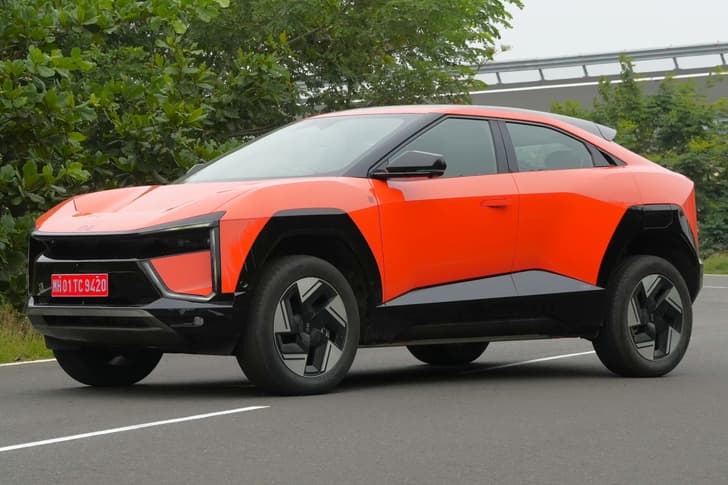

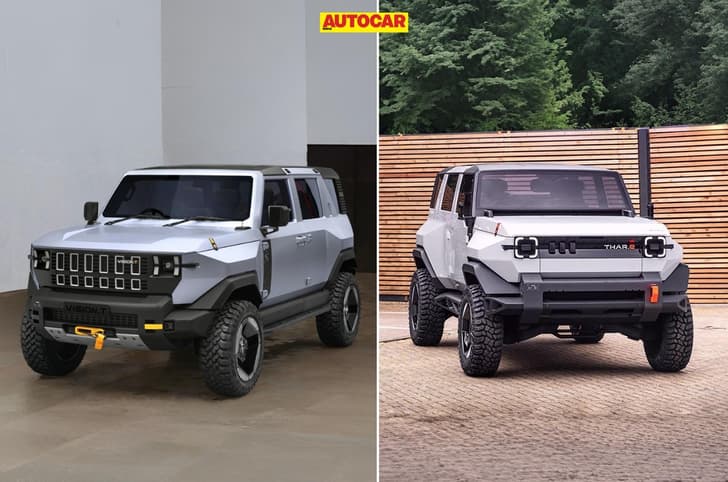
Mahindra made quite a bit of noise this Independence Day, unveiling four head-turning concept SUVs – all underpinned by the new NU_IQ modular monocoque platform. Of these four Mahindra Vision Concepts, three were completely new, but one was not – no prizes for guessing that the Vision T is an evolution of Thar.e concept from 2023.
While the resemblance is immediately apparent, there are also a few notable changes since then. The Vision T is still a vision, but Mahindra has really raised our expectations in the recent past with how closely their concepts translate into production cars – just look at the BE 6 and XEV 9e. It wouldn’t be surprising if a lot of this actually materialises into a production vehicle. But here, we are looking back to take a closer look at how the new-generation Thar has evolved from the Thar.e to Vision T.
Mahindra Vision T vs Thar.e exterior design
.jpg?w=728&h=415&q=75&fm=auto "Mahindra Thar.e front quarter")
.jpg?w=728&h=415&q=75&fm=auto "Mahindra Vision T front quarter")
The overall proportions, the edgy surfacing of the body panels and the rugged persona are strikingly similar between the two concept SUVs. It’s in the details where the two are set apart, and the most distinguishing of them are on the face. In fact, Mahindra has opted for a completely different design for the face with a traditional double-stacked grille, much like the Thar Roxx. The original concept had a more digital face with a sealed-off fascia. The other big change is the headlight, where the LED DRLs aren’t bracket-like units, but appear as four individual lighting elements arranged in two horizontal bars. The bumpers on the Vision T also appear more production-ready.
.jpg?w=728&h=415&q=75&fm=auto "Mahindra Thar.e side profile")
.jpg?w=728&h=415&q=75&fm=auto "Mahindra Vision T side profile")
Not a lot has changed in profile, though, except for more production-ready details like the regular door handles for the front doors, regular wing mirrors and regular body cladding. Some of the nice details that have been retained include the exposed door hinges and bonnet latches, but the kink in the window line has been given a miss. Some elements also link it to the Thar Roxx, for instance, the quarter-glass treatment that brings a dual-tone look, albeit with accessory mounts here, and the C-pillar-mounted rear door handle. At the rear, the tail-lights again mimic the headlamp design, and the bumper has been toned down a little.
Which features do you want in Vision T?
Mahindra Vision T vs Thar.e interior and features
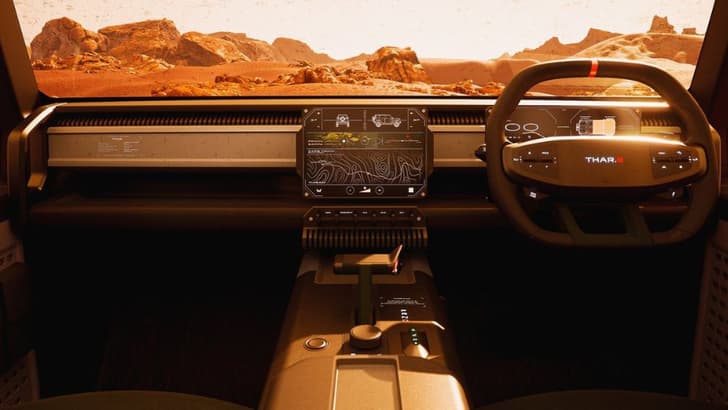
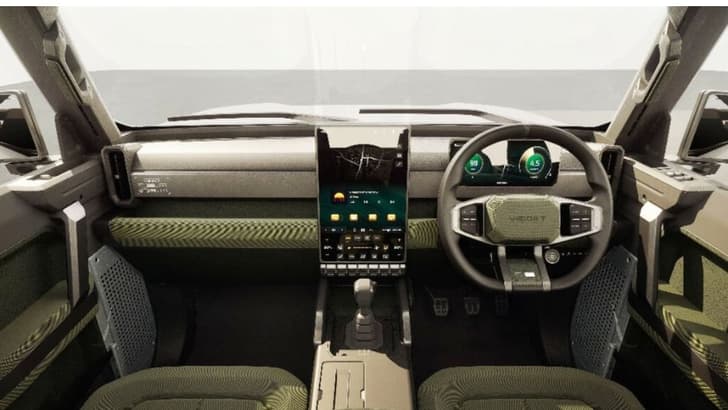
While the exterior has remained relatively similar, the same can’t be said about the interior of the Vision T compared to the Thar.e. The Thar.e had an aircraft-like thrust lever and a squarish steering wheel, both of which can be seen on the BE 6 today, but the Vision T uses a more conventional flat-bottomed steering wheel and a regular gear lever. The free-standing instrument cluster has been retained, but the central infotainment screen, now portrait-oriented, has grown much larger in size.
What is very much welcome, though, are the physical toggle switches on the centre console and steering wheel. The Vision T also gets regular AC vents at either edge, but overall, the rugged and hard-wearing nature of the interior has been retained.
Mahindra Vision T vs Thar.e technical details
The Thar.e was showcased as an electric concept, but the Vision T is obviously much more than that. The Thar.e was underpinned by the P1 platform (a derivative of the INGLO platform), but the Vision T has moved to a more modular architecture that’s not only compatible with an electric drivetrain, but also with petrol, diesel and hybrid powertrains.
.jpg?w=728&h=415&q=75&fm=auto "Mahindra Thar.e rear quarter")
.jpg?w=728&h=415&q=75&fm=auto "Mahindra Vision T rear quarter")
Mahindra has not shared specific details yet, but we understand all of the brand’s existing combustion engines can fit this new monocoque platform. Meanwhile, the battery for the EV version will likely be shared with the BE 6 and the XEV 9e. This platform also supports AWD in both ICE and EV guise, but it is natively front-wheel drive – quite a departure from the rear-wheel drive-biased ladder-frame construction of the existing Thar family.
In essence, the Vision T is the precursor to the next-generation Thar. The first of the NU_IQ models, the Vision S, will hit showrooms from 2027 onwards, and the Vision T will likely follow soon after.


 Uday Singh
 Dipan Sur

 Glenn Noronha