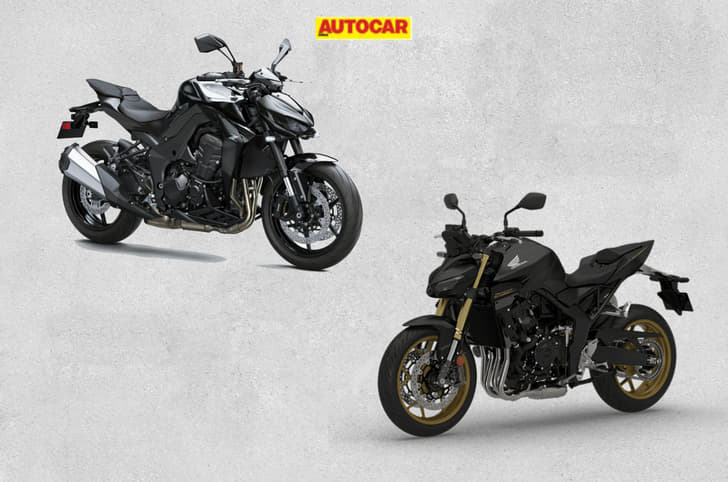
Kawasaki is one of the few big-bike manufacturers in India that brings its international models to our market soon after their global debut; and understandably so, given how bikes like the Z900 consistently rank among the bestselling high-capacity motorcycles here. The latest addition to its India line-up is the new Z1100, which replaces the erstwhile Z1000 and now sits at the top of Kawasaki’s naturally aspirated street-naked range. Its only real rival in our market is the Honda CB1000 Hornet SP. Here’s how the two stack up on paper.
Kawasaki Z1100 vs Honda CB1000 Hornet SP: engine and output
The Honda makes notably more power.
On paper, the CB1000 holds a clear performance advantage over the Kawasaki, and that will almost certainly translate into real-world performance as well. The engine on the Hornet started life on the previous generation Fireblade and produces its peak power higher up in the rev band. If you prefer an inline-four that loves to scream toward a higher redline, the Honda will probably appeal more; but that’s not to say the Z1100 will be any less exciting to ride.
On the flipside, the Z1100 produces slightly more torque, and it does so lower in the rev range. Gearing aside, this should translate into better low-speed manners and tractability in everyday riding. Both engines are paired with a 6-speed gearbox with a bi-directional quickshifter.
Kawasaki Z1100 vs Honda CB1000 Hornet SP: weight and dimensions
Honda CB1000 Hornet SP is lighter and offers more ground clearance.
The Honda is lighter than the Kawasaki by 9kg, and when you combine that with its power advantage, the gap in power-to-weight figures becomes quite apparent. The Z1100 delivers 615.38hp/tonne, while the Hornet is noticeably higher at 740.56hp/tonne.
Both bikes have similar seat heights and identical fuel tank capacities, but the Honda offers 10mm more ground clearance at 135mm. While that number is already on the lower side, the 125mm clearance on the Z1100 is more concerning and could pose problems on our roads.
Kawasaki Z1100 vs Honda CB1000 Hornet SP: suspension, brakes, and tyres
Both bikes offer fully adjustable suspension.
In terms of suspension hardware, both bikes use the same 41mm Showa SFF-BP USD fork up front, offering full adjustability for compression, rebound and preload. The key difference lies at the rear – the Hornet SP is equipped with an Ohlins TTX36 monoshock, while the Kawasaki uses a fully adjustable Showa unit.
While both bikes use twin 310mm front discs, the Hornet SP gets Brembo Stylema calipers compared to the Z1100, which features Kawasaki-branded Tokico units. Tyre profiles are nearly identical too, with both bikes running the same front tyre size, while the Z1100 uses a slightly wider rear tyre.
Kawasaki Z1100 vs Honda CB1000 Hornet SP: features
Both bikes offer an extensive suite of electronic rider aids.
Unlike its predecessor, the Kawasaki Z1100 now comes with a comprehensive electronics package built around a 5-axis IMU. It features Kawasaki Cornering Management Function (KCMF), three levels of traction control, two power modes, a bi-directional quickshifter and cruise control. All settings can be accessed and adjusted through a 5-inch TFT display that also supports Bluetooth connectivity via the Rideology app.
The Honda CB1000 Hornet SP, meanwhile, offers five riding modes – Standard, Sport, Rain and two customisable User modes. It also gets traction control, and a bi-directional quickshifter. Like the Kawasaki, it features a 5-inch TFT with smartphone connectivity through Honda’s RoadSync app that enables navigation, call alerts and music control.
 Ved Janve
 Stephen Raj Antony