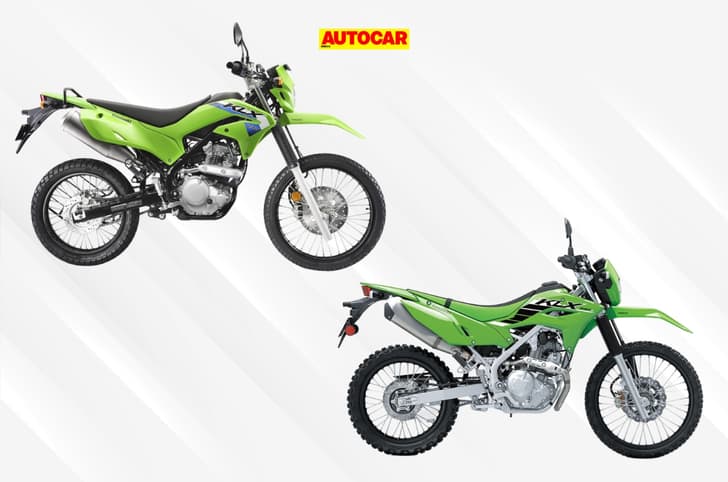
When we first rode the Kawasaki KLX230 last year, the verdict was unanimous that it was a supremely capable dual-sport machine, held back mostly by a steep price tag. Earlier this week, Kawasaki India addressed that, making an announcement that’s sure to have delighted off-road enthusiasts across the country – the KLX230’s price was slashed by a substantial Rs 1.30 lakh thanks to increased localisation.
However, the changes go beyond just the price, and the localisation has also brought with it notable mechanical differences between the two versions. For clarity, we’ll refer to the locally manufactured Kawasaki KLX230 as the MY26 model and the earlier CKD import as the MY25 model, in line with Kawasaki’s own nomenclature. As you’ll see, calling the MY26 bike the “new” KLX230 isn’t entirely accurate.
Kawasaki KLX230 imported vs India-made: Chassis and dimensions
The India-made KLX230 appears to use suspension from an older-spec global model
The most noticeable change on the MY26 Kawasaki KLX230 is in the suspension setup. Compared to the earlier imported MY25 model, the locally built version offers 20mm less travel at the front and 27mm less at the rear. This combination of a non-adjustable fork with 220mm of travel and the rear monoshock with 223mm of wheel travel is identical to what the previous-generation KLX230, sold overseas until 2023, was equipped with.
While Kawasaki has yet to officially confirm whether this is the same hardware carried over from that older model, the specifications suggest as much.
A closer look at the chassis reveals that while the main frame and swingarm appear visually different (largely due to the colour), Kawasaki’s website specifies that both bikes continue to use the same high-tensile steel frame. That said, we’re yet to get our hands on the MY26 bike and can comment on how build and finish quality compare only once we do.
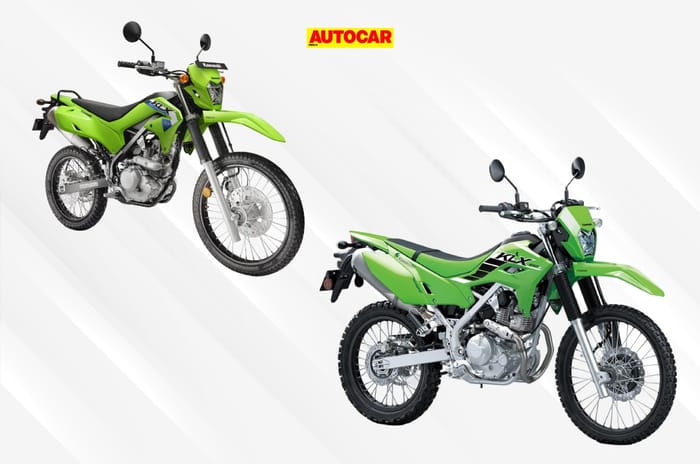
Braking hardware has changed significantly, too. Unlike the MY25 bike, which used a 265mm front disc and a 220mm rear disc, the made-in-India version gets larger units – a 290mm disc up front and a 230mm disc at the rear. And while the MY25 bike came with dual-channel ABS, the MY26 model gets a single-channel system.
Other dimensions remain largely unchanged, with both models sharing an 880mm seat height, 139kg kerb weight and 1,370mm wheelbase. The MY26 bike, however, does lose 10mm of ground clearance, now at 255mm.
Interestingly, not all of these numbers match those of the older international-spec bike, which suggests that Kawasaki’s localisation effort may involve components from different iterations of the KLX230.
Kawasaki KLX230 imported vs India-made: Engine
Made-in-India KLX230 produces slightly higher peak output figure
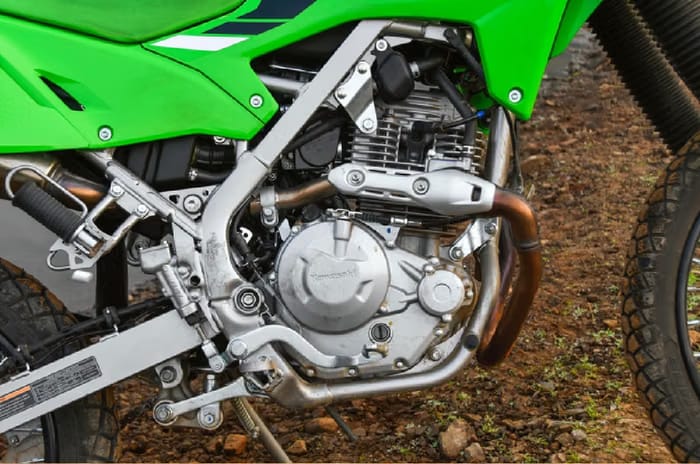
Both versions are powered by a 233cc single-cylinder air-cooled engine but tuned slightly differently. The MY25 CKD model produces 18.1hp at 8,000rpm and 18.3Nm at 6,400rpm, while the MY26 locally manufactured bike delivers 19hp at 7,800rpm and 19Nm at 6,200rpm.
For context, the same engine produced 19hp at 7,600rpm and 19.8Nm at 6,100rpm before its 2024 international update. The India-spec model also features a differently positioned exhaust manifold compared to both last year’s CKD unit and earlier overseas models.
Kawasaki KLX230 imported vs India-made: Design
Design cues suggest strong links to the older international KLX230
Design details also indicate that the MY26 Kawasaki KLX230 shares some components with the older-spec international model. At first glance, the differences are subtle, but closer inspection reveals that much of the bodywork resembles the 2023 KLX230 sold overseas.
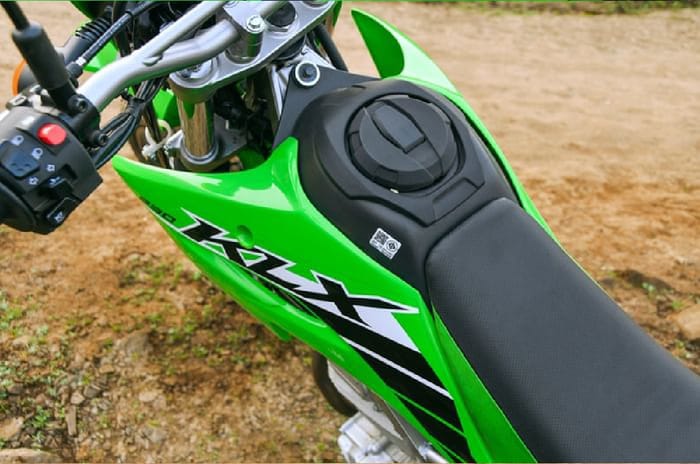
The headlight cowl and fuel tank panels, which extend midway along the single seat, appear nearly identical to the older bike. Speaking of which, the seat itself also seems to be carried over, with the MY25 CKD unit featuring a dual-tone finish, while the MY26 bike gets a simpler all-black design. Another small detail is the fuel cap. The MY25 bike has a slightly raised cap, whereas the MY26 has one that sits flush with the tank – again, like the 2023 international model.
It’s worth noting that these are based on visual observations, and confirmation on whether the parts are identical will only come once Kawasaki India provides further details.
Kawasaki KLX230 imported vs India-made: Price
Revised pricing puts India-made KLX230 in Hero Xpulse territory
Ultimately, while the MY26 KLX230 does appear to carry over some older-spec components, it doesn’t take away from the fact that this should remain a highly capable motorcycle. We’re yet to ride it and assess how localisation has affected performance and quality, but on paper, you’re still getting largely the same machine – arguably better in certain aspects, such as peak output figures. And at Rs 1.99 lakh, it’s a very strong value proposition compared to the earlier CKD unit priced at Rs 3.30 lakh (ex-showroom, Delhi).
 Autocar India Team
 Stephen Raj Antony