The sale of a car or two-wheeler isn’t considered complete until its registration certificate (RC) carries the name of the new owner. Prior to this, the seller of the vehicle remains its legal owner on record. This means that any challans issued, tax dues, or even liability in case of an accident are to be resolved by the existing owner. So, how does vehicle ownership transfer work and what are the necessary steps one needs to take to complete this process.
Disclaimer: This guide is for buyers and sellers of private vehicles. Commercial vehicles need additional paperwork, such as permit and fitness documents, which isn't covered here. The information used here comes from the Parivahan portal and state transport department websites. Documents, fees and deadlines vary by state and RTO, and are subject to change. Check with your local RTO or a government-approved official portal before you apply or pay.
1. Why you need to complete the RC transfer soon after sale?
Both the seller and buyer should sign a sale agreement, thus documenting the transaction. Remember, the vehicle legally belongs to whoever’s name appears on the RC. This means unless the RC is transferred to the new owner, any untoward incident (including traffic violations, accidents and crimes) involving the vehicle can remain the responsibility of the seller. A factor for the buyer to consider is the insurance policy, which is deemed transferred along with the vehicle, though the buyer still has to apply to the insurer within 14 days to have it put in their name.
Before the sale, the seller should clear any pending challans and ensure that there are no unpaid National Highway tolls. Both parties should confirm that any pending loan amount (if applicable) on the vehicle has been cleared. Once the vehicle is handed over, the seller should also close or delink the FASTag linked to it.
2. What paperwork do you need for an RC transfer?
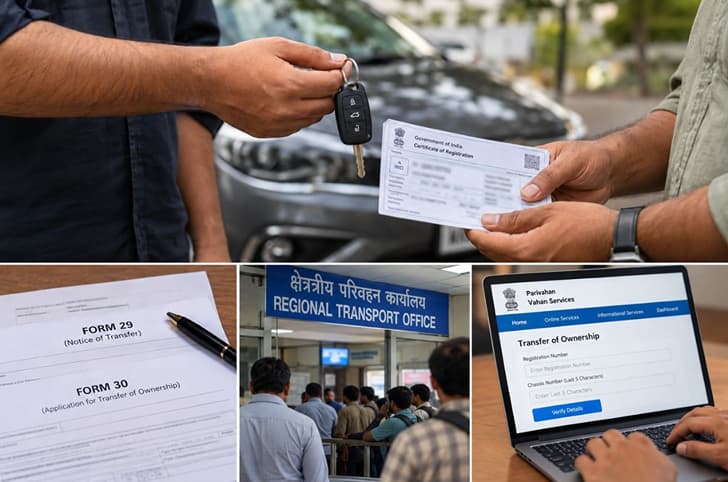
A normal sale of a vehicle involves two forms. The seller files Form 29 (notice of transfer), reporting the sale to the registering authorities where the seller and buyer reside. Meanwhile, the buyer files Form 30 (application for transfer), along with the RC and insurance certificate. Depending on the state, the RTO may also ask for the PUC certificate, PAN card or Form 60, address proof, a chassis and engine pencil print, the buyer’s date of birth proof and undertaking, a passport-size photograph and a tax clearance certificate.
There are three cases that may involve extra paperwork. If the vehicle is registered in another state, the RC transfer application will also need a no objection certificate (NOC) from the source RTO (whether it be from Delhi, Maharashtra or Karnataka). If the owner has died, the legal heir applies on Form 31 with the death certificate. In case the vehicle was bought at a government auction, the buyer applies on Form 32 with the sale certificate and a copy of the government order authorising the auction.
Bank auctions are a bit different to government-run ones. These usually involve vehicles repossessed by banks and finance companies over unpaid loans. Since they aren’t government auctions, Form 32 doesn’t apply here. Instead, the lender provides a sale letter and a NOC, though the RC transfer follows the same process as a government auction. Vehicles here are sold on an ‘as is’ basis, so no warranty or test drives – any pending challans or road tax are likely to be sorted by the buyer. To know about all the other forms that may be required, scroll to the bottom of the story.
3. How much does an RC transfer cost and what are the deadlines?
The RC transfer application has to be submitted within 14 days of the transfer if the vehicle is registered in the same state. The deadline goes up to 45 days if the vehicle is from another state. A legal heir has to inform the RTO within 30 days of the original owner's death and apply for a transfer within three months. Meanwhile, an auction buyer gets 30 days to transfer the RC from the date of taking possession of the vehicle.
As for the costs involved, the central fee that’s set under Rule 81 of the Central Motor Vehicles Rules describes it as half the registration fee, depending on the vehicle's class. This works out to Rs 150 for a motorcycle and Rs 300 for a private car. If the buyer misses these deadlines, they will attract a late NOC fee of Rs 300 a month for motorcycles and Rs 500 a month for cars. Certain states levy a penalty if the RC transfer isn't applied for within 14 days of purchase. Road tax is separate, and is applicable if the vehicle is being re-registered in another state.
4. Should you apply for RC transfer online, through an agent or do it yourself?
You can apply for an RC transfer through the Vahan portal (vahan.parivahan.gov.in/vahanservice/vahan). Enter the registration number, select ‘Basic Service’s and verify with the last five digits of the chassis number and an OTP sent to your registered mobile number. Then choose ‘Transfer of Ownership’, fill in the details and pay the fee displayed. The receipt carries a trackable application number, while the application moves to the concerned RTO for processing.
Some states also let you upload documents and book an appointment online, while others still want the papers submitted in person. Doing it yourself at the RTO costs nothing beyond the official fee, and your documents go directly to the office in charge of processing them. However, this can take time and effort from your end, perhaps even requiring multiple visits in case of missing or incorrect documents.
If absolute convenience is what you want, you can get the process done through an agent. This will not only save you the hassle of standing in queues or making follow-up visits to the RTO, but also help with inter-state RC transfers that can involve an NOC and re-registration. Understandably, this convenience comes at a cost (which can vary from agent to agent) and also having your original documents and signed forms being with a third party. If you do use an agent, don't sign blank forms and always ask for official receipts and the application number for self-tracking the progress.
5. Other forms that may be required for an RC transfer

 Uday Singh
 Dipan Sur


 Glenn Noronha