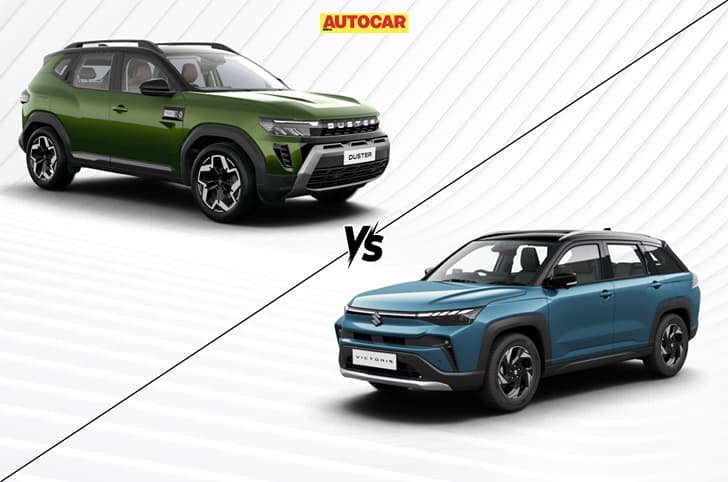
Renault has expanded the new Duster line-up with a strong-hybrid option, joining the existing 1.0-litre and 1.3-litre turbo-petrol engines. While the hybrid shares much of its design and cabin layout with the petrol versions, there are differences in styling, equipment and, most importantly, how the two powertrains deliver performance and efficiency. Here’s a closer look at what sets them apart.
Renault Duster turbo petrol vs hybrid: Exterior
The illuminated grille and badges are the main styling difference
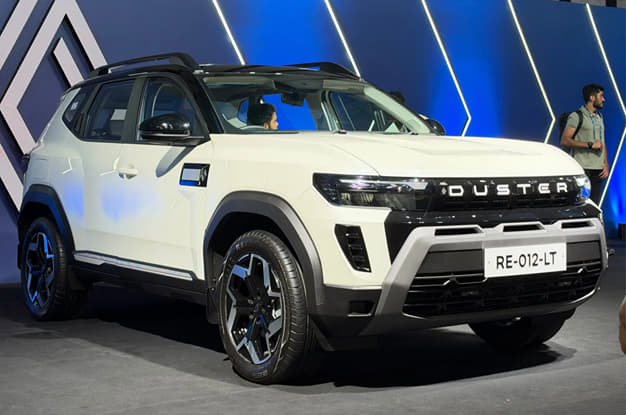
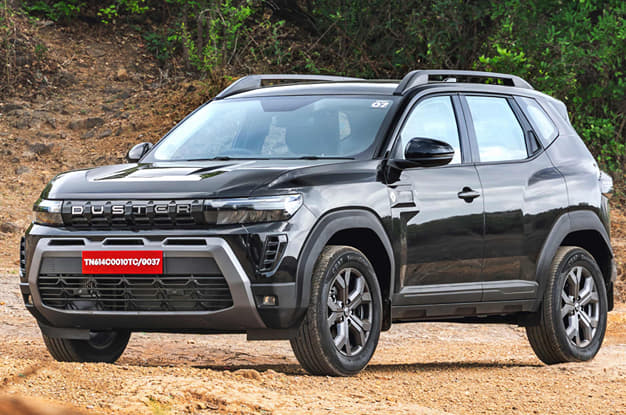
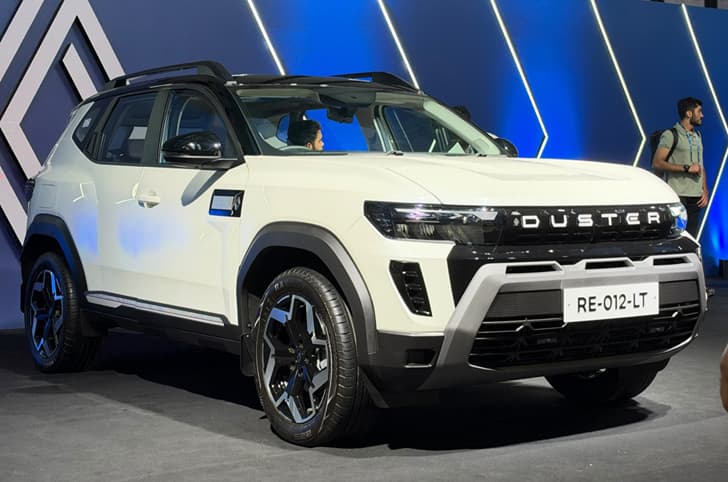
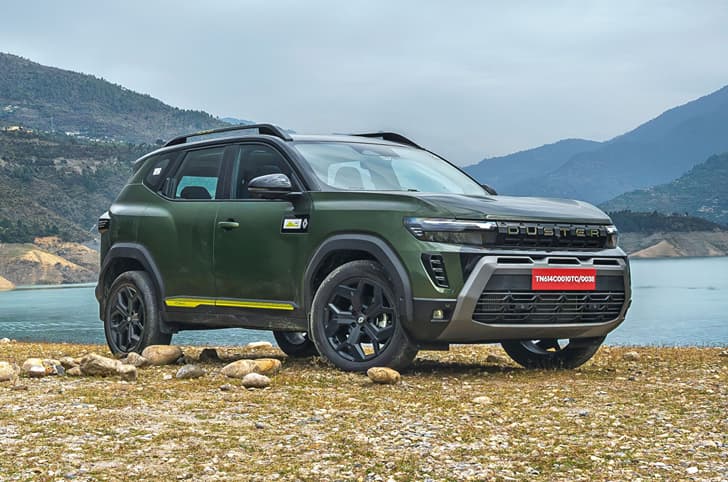
The Duster hybrid retains the turbo-petrol model’s overall design, including its eyebrow-shaped LED daytime running lamps, chunky body cladding, roof rails and C-pillar-mounted rear door handles. It also has the same 212mm ground clearance.
The main styling changes are an illuminated ‘Duster’ grille emblem and ‘E-Tech Hybrid’ badges on the front doors and tailgate. The Hybrid version also gets frequency-dependent dampers. Boot capacity is lower than in the turbo-petrol versions, although the overall exterior design remains largely unchanged.
Renault Duster turbo petrol vs hybrid: Interior and features
The cabin layout is similar, but the upholstery and equipment differ
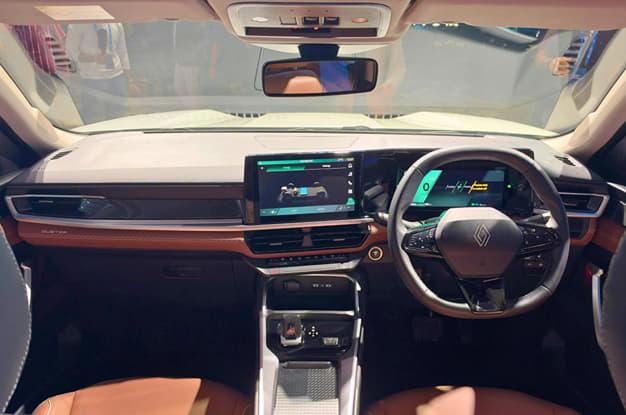
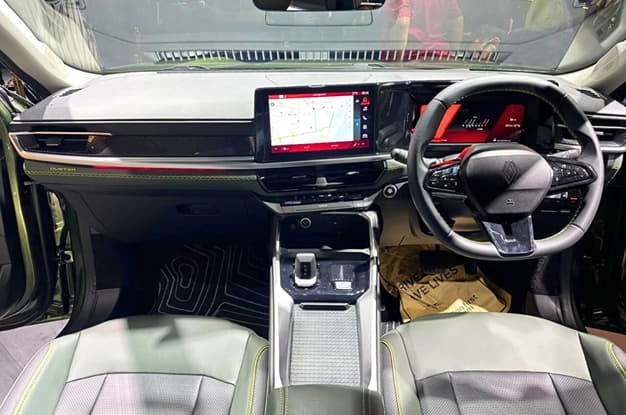
The hybrid follows the turbo-petrol Duster’s dashboard layout, with a dual-screen setup and an e-shifter on the centre console. The hybrid gets a different upholstery scheme from the turbo-petrol Duster, with black upholstery and grey stitching on the Evolution, Desert Beige semi-leatherette on the Techno and Dune Brown leatherette on the Emotion. The hybrid also gets a smaller headrest.
The Duster hybrid is offered in Evolution, Techno and Emotion trims, while the turbo-petrol range gets Evolution, Techno, Techno+, Iconic and Iconic Launch Edition variants.
The hybrid and turbo-petrol Duster share some equipment across their respective trims, but there are differences. The hybrid Evolution gets a 7-inch digital driver’s display, a 10.1-inch touchscreen and dual-zone automatic climate control. The turbo-petrol Evolution has the same touchscreen and driver’s display, but gets single-zone manual air conditioning. Both the hybrid and turbo-petrol Techno trims get a panoramic sunroof.
At the top of the range, the hybrid Emotion gets a 10.25-inch digital driver’s display, ventilated and electrically adjustable front seats, and a powered tailgate. The turbo-petrol Iconic offers these features too, but additionally gets a 360-degree camera and Level 2 ADAS, which are not available on the hybrid.
Renault Duster turbo petrol vs hybrid: Engine and Performance
The 1.3-litre turbo-petrol makes more torque
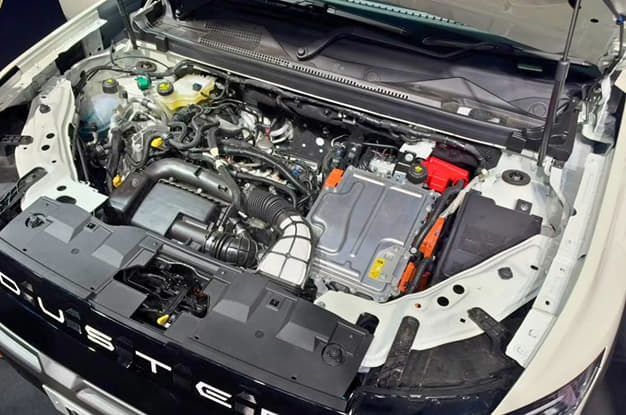
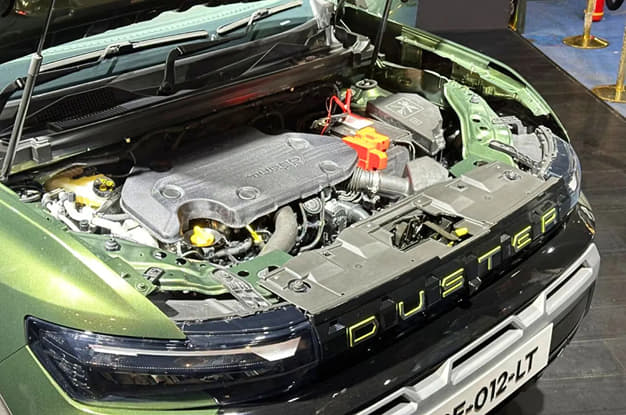
The Duster turbo-petrol is available with two engine options. The 1.0-litre, three-cylinder unit produces 100hp and 166Nm and is paired with a 6-speed manual gearbox. The larger 1.3-litre, four-cylinder engine develops 163hp and 280Nm, and is available with a 6-speed manual or a 6-speed dual-clutch automatic gearbox.
The hybrid uses a naturally aspirated 1.8-litre, four-cylinder petrol engine paired with two electric motors: a 20hp generator and a 49hp motor that drives the wheels. The system produces a combined 160hp and 172Nm, with a 1.4kWh battery supporting the setup. It uses a 'multi-mode' automatic gearbox with two electric gears and four petrol gears.
The hybrid system automatically switches between six operating modes, including all-electric, petrol-only and series and series-parallel hybrid modes. Renault claims the Duster hybrid can cover up to 80 percent of city driving in pure electric mode and accelerate from 0-100kph in a claimed 9.61 seconds.
While the hybrid’s combined output of 160hp is close to the 1.3-litre turbo-petrol’s 163hp, its claimed torque figure of 172Nm is lower than the turbo-petrol’s 280Nm.
Renault Duster turbo petrol vs hybrid: mileage
Duster hybrid mileage is 10.55kpl higher than turbo-petrol DCT
The hybrid’s claimed mileage is significantly higher than that of either turbo-petrol engine. The difference is 9.59kpl over the 1.0-litre turbo-petrol manual, 11.25kpl over the 1.3-litre turbo-petrol manual and 10.55kpl over the 1.3-litre turbo-petrol DCT. At 29kpl, the hybrid’s claimed mileage is around 57 percent higher than that of the DCT version.
The hybrid has a 50-litre fuel tank, the same capacity as the turbo-petrol versions. Renault claims a driving range of more than 1,400km on a full tank of the Hybrid variant.
Duster turbo petrol vs hybrid: Price
The hybrid costs more, even though it misses some features available on the top-spec turbo-petrol
MT = manual; DCT = dual-clutch automatic
The hybrid’s introductory prices apply to deliveries until December 31, 2026. In Evolution trim, the hybrid costs Rs 2.50 lakh more than the 1.3-litre turbo-petrol DCT, while the top-spec Emotion hybrid is Rs 1 lakh more than the Iconic DCT. The hybrid offers higher claimed mileage but misses out on the 360-degree camera and Level 2 ADAS available on the turbo-petrol Iconic.
The hybrid version suits buyers who cover long distances and prioritize fuel efficiency, while the 1.3-litre turbo-petrol is worth considering for its higher torque and additional driver-assistance features.
All prices are ex-showroom, India.

 Uday Singh

 Dipan Sur


 Glenn Noronha