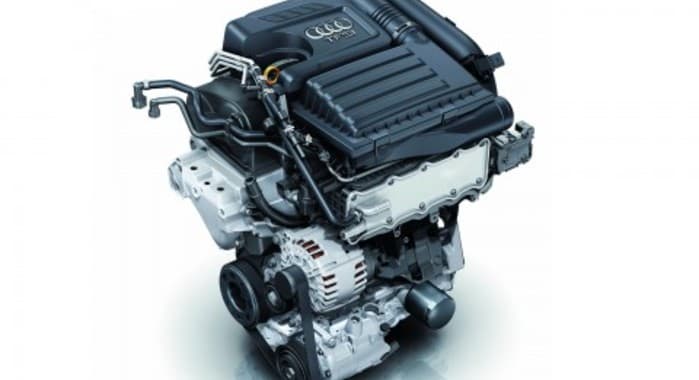
The Volkswagen Group is working on developing engines with “electro-mechanical assistance for forced induction” and “variable compression ratios, Audi’s technical chief Ulrich Hackenberg said at a recent annual conference. With these engines, the company is preparing a revolution in petrol engine efficiency.
Hackenberg also said that coasting would become an important fuel-saving technology over the next few years. A coasting function – where the transmission disengages from the engine on the overrun – is already built into some VW Group models equipped with dual-clutch automatic gearboxes. Hackenberg also went on to details about how Audi will introduce variable compression ratio technology, but the principle has long been something of a Holy Grail for engine designers. Having the ability to vary an engine’s compression ratio depending on immediate demands should lead to significant advances in efficiency.
Saab, in 2000, demonstrated its experimental supercharged and turbocharged SVC engine, which used a tilting block to change the volume of the combustion chamber, and, therefore, the compression ratio. More recent designs have altered compression ratios by changing the throw of the crankshaft or through the manipulation of conrods. Audi demonstrated electrically assisted forced-induction technology in the summer of 2012 as part of an experimental twin-turbo V6 engine. It used an electrically driven turbo which was spun up to high speed by a motor, and would force air into the engine at low speeds — something a normal turbo cannot do until the engine is running at higher revs. This technology not only allows turbocharged engines to perform effectively from a standstill, but is also very effective for downsized two- and three-cylinder engines. Hackenberg said coasting technology – which has significant fuel-saving potential – would arrive in four stages.
The first level already features on some dual-clutch gearboxes, with the next version expected to function when the car is travelling below 6kph. The ultimate version will see the transmission decoupling and the engine shutting down when cruising at speed, travelling downhill or approaching traffic lights that are about to turn red. Electric turbochargers, variable compression ratios, cylinder deactivation and coasting combined have the potential to hugely improve the real-world economy of future petrol engines.

 Viraaj Bhatnagar
 Dipan Sur
 Dhruv Dhaka

 Saptarshi Mondal