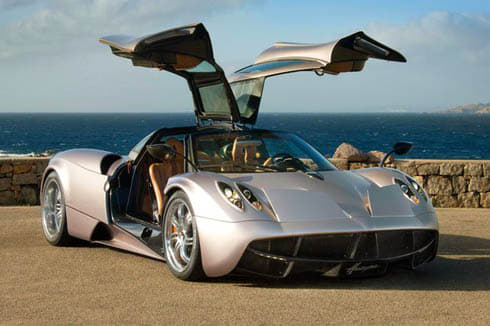
This is the Pagani Huayra, the Italian firm’s one million euro hypercar replacement for the Zonda. Known in development as the C9, the Huayra – a ‘god of wind’ and pronounced ‘Wirer’ with a heavy Spanish accent – has taken Pagani seven years to develop and, according to company boss Horacio Pagani, offers a different flavour of supercar to the Zonda.
Continuing Pagani’s alliance with Mercedes’ AMG department, the Huayra is powered by a bi-turbo 6.0-litre V12. Pagani will sell two versions of the Huayra: the standard engine with 700bhp and 91.8 kgm and a Sport version with 730bhp and 112 kgm. While the block is shared with Mercedes’ own SL65 Black Series, Pagani commissioned AMG to reduce turbo lag and improve the throttle progression, resulting in new heads, pistons, manifolds and turbos.
Currently Pagani is being quite coy about the Huayra’s performance, but is claiming to have seen 230mph, and Zero to 62mph in 3.3sec in testing. Helping to manage the inevitable slip is a three-stage Bosch traction control system.
The Huayra uses a mandatory seven-speed paddle-shift gearbox, built for Pagani by UK race specialist XTRAC. To reduce the length of the drivetrain the gearbox is mounted transversely behind the engine.
Kerbweight has been kept to 1350kg (dry), despite the fact the Huayra is larger than the Zonda and carries more safety equipment. Which along with the forced induction ensures the Huayra is homologated for the US - the first time a Pagani has done so.
Another first are the enormous gullwing doors, like the rest of the body constructed from carbonfibre. While the tub is carbon-titanium, the titanium allowing the material to flex just slightly in the event of an impact rather than shattering, but without compromising the strength.
Pagani claim the overall body is designed to act like an aircraft wing, changing its shape to manage the airflow over it to best effect. It does so, using four moveable aerodynamic flaps, one at each corner of the car. Each independently and automatically operated. These not only tailor downforce as required for acceleration and braking but also work across the car to add grip during cornering.
In addition, the front ride height is adjustable, not only for garage/ramp access at low speeds but also to actively manage the airflow under the car at speed. And under hard braking the ride height (controlled by the dampers) increases to negate dive.
The interior is instantly recognisable as a Pagani, but has designed to be more comfortable and useable on longer journeys, with more cabin space plus a touch screen sat-nav and Bluetooth.
The Huayra also marks a step-change for Pagani. If it can find enough suitably wealthy customers the Huayra will double annual production and take Pagani into the US and Chinese markets. To facilitate that growth Pagani plans to start construction of a new, larger factory during 2011.
 Viraaj Bhatnagar
 Dipan Sur
 Dhruv Dhaka