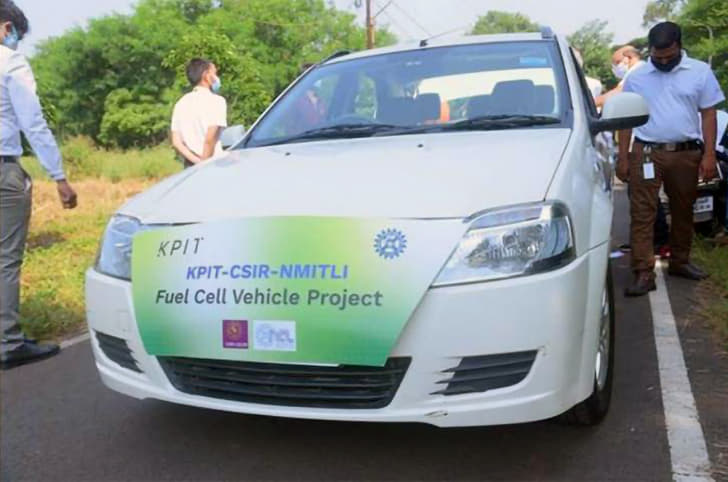
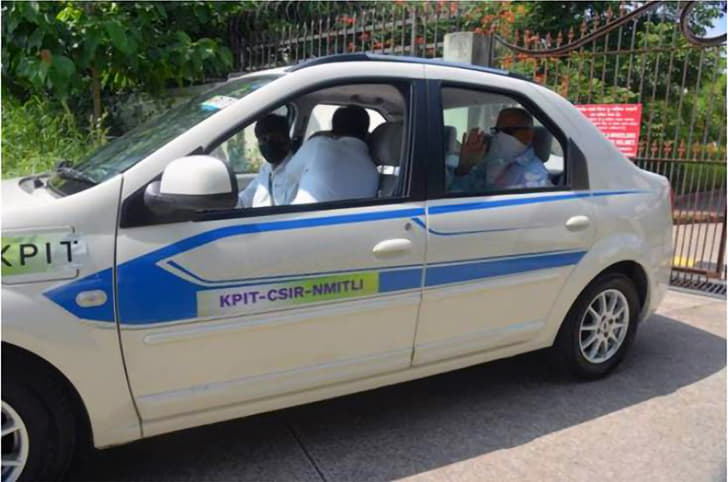
India’s first Hydrogen Fuel Cell (HFC) prototype vehicle developed by The Council of Scientific and Industrial Research (CSIR) and KPIT – a Pune-based multinational corporation – has successfully undergone trials. The vehicle features an indigenously developed a low-temperature PEM (Proton Exchange Membrane) type fuel cell.
- Prototype fuel cell electric vehicle fitted with indigenously developed fuel cell stack
- Fuel cell prototype has expected range of 250km
- Tech likely to be introduced in commercial vehicles
The jointly developed fuel cell stack is a 10kWe automotive-grade LT-PEMFC unit that combines CSIR’s knowhow in membrane electrode assembly and KPIT’s expertise in stack engineering, including lightweight metal bipolar plate and gasket design, system integration, control software and electric powertrain. The fuel cell stack uses extremely thin metal bipolar plates, thus reducing the stack weight by about two-thirds and operates at 65-75 degree Centigrade, which is suitable for vehicular applications.
CSIR and KPIT entered a partnership for the development of automotive grade PEM Fuel Cell technology back in 2016, under the New Millennium Indian Technology Leadership Initiative (NMITLI) – an initiative to establish public-private partnerships in the field of research and development.
How does hydrogen fuel cell technology work?
Hydrogen Fuel Cell (HFC) technology uses chemical reactions between hydrogen and oxygen (from air) to generate electrical energy, eliminating the use of fossil fuels. Further, the fuel cell technology emits only water, thus cutting down the emission of harmful greenhouse gases and pollutants.
The technology has been adopted by carmakers such as Toyota in international markets, with others looking to develop hydrogen-powered models. For India, however, it will likely be a while before the technology can be successfully adopted, with the lack of infrastructure to currently support such vehicles.
The test car
The trials were run on a battery-electric passenger car platform retrofitted with the fuel cell stack. The fuel cell vehicle was fitted with a Type III commercial hydrogen tank. With capacity of around 1.75kg of H2 stored at about 350 bar pressure, the eco-friendly car could possibly run for approximately 250km under typical Indian road conditions at moderate speeds of 60-65kph. The entire fuel cell stack and its associated components with powertrain were retro-fitted in a standard 5-seater sedan.
However, it is expected that the technology is more suited for commercial vehicles as HFC technology requires a much smaller battery for a very large operating range as compared to regular battery EVs. Hence, HFC technology offers more promise for the commercial vehicle segment.
 Viraaj Bhatnagar
 Dipan Sur
 Dhruv Dhaka
 Saptarshi Mondal