The problems associated with rare and difficult-to-obtain materials – as used in motors that power EVs as well as batteries – provide a good reason for focusing on recycling and finding alternatives.
Most EVs have permanent magnet synchronous motors (PMSMs), where the rotor has permanent magnets embedded in it that are attracted to a rotating magnetic field generated using power from the battery. Magnets made from rare earth elements (REEs) are far more powerful than any other kind but raise the question of economic security. (China dominates the market for rare earth elements, with 70-80 percent of the supply.)
A project established in 2019 with the hefty title ‘Sustainable Recovery, Reprocessing and Reuse of Rare-Earth Magnets in a European Circular Economy’ is aiming to make the process more effective. Nineteen European partners are involved, including ZF, which is evaluating recycled REEs for use in new motors and developing designs that make electric motors easier to recycle.
These powerful magnets are tricky to separate from the rotor, and they break up into a magnetised powder that sticks to other ferrous scrap. But a new method called hydrogen processing of magnet scrap (HPMS), developed at the University of Birmingham, produces a nonmagnetic, reusable powder without removing magnets from the rotor first.
.jpg?w=700&c=0)
The rare earth-rich powder can be reprocessed into new magnets while avoiding traditional energy-intensive methods, so the energy used to produce magnets is 12 percent of that needed to make them from virgin material.
ZF has built and tested motors made using HPMS and found the performance of the magnets was almost identical to those manufactured using freshly mined materials.
Another way of reducing the need for virgin REEs is not to use permanent magnets at all. Externally, or separately, excited synchronous motors replace the permanent magnets in the rotors with electromagnetic windings and have been used by Renault since the launch of the Zoe in 2012. Feeding an electric current from the outside of the motor into the rotating core involves the use of brushes, so the motor isn’t ‘brushless’ like a PMSM.
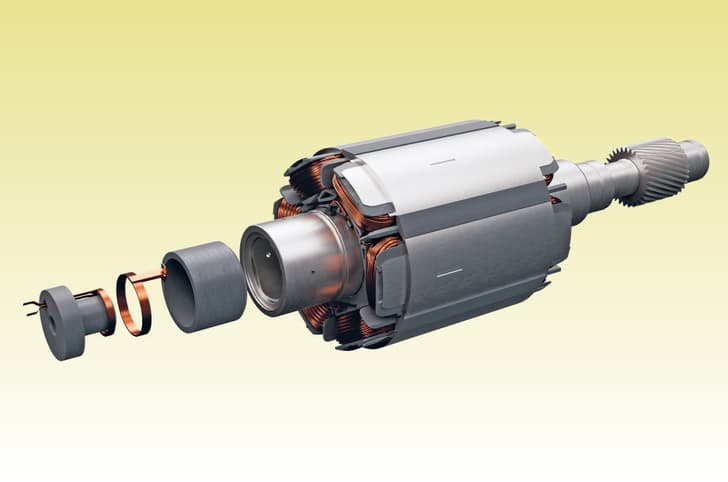
One alternative that avoids the use of brushes is ZF’s I2SM (in-rotor inductive-excited synchronous motor). This has a small electronic generator called an inductive exciter, uniquely fitting inside the rotor shaft rather than on the end, which makes the motor longer. It works on the same principle as wirelessly charging a car or mobile phone, generating current that, in turn, is used to create a magnetic field in the rotor. ZF claims the same power and torque density as a PMSM equivalent, and the motor also fits into a similar space, making it easier for car manufacturers using PMSMs to make the switch.

 Uday Singh
 Dipan Sur

 Glenn Noronha