Mention remote-controlled cars and thoughts immediately turn to the sort many of us have had fun with, like Tamiya or Kyosho. But behind the scenes at the movers and shakers in automotive firms like Continental, engineers might be talking about something quite different: full-size remote-controlled cars.
Autonomous vehicle technology is not just about the infamous ‘driverless car’ concept. It also covers a whole range of things that are far less dramatic, such as park assist systems, and beyond that, the ability for cars to move themselves around for automated valet parking (AVP).
The idea with AVP is that a driver turns up at the car park and leaves the car to park itself and return when summoned. Plans for this kind of system have formed a part of fully autonomous vehicle development programmes, but it can also be deployed in cars that fall short of being self driving.
In those cases, the idea is to create joined-up mobility systems, where the autonomous car arrives at the car park on the outskirts of an urban area, and the driver and passengers alight and transfer to a pod to be transported into town.
Beyond that, a whole new vocabulary is emerging, such as ‘infrastructure orchestrated manoeuvring’ (IOM). The traditional approach to AVP is to equip cars with more intelligence and technology, something Continental calls ‘AVP Type 1’. A more sophisticated approach, and part of what it calls ‘Safe Infrastructure Solutions’, is to install the intelligence in the infrastructure as well. This makes it possible to extend the idea of AVP to ‘intelligent vehicle manoeuvring’ in other environments such as car plants, and that’s where IOM comes in.
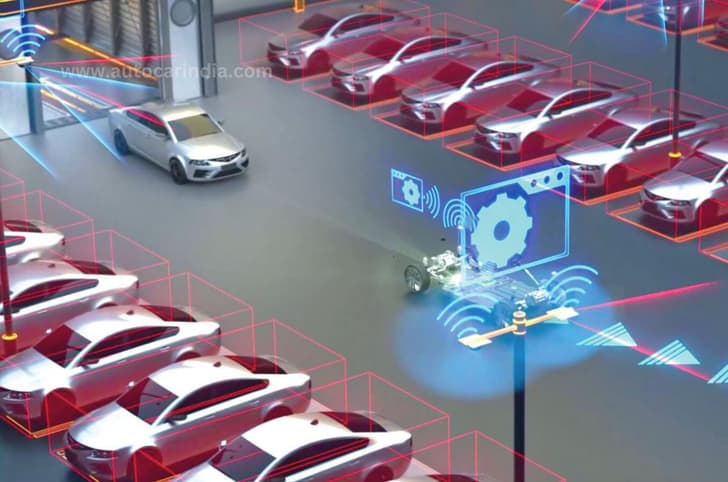
Taking today’s car plant as an example, finished cars need to be moved to different locations around a factory and doing that manually isn’t necessarily as efficient as it could be. With IOM, cars can be sent to another station from the end of the production line for snagging, testing or calibration, or even to a logistics team for delivery. It works by handing the car over to an intelligent infrastructure using an app, and then the infrastructure does the manoeuvring.
This involves technology similar to that used in cars. Cameras and sensors, intelligent algorithms, infrastructure-based object recognition, dynamic route planning, autonomous emergency braking functions, and others are all integrated to allow the car to be moved under wireless control. Cars need to be equipped with an automatic transmission, an electric parking brake, electric power steering and an intelligent communication unit to move through their surroundings.
The fundamentals behind IOM also apply to AVP Type 2, otherwise known as ‘the intelligent garage’. In that scenario, automated garages could be operated at, say, airports, hotels and railway stations under full digital control, without handing over the keys to a human parking attendant. That hasn’t happened yet, but Continental says there’s a lot of interest in the system, and expects it will be used first in vehicle production plants in the near future.