


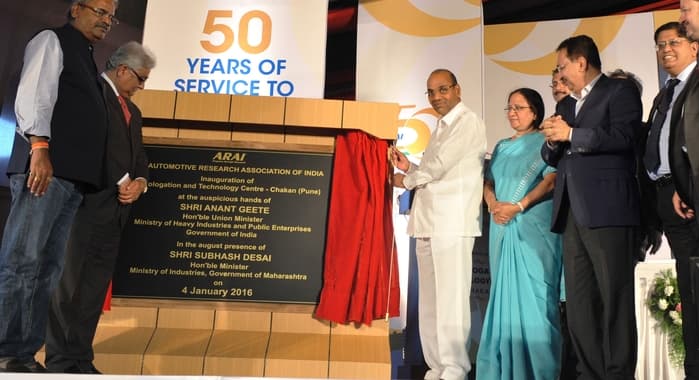
On January 4, 2016 Anant Geete, the Union Minister for Heavy Industries and Public Enterprises, inaugurated the Homologation and Technology Centre at the auto industry hub of Chakan, 40km from Pune. The inauguration was part of the year-long golden jubilee celebrations of ARAI, which Maharashtra chief minister Devendra Fadnavis kick-started on Sunday. The centre has been established under the National Automotive Testing and R&D Infrastructure Project (NATRiP) of the government of India which aims at creating global competencies in the automotive sector in India.
The centre, set up with an investment of Rs 370 crore (Rs 270 crore from ARAI and Rs 100 crore from NATRiP), offers homologation services to automobile manufacturers for both the Indian and global export markets. The state-of-the-art centre is equipped with all the latest equipment, and comprises a Passive Safety Laboratory, Powertrain Laboratory, Fatigue and Materials Laboratory and Automotive Electronics Laboratory.
The Passive Safety Laboratory has all the facilities for providing homologation support for upcoming crash regulations and the ensuing Bharat New Vehicle Safety Assessment Programme, a safety star rating system for India. It can conduct crash tests of vehicles (full frontal, offset frontal – 56kph, side, side pole and rear impact) in accordance with AIS, ECE, FMVS and NCAP rules. The electric AC drive crash test system has a capacity to handle 3,500kg payload and a propelling speed of 80kph. Static rollover tests can also be conducted. There are also instrumented dummies (Hybrid III AM50, AM95, AF5, EuroSID-II, SID-IIs, Bio-RID-II as well as child dummies) and a dummy calibration laboratory. Structural deformation can be assessed by using a 3D coordinate measurement machine. Also in place are high intensity lighting systems for on-board and off-board high-speed photography. Meanwhile, 16 high-speed cameras with image analysis software are expected to be fitted soon.
The Powertrain Laboratory is a Centre of Excellence for powertrain testing and set up under NATRiP. It can undertake testing of vehicles, engines and powertrains and other accessories for their performance with respect to power, efficiency, and exhaust emissions, as per both Indian and global regulations. Some of its highlights include a 220 kW chassis dynamometer (endurance testing of 2WD/4WD vehicles, automatic refuelling system which can handle liquid fuels like petrol, diesel, ethanol, methanol and various blends and also gaseous fuels like LPG, CNG and other alternate fuels), advanced emission tests (for vehicles up to 3.5 tonne GVW), a climatic chamber which can replicate conditions with temperatures ranging from -30deg C to +55deg C, a Vehicle Test Cell(VTC 1) which can handle domestic certification for current BS III, BS IV emission regulations and forthcoming BS-V and BS-VI norms, and export homologation testing as per UNECE, EEC directives and US EPA and Japanese emission regulations.
The Fatigue and Materials Laboratory is a Centre of Excellence for prediction of structural failures and evaluation of vehicles’ structural components, systems and sub-systems and chassis /full vehicle subjected to real life dynamic loading conditions. The aim of this facility is to assist the automotive industry in developing lightweight and eco-friendly vehicles. Importantly, it is fully equipped with simulation facilities and aims to assist medium and small scale enterprises (which often are unable to procure expensive CAE software) to develop high-quality components.
The Automotive Electronics Testing Laboratory being established at the centre will consist of state-of-the-art testing infrastructure for testing electric and hybrid electric vehicles.
Speaking at the inauguration of the new Homologation and Technology Centre, minister Anant Geete said: “The country has been attracting investments in its automobiles sector thanks to the engineering and manufacturing capabilities available here. The government will extend all the necessary help to the automotive sector which is at the forefront of the Make In India initiative announced by prime minister Narendra Modi.” He added, “The seven specialised testing facilities being developed under NATRiP across India will be completed in the next two years according to the revised timeline for them and the government will have invested close to Rs 3,800 crore in the facilities accommodating the project cost overrun. These facilities are coming up in Pune, Manesar in Haryana, Chennai, Indore, Ahmednagar in Maharashtra and Silchar in Assam.” “As all these facilities hold the brief of assisting the government in the formation of regulatory norms in the areas of safety, emission and fuels, the government intends to unify them under an umbrella body called the Automotive Regulatory Board,” Geete said.
“The Board will come into existence soon after all the seven facilities are complete and it will work under the Ministry of Heavy Industries and Public Enterprises,” Geete added. Rashmi Urdhwareshe, Director, ARAI, said: “The institute will retain its identity even after such a Board comes into existence and will continue its research and development as well as testing services”. ARAI’s role in advising the government in the formation of regulatory norms for the automotives sector will move to the Board, Urdhwareshe said.

 Uday Singh
 Dhruv Dhaka


 Glenn Noronha