

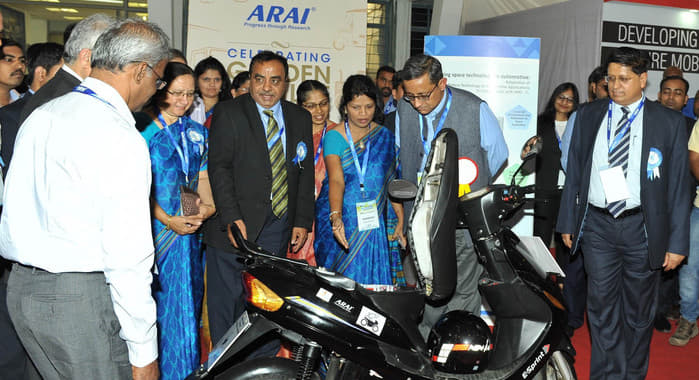
Automotive Research Association of India (ARAI) and Indian Space Research Organization (ISRO) are jointly working on a project to explore the applications of lithium-ion battery technology used in space for surface transport vehicles. This success could prove to give a big fillip to electric mobility in the country.
A prototype two-wheeler developed using ISRO’s lithium-ion battery was unveiled by Sanjay Mitra, secretary, Ministry of Road Transport and Highways, government of India during the inauguration function of the Symposium on International Automotive Technologies (SIAT 2017) at the ARAI Campus in Pune. Our sister publication, Autocar Professional, is the official media partner for this biennial event.
90km per charge, 45kph top speed, 20-30 paise per km running cost
Sharing some details of the two-wheeler prototype, Anand Deshpande, convenor of SIAT 2017 said, “This is a landmark development under the joint research project of ISRO and ARAI, where lithium-ion battery technology developed for space applications was successfully adapted for the automotive segment. We at ARAI have worked upon on various factors like the battery management system, lab testing, road testing and automotive duty cycle at different temperatures, charge and discharge.”
“In space applications, reliability is of paramount importance while in the automotive segment affordability is equally important. Thus, our teams are now working in this direction. The prototype is loaded with a 48 volt, 50 ampere-hour battery and successfully runs up to 90 kilometres once charged for two hours. We are working on reducing the charging time and have set the target to bring it down to one hour initially. It does not use much electricity for charging and the running cost per kilometre could be as less as 20-30 paise per kilometre. The vehicle can attain the speed of 40-50 kilometres per hour,” he added.
 Ved Janve
 Azaman Chothia
 Dinshaw Magol
 Vishal Venugopal