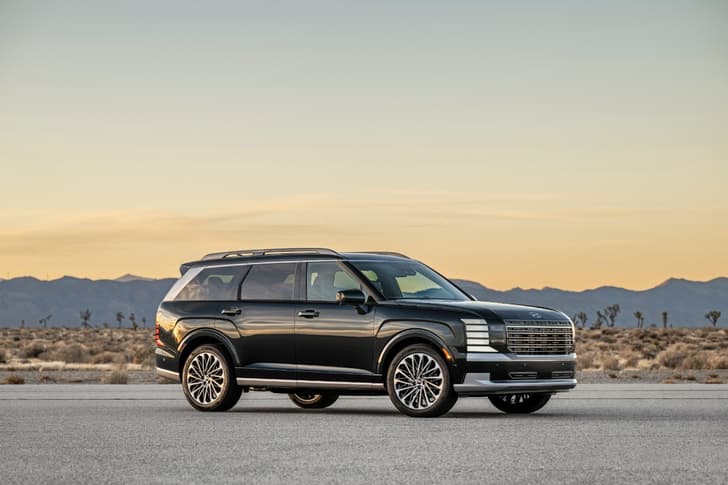
Tata’s claim of 622km on a single charge for the Harrier EV, with its 74.61kWh battery and dual-motor AWD system, sounds ambitious. But is it realistic? To find out, we charted a familiar route: South Mumbai to Pune’s Kalyani Nagar (around 170km one way) and back, with no special effort to drive efficiently.
The conditions were set to mimic a regular day trip. The battery was fully charged, drive mode left in ‘Normal’, the air-con at 24 degrees centigrade in ‘Econ’ mode, and all electricals—including ventilated seats and the music system—running throughout. With two passengers on board and light luggage in the boot, it was a scenario most users can relate to.
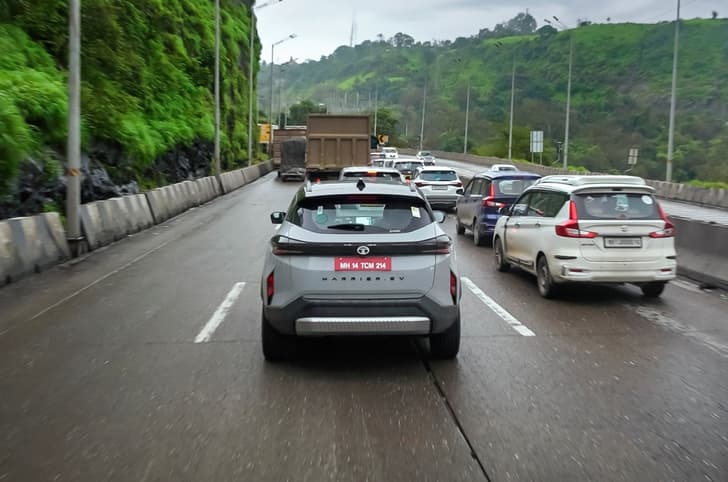
Setting off from Mumbai in the Tata Harrier EV
At 100% state of charge (SoC), the trip computer estimated 437km of range. Traffic was light leaving Mumbai, so we kept regenerative braking at Level 1 and cruised steadily at 100kph, the legal limit on most stretches of the Expressway. Cruise control was avoided, since engaging it activates both motors at all times, which is less efficient. In normal driving, the Harrier EV is powered primarily by the rear permanent-magnet motor, with the front induction motor only joining in when grip or performance demands it.
By the time we reached Khalapur Toll Plaza, 91km into the journey, the SoC had dropped to 79%, with the on-board computer showing an average consumption of 177Wh/km.
Tata Harrier EV uphill on the ghat section
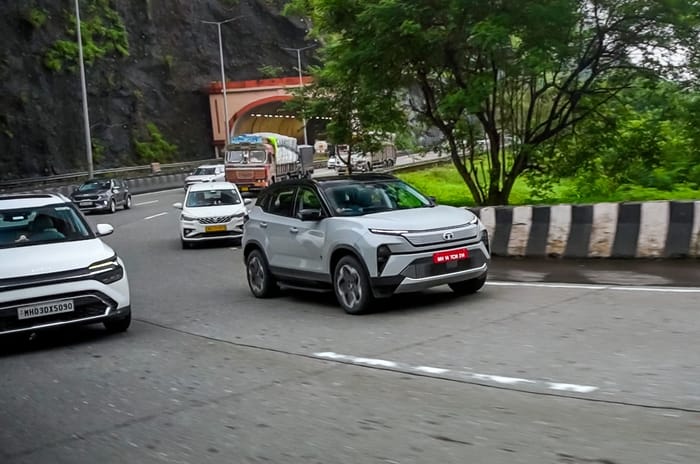
The steep ghat (uphill) section inevitably took a toll on this 2,335kg SUV’s battery. Covering the 20km climb consumed another 9% of charge, raising the consumption figure to 208Wh/km.
Traffic thickened as we rolled into the city. Regen cranked up to Level 3 worked nicely in stop-go conditions, slowing the car down to crawling speeds. A full one-pedal setup isn’t on the menu, but honestly, we didn’t miss it.
By the time we arrived at our destination in Kalyani Nagar, the trip meter read 183.7km, SoC stood at 54%, and the display still showed 238km of range—ample to return to Mumbai with no concern.
Tata Harrier EV Pune to Mumbai return run
Some additional city driving in Pune added more kilometers to the trip and reduced SoC further before we began the return run. With lighter traffic though, regen was set to Level 2. On the downhill ghat section, the Harrier EV demonstrated the benefits of regenerative braking—SoC remained steady at 34%, even as the distance travelled rose from 264km to 290km.
The rest of the drive was uneventful, but it highlighted Tata’s energy-management strategy at lower charge levels. Below 50% SoC, ‘Boost’ mode is disabled. Drop under 20%, and ‘Sport’ mode is also inaccessible. And in the final 10%, performance—including acceleration, top speed, and air-con strength—progressively reduces, ensuring maximum range in a ‘limp-home’ mode.
It’s important to highlight the differences in test conditions. In our earlier controlled run, the air-con was set at 22 degrees centigrade, whereas in this drive it was at 24 degrees centigrade—a seemingly small change that has a significant impact on energy consumption. Additionally, the Harrier EV gradually reins in performance once SoC drops below 20%, which not only conserves power but also improves overall efficiency, effectively stretching the available range as the battery depletes further.
The Final Numbers
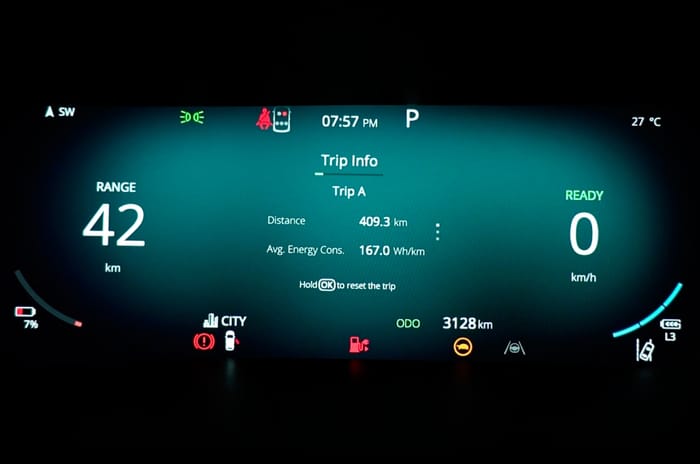
Total distance 409km | Battery consumed 93% | Avg energy consumption 167Wh/km |
Avg efficiency 5.89km/kWh |
By the end of the day, we’d covered 409km, consuming 93% of the battery. Consumption settled at 167Wh/km, with the computer still showing 42km of range left. Overall efficiency - 5.89km/kWh. Extrapolating, that puts real-world range at around 440km—without hypermiling or special effort.

 Uday Singh

 Dipan Sur


 Glenn Noronha