India has the world’s worst road-safety record. An incredible number of people lose their lives every hour on our roads. We’re not even considering those who may be injured or even those accidents which go unreported. The situation is alarming. And in a country where most of the population is under the age of 30, with more access to cars than ever, the likelihood of these numbers going up is quite high. The first step to any major change, of course, is awareness. To that effect, Mercedes-Benz has launched Safe Roads, a pro-safety campaign that it has been conducting across the country since early last year. On October 5 and 6, Safe Roads event was held at the Jawaharlal Nehru Technological University, Hyderabad, to help inculcate a culture of road safety among the students.
The event
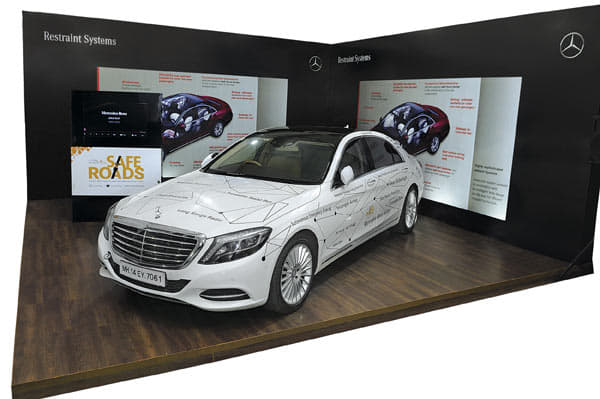
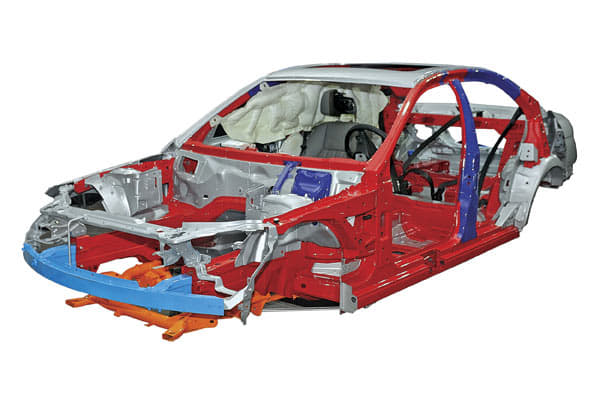
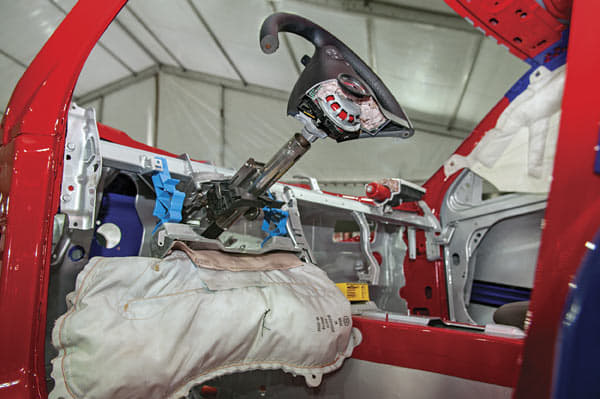
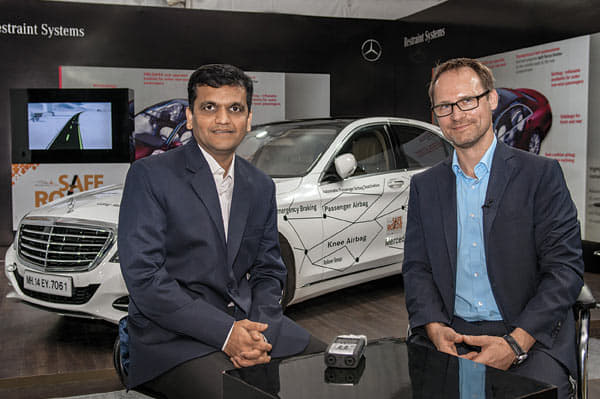
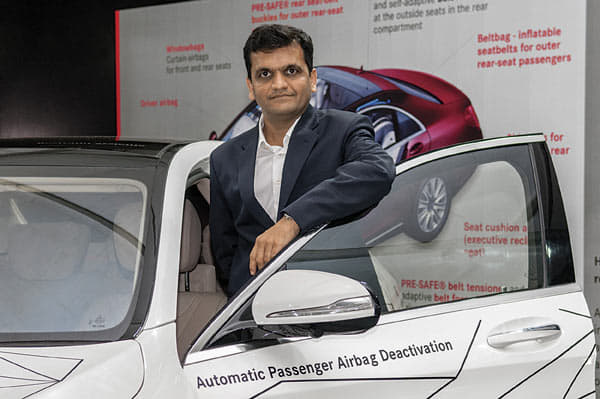
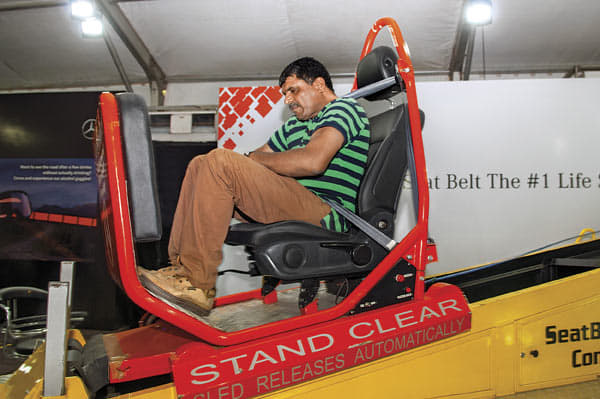
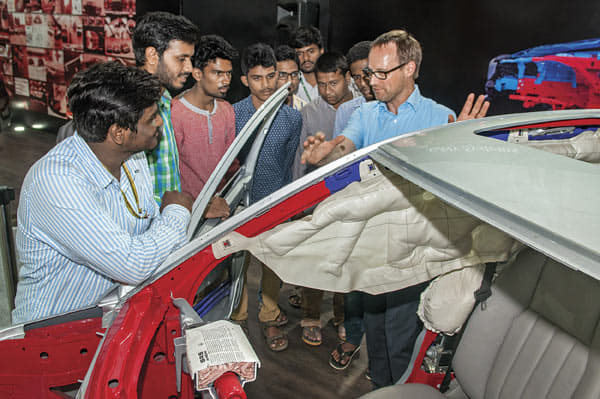
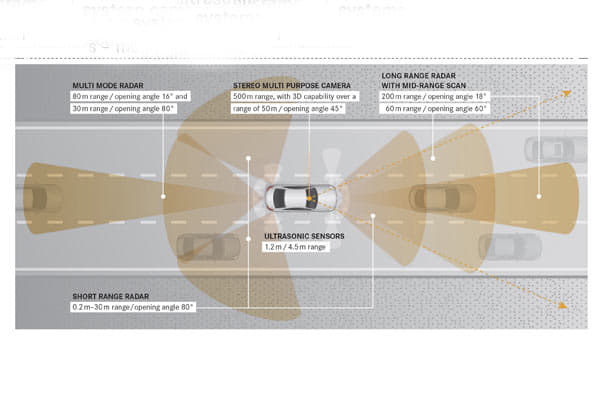
The event was officially opened by Parthiv Shah, VP CAE for Safety, Aero and Thermal, Mercedes-Benz with a quick presentation on the current scenario and the need for road safety. He then introduced Matthias Struck, Head Communications Safety Research and Development, Mercedes-Benz Cars, who shared an impassioned view on the collaborative work being done to make cars safer. The event was then thrown open to the students of the university, local dignitaries and members of the local media. As was the case with Kochi, the Seat Belt Convincer experience got a lot of attention. Most couldn’t believe the impact a low-speed crash at 10kph could deliver. After almost knocking off a few pairs of spectacles (all were caught safely), the grins of those dismounting showed that the Seat Belt Convincer was quite effective at its job. The crashed Mercedes-Benz GLC too received its fair share of attention. It’s not often that one gets to see a Mercedes-Benz that was crashed on purpose. What had visitors amazed was that despite a crash against an offset deformable barrier at 64kph, the passenger cabin was completely unaffected. No wonder the GLC scored full marks in safety tests. To understand how the GLC managed to do well, all one had to do was walk over to the Body-in-White, which displayed the types and strengths of material used in various colours, and the sophistication employed in the design and development of Mercedes-Benz cars. And this was without any of the cutting-edge passive and active safety systems that these cars come with. For those, there was an S-class which showcased nearly the full arsenal of Mercedes-Benz safety systems. It also offered a glimpse into the future of vehicular safety. Eliciting laughs and clearly explaining the effects of inebriation on vision, spatial awareness and slowed reactions were alcohol goggles.

 Uday Singh
 Dipan Sur
 Glenn Noronha