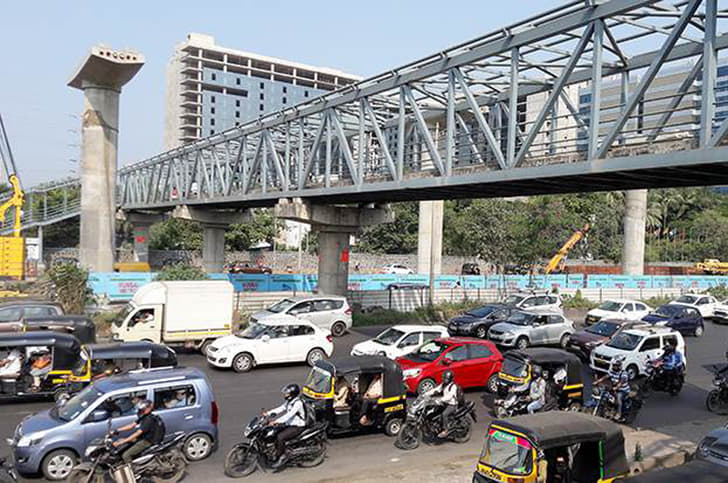
2019 has been a rather forgettable year for the Indian automobile industry and the reasons are many. A prolonged economic slowdown, increase in vehicle prices, revised axle-load norms for CVs that reduced buying of medium and heavy commercial vehicles, the IL&FS crisis which impacted lending in rural India, the shift from BS4- to BS6-compliant vehicles, and subdued consumer sentiment.
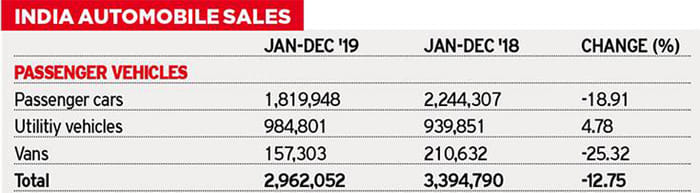
Apex industry body Society of Indian Automobile Manufacturers (SIAM) released the CY2019 sales numbers yesterday. Take a close look at the sales tables below and you find that all four vehicle segments are in the red, compared to the industry's performance in 2018. Overall vehicle sales in 2019 declined 13.77 percent to 2,30,73,438 units (CY2018: 2,67,58,787). This is, according to SIAM, the industry's worst performance in nearly two decades
The passenger vehicle (PV) segment continued to be hit hard, leading to 12.75 percent slump to 29,62,052 units (33,94,790); CVs declined 15 percent to 8,54,759 units (10,05,502); three-wheelers fared the best with 4.36 percent de-growth to clock 6,86,944 units (7,18,284) while two-wheelers continued to see a downtrend with a 14.19 percent decline to 1,85,68,280 units (2,16,40,033).
Utility Vehicles, with 4.78 percent growth and riding on robust demand for compact SUVs, have done well. But flat growth in crop production, drop in consumer goods sales and decelerating GDP growth to a six-year low have had an impact on the CV segment. Two-wheelers – which saw a price increase due to ABS/CBS implementation as well as weak rural sentiment – was hit hard too.
According to Rajan Wadhera, president, SIAM, "While things are improving, the rate of growth is not very steep. It may take a bit longer to come out of this recessionary phase. One of the reasons for growth in UVs is the launch of new models. In the past 5-6 years, in PVs, the number of UV models has grown to match the number of passenger car models. At present, UVs have grown to 53 models to where car models have reached, after seeing a decline."
"In the two-wheeler segment, there is an expectation that after rabi's loss, the kharif crop will be good this year. However, we are still not fully out of the challenges. Whatever growth has come, has been in some pockets,” he said.
"While the government is focusing on the revival of the auto sector in the form of a number of initiatives taken such as depreciation benefits, corporate tax reduction and a boost to infrastructure projects which has increased demand for tippers and goods carriers, the revised GDP growth rate nowhere augurs well for the industry. Moreover, our demand for a GST cut has still not been met, and the BS4 to BS6 transition continues to remain one of the biggest challenges arresting growth of the Indian auto industry," concluded Wadhera.
Nonetheless, not all is doom and gloom. The numbers for December 2019 show that the rate of sales decline has slowed down. Demand for passenger cars is gradually improving, SUVs are firing on all cylinders and LCVs are doing much better than six months ago. The government has also recently announced its Rs 102 lakh crore investment in building new infrastructure including roads, which feels like something that the CV sector may benefit from, to some extent. All OEMs are actively engaged in the upgrade to BS6 and have begun rolling out BS6-compliant products, with increased prices. The price mark-up will no doubt impact sales in the early months of CT2020 but it is felt that proper demand is likely to return by the festive season. Till then, industry will be riding a tough line, balancing production and inventory at dealers.
Captains of industry are fervently looking forward to a cut in the GST on automobiles, a move that will help spur growth and revive demand. Likewise, it is felt that the government will introduce a vehicle-scrapping policy once the BS6 mandate kicks in on April 1 this year.

 Viraaj Bhatnagar
 Dipan Sur
 Dhruv Dhaka
 Saptarshi Mondal