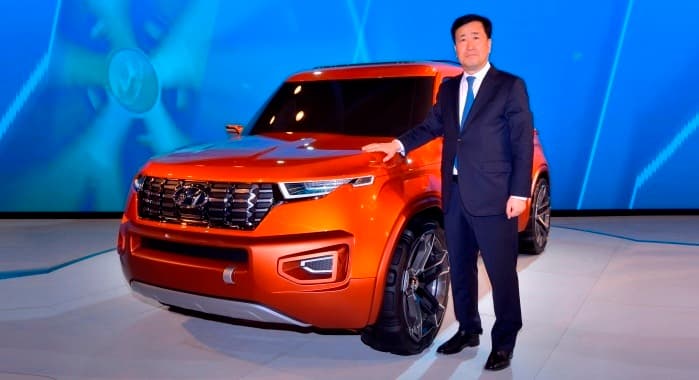
Hyundai Motor India (HMIL) is fortifying its strategy for India after YK Koo took over as the managing director and CEO of the company last November. Building on the pillars of aggressive product planning that will close the gaps in the system, upping its local contribution of R&D for new models, and increasing sales and service facilities especially in rural India, will be the key to sustaining its growth momentum.
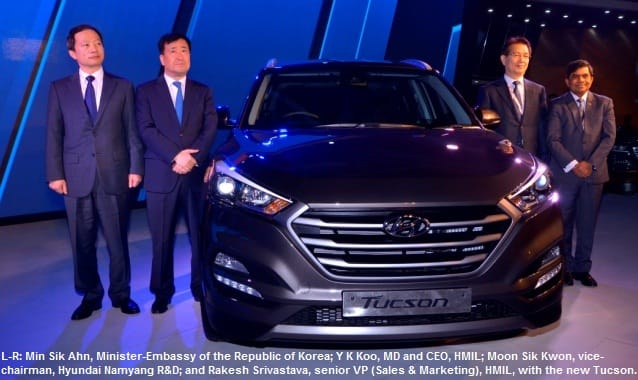
While unveiling the new Tucson SUV at Auto Expo 2016, Koo outlined Hyundai’s India strategy of launching two new products every year along with updates to maintain the strength of its product line-up. Interestingly, HMIL has also catapulted to the third position in terms of global sales with a 13 percent share in CY 2015, overtaking Europe by about 5,000 units.
Outside of Korea, China ranks first in the pecking order with sales of over 1.1 million units and USA second with sales of 7,00,000 units. However, India has earned the status of being the fastest growing market, as China has been slowing down and USA seems to be hitting a plateau.
“But we are not targeting positions and are looking forward to strengthening our leadership position by sustaining the current growth rate of 16 percent achieved in CY 2015 against the industry growth of around 8 percent. For this, Hyundai has to introduce more product offerings and refurbish, at least two products annually. We will attack more segments like corporate sales, taxi market, rent-a-car or fleet or rural markets to acquire more customers. Hyundai’s biggest vision is three-fold – strengthen its leadership position through sustained growth, become the most beloved company in India, and realise the modern premium brand direction,” Rakesh Srivastava, senior VP (sales and marketing), told Autocar Professional.
Expanding its retail and servicing arm and strengthening its footprint in areas where it is not currently not present and expanding its network in the rural sector will be the key. At present, HMIL has 320 outlets in the rural areas with 11 percent of its sales coming from here. The carmaker is also setting up several digital showrooms to enhance customer experience in a digital way.
CRETA – A REAL GAME-CHANGER
The compact Creta SUV has garnered a market share of 20 percent in the compact SUV segment and is being branded as a modern and premium product. “For any product, the first challenge is in terms of capacity. When we brought the Creta, the compact SUV market was worth only 12,100 units with models like the XUV500, Renault Duster, Nissan Terrano, Mahindra Scorpio and the Ford EcoSport present there. We went in with 6,000 units per month with the intention of taking over about 50 percent of the market. So when you plan for selling 6,000 units a month and the balance players are selling the balance 6,000 units, that is aggressive production planning. The customer response that we have received for the Creta has been overwhelming and that is the reason why we are enhancing its capacity,” elaborated Srivastava.
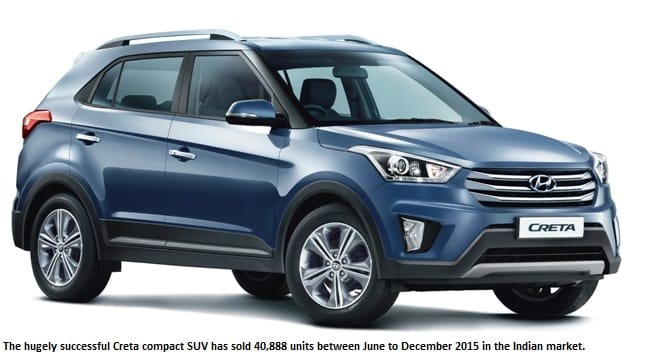
Within six months of its launch, the Creta has mustered 90,000 bookings, with supplies of 45,000 units. The vehicle has a waiting period of three months and to lower this, Hyundai is upping the production to 10,000 units for the domestic market from June onwards. This will bring down the waiting period to a month. For exports, the Creta’s capacity is being increased to 2,500 units per month, taking up the total volume to 12,500 units. Currently the Creta’s production is below 10,000 units per month with about 7,000 units going into the domestic market and 2,000-3,000 units being exported. He added, “I think volumes will come in but the priority is to get the product right with the right communication, right variants, right size and right positioning".
TURBOCHARGING THE FUTURE
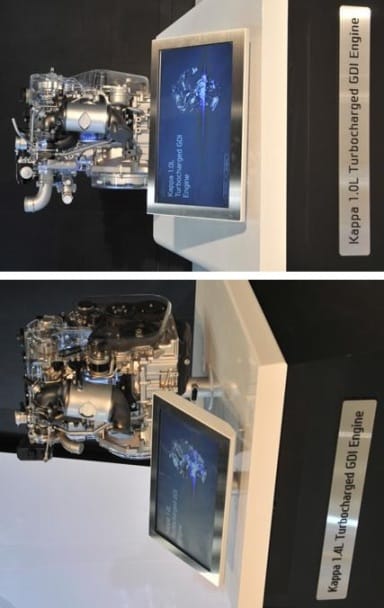
Hyundai is also planning to bring turbocharged engines of 1.0 litres and above, both petrol and diesel, to India in the future. These were also displayed at the Auto Expo and will power both the existing as well as future crop of models. HMIL’s current petrol engines are not turbocharged but the new ones will be high on performance, mileage and power and also meet the new Euro-VI emission norms.
Underlining its commitment to India, the Korean carmaker has been upping its R&D game in India for new models. While its Hyderabad R&D Centre contributed 45 percent of the inputs for the Creta, for the concept Carlino HND14 – expected to take shape in 2-3 years – the contribution will be up to 60 percent. The centre works in collaboration with the Namyang R&D Centre in Korea and has 750 engineers, involved in market research, vendor management, Indian customer behaviour as well as in testing and localisation of parts. The current year, therefore, promises to be an eventful one for the Korean brand in India.
 Viraaj Bhatnagar
 Dipan Sur
 Dhruv Dhaka