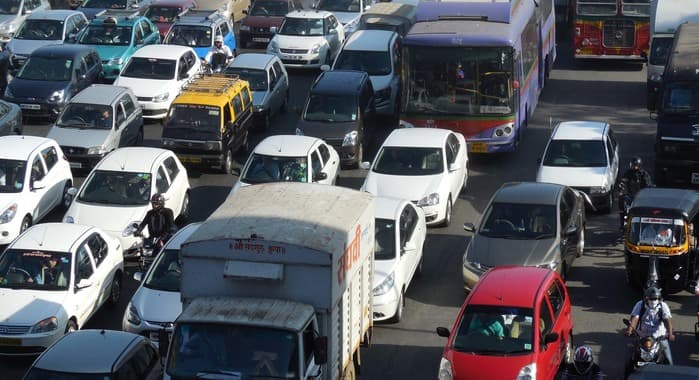
Many cars in the middle and low income countries fail to meet the basic Global NCAP safety standards for front and side impacts, the international automotive safety regulatory body has revealed. Speaking at the United Nations in Geneva while launching its new policy report - Democratising Car Safety: Road Map for Safer Cars 2020 - on March 10, Global NCAP chairman Max Mosley said, "Safety improvements stimulated by legislation and consumer awareness campaigns in high income economies that have saved hundreds of thousands of lives are not yet systematically available for drivers and their families in rapidly growing lower income markets”.
He added that car safety laws accepted as a norm in Europe for the last 20 years, are yet to be met by manufacturers in middle and low income countries in Asia, Africa and Latin America. He said that manufacturers cannot treat millions of its customers as second-class citizens when it comes to life saving standards of occupant protection.
Global NCAP secretary general and the author of this report, David Ward said, "The drive for the democratisation of car safety must now be extended across all automotive markets worldwide. By 2020, at the latest, we want all new cars to meet basic standards for both, crash protection and crash avoidance. They must have crumple zones, airbags, and electronic stability control".
Global NCAP, at the UN, also set forth ten recommendations to help transform global car safety as well as a timeline for its implementation. Together, these life-saving recommendations have the potential to prevent tens of thousands of avoidable deaths, and hundreds and thousands of injuries every year, Ward said.
The Global NCAP's policy recommendations are:
- That all UN member states adopt the following two-stage minimum car safety regulation plan and implementation timescale by the end of the UN Decade of Action in 2020:
Stage 1: UN Regulations for Frontal Impact (No.94), Side Impact (No.95), Seat Belt and Seat Belt Anchorages (No.14 & No.16) by 2016 for all new car models produced or imported, by 2018 for all cars produced or imported.
Stage 2: UN Regulations for Electronic Stability Control (No.13H or GTR. 8), Pedestrian Protection (No. 127 or GTR.9) by 2018 for all new car models produced or imported, by 2020 for all cars produced or imported.
- All UN member states with significant automobile production should participate in the World Forum for Harmonisation of Vehicle Regulations, to promote a leveling up of the safety standards in an open and competitive market for automobiles and their components.
- Fleet purchasers both, in the private and public sectors and rental companies should adopt Global NCAP's buyer's guide and choose 'five star' vehicles wherever possible.
- Governments and the insurance industry should provide fiscal incentives and encourage more rapid deployment of new technologies through the passenger car fleet.
- NCAPs should be supported by governments and donors to extend consumer-related testing, to include all the world's major automobile markets and the widest range of models, especially the most popular and important.
- Investment should be encouraged in laboratory capacity and skills training to enable homologation, in use compliance, and independent NCAP testing in all world regions.
- The automobile manufacturers should make a voluntary commitment to apply front and side impact crash test standards (UN Regs. 94 & 95 or FMVSS 208 & 214) to all its new models from 2016.
- The automotive industry should cease the practice of de-specification and bundling of safety features. Instead, it should make the full range of safety design and devices available in all its major markets, and price the relevant technologies separately.
- The automobile manufacturers should improve the content of its sustainability responsibility reporting to include data on the applied safety standards of its global vehicle production.
- To sustain the in-use safety of automobiles, UN member states should:
a) apply conformity of production checks to models already approved on their market
b) carry out regular roadworthiness testing and include tyre depth and pressure checks in such PTI (Produce Traceability Initiative) requirements, and
c) consider using scrapping schemes to remove older, unsafe vehicles from the road.

 Dipan Sur
 Dhruv Dhaka

 Viraaj Bhatnagar