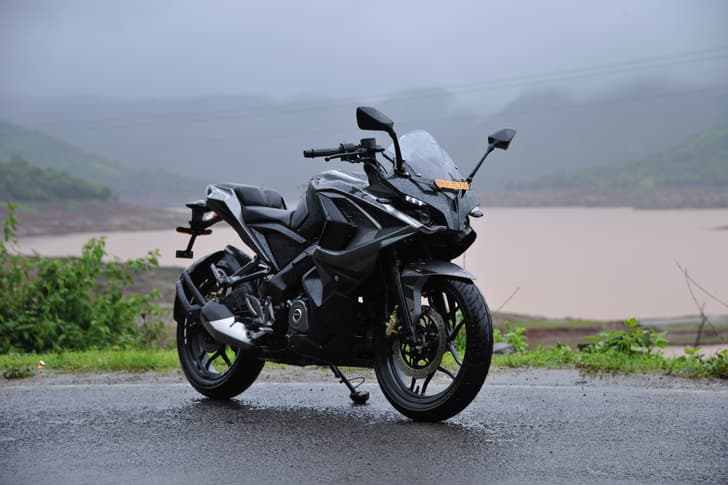
The RS 200 is the latest evolution of India’s favourite small capacity sportsbikes, the Pulsars. Bajaj’s ‘modern day Chetak’ in some ways, and its most precious baby today, the Pulsars have stood for sportsbike performance in a user friendly package with impressive specifications.
The Pulsar RS 200 gets a full fairing along with newfound ambition to scrap with Yamaha’s YZF-R15, Honda’s CBR150R and the KTM RC 200, in this junior supersports class. The burning question is whether the RS 200 succeeds in embracing the Pulsar family DNA – a balance of sporty and practical. RS stands for Race Sport, and let’s find out where it stands.
There’s been plenty of buzz regarding the styling of the Pulsar RS 200 with some impressed and others, not so happy. Chances are, if you’re still in the 20-30 years age bracket, you will like its funky look. But then again, everyone may not want a bike that looks this flamboyant, perhaps a shade too busy.
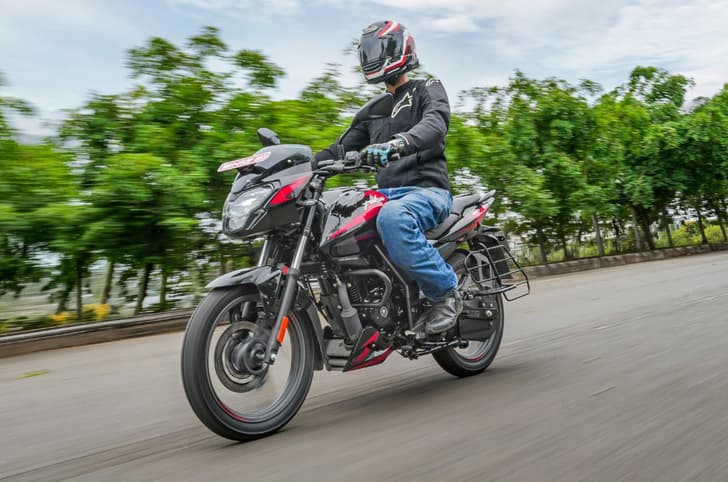
It’s edgy and modern, with a masked, twin-projector headlight equipped nose that reminds one of the Yamaha YZF-R1. There’re LED pilot lamps as well. Aggressive and compact, the RS 200 has sharp lines, Pulsar-typical slender-spoke alloy wheels and a stubby, cropped exhaust end can.
The RS 200 comes with a see-through visor, small but effective in deflecting wind while pushing high speeds gunning down the long Bajaj test track back straight. High set – but lower than the 200NS – clip-on handlebars are standard as is a sporty, compact cockpit, with a broad, well laid out instruments panel. There’s a large analogue rev counter, redline starting at 9,500rpm, with a shift beacon on the top left and digital format for other readings, including a speedometer, odometer and the other regulars. Bajaj-typical crisp functioning switchgear is in place with an engine kill-switch on the right. The RS 200 comes with nice palm grips and dog-leg shaped brake and clutch levers, along with a set of fixed stalk fairing-mounted mirrors that function well to offer good rear view.
Split seats look sporty and feel comfortable enough for a motorcycle as sporty as the RS 200.
The RS 200's engine sits encased under the bike fairing, the new Pulsar’s broad perimeter frame spars reaching over to the swingarm. There’s thoughtfully provided scratch protection for the tank, Pulsar-typical boomerang shaped side panels that are perforated and a free formed tail-light cluster that looks a bit over the top. A generous sprinkling of alloy parts and neatly integrated grab bars are standard fare on the RS 200. Overall quality and fit-finish are both good.

The Pulsar RS200 is powered by a really refined and smooth, 199.5cc, four-stroke, single overhead camshaft and liquid-cooled engine with triple spark-plugs. The engine is shared with the Pulsar 200NS, the RS gaining fuel-injection technology. Thanks to this, power output is one bhp up on the RS, 24.2bhp at 9,750rpm now with maximum torque of 1.9kgm output at 8,000rpm.
The RS 200 offers light, well-weighted clutch feel, and its six-speed gearbox shifts precisely, in the one-down, five-up pattern via a toe-shift lever. Gearing is different from the 200NS, and the engine revs a bit higher in its new state-of-tune, the RS peaking out just over 130kph in fifth and 146kph in top, both indicated, but significantly higher than the 200NS. Throttle response is nice, the RS 200 offering smooth power delivery. The powerband is wide, coming in with a nice, linear flow and this Pulsar likes being ridden hard and revved high, performance feeling best when up-shifting with the rev indicator nudging redline territory.
Acceleration feels in about the same bandwidth as the Pulsar 200NS, so expect to see a 0-60kph time of about 4 seconds, with 100kph achieved in close to 11secs.
Telescopic fork suspension is in place at the front with a Nitrox-charged monoshock at rear. This ride being solely at a smooth surfaced test track, we’re unable to comment on ride quality. The RS 200's riding position feels a touch sporty, still upright and relatively comfy versus the aggressive KTM RC bikes. Handling is taut, the RS 200 feeling really confident on track. The RS 200 has a shorter wheelbase compared to its NS sibling, with rake having become more aggressive in the front, which helps the bike turn in effortlessly and corner well, perhaps only a smidgen behind the razor-quick edge of the more focussed RCs. Confident enough to hold its own at the track, the RS 200 offers improved compound MRF tyres, these providing excellent grip, so long as not compared with the RC’s terrific Metzelers. Grip was adequate to allow us to run the bike right onto the edge of the tyres through fast corners.
There’s a petal type single rotor 300mm disc brake in front and 230mm disc at the rear, the RS 200 being the first Pulsar to offer ABS, a Bosch-made single channel system that you can’t switch off, and works to keep the front end lock free under emergency braking. The brakes and ABS system worked well during our test ride, with good feel at the levers, progressive with ample stopping power.
The RS 200 is available in red and yellow, priced at Rs 1.18 lakh and Rs 1.30 lakh (ex-showroom, Delhi) with ABS. Racy and perhaps just a shade too flashy looking, the RS 200, as expected, isn't as aggressive and uncomfortable for daily use as a KTM RC200. Looking for a sporty bike with the presence of a full-fairing, that’s good to go on Indian city roads as well? The RS 200 makes a well rounded package that ticks almost all the right boxes.

 Dinshaw Magol
 Rishaad Mody
 Azaman Chothia