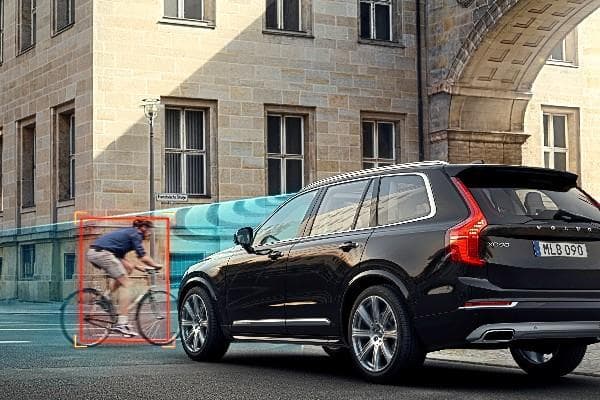
The Volvo XC90 T8 Excellence Plug-in Hybrid, which was launched last week, has given the Swedish carmaker a head-start in India on radar-based safety technology. The SUV boasts some unique features based on a frequency band of 76-77GHz. These include the adaptive cruise control, lane departure warning, blind-spot detection with cross-traffic alert, rear collision warning and park assist.
The Indian government de-licensed low-frequency bands for the automotive sector a few months ago. They are in the range of 36-38MHz, 433-434.79MHz, 302-351kHz and 76-77GHz. At the Autocar India Awards in February 2015, Eberhard Kern, then MD and CEO, Mercedes-Benz India, raised the issue of spectrum de-licensing with chief guest Nitin Gadkari, the Union minister of transport, to enable automotive short range radar systems (SSRS) in high-tech cars. SSRS enable a host of advanced driver assists which improves road safety. Most SRRs use spectrum in the band of 24-26.65GHz and 76-81GHz to interact with their surroundings. In India, the frequencies of 24, 76 and 79GHz are reserved and regulated by the Department of Telecommunications. It, therefore, restricts auto manufacturers from arming their vehicles with these technologies. “I will take up this issue personally, especially if it enhances road safety,” Gadkari had said. The government seems to have taken the first steps in this direction, after almost two years.
Detecting and reacting appropriately to impending collisions gives SRR-equipped cars the ability to reduce road accidents — something we desperately need in India. And apart from safety, even comfort-oriented features such as Mercedes’ Magic Body Control (a feature the carmaker had to drop for the Indian S-class for lack of spectrum) depend on radartech.
Worldwide, luxury carmakers such as Mercedes do offer the technologies.But these features work on a band of 24GHz and 79Ghz. India is yet to de-license them. Mercedes says it is awaiting a decision before it brings such tech into the country.
“Mercedes-Benz products globally are available with radar-based driver assist systems like collision prevention assist, blind spot assist, Distronic Plus among others. We are unable to introduce these state-of-the-art technologies in our products in India since the required frequency bands are not yet de-licensed," says Roland Folger, MD and CEO, Mercedes-Benz India.He adds that the automaker has requested the government to free up 24, 76 and 79GHz spectrum "considering our immediate and future requirements".
With its radar-frequency band fitting perfectly in the list of de-licensed frequencies, Volvo India has only set the trend. It is now looking forward to riding the tide and introducing similar features in its S90 sedan slated to hit the Indian roads this festive season.
 Viraaj Bhatnagar
 Dipan Sur
 Dhruv Dhaka
 Saptarshi Mondal