

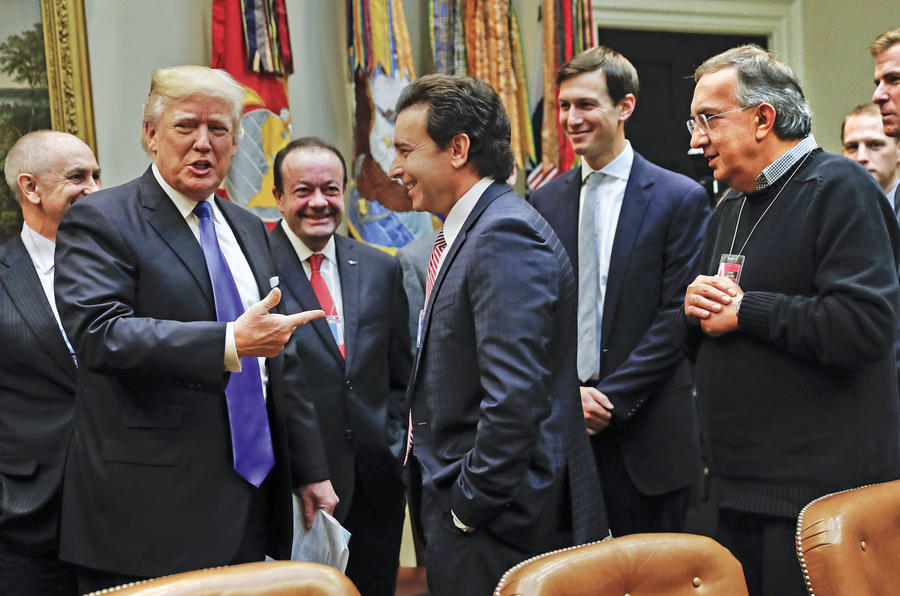
President Donald Trump looks set to pull the plug on plans for “onerous” US fuel economy laws as his administration embarks on its promised ‘business first’ policy drive and seeks to massively reduce the number of regulations in US law.
Changes to existing legislation could also cause California to lose its independent control of CO2 emissions and, with it, its ambitious regulations to increase electric vehicle sales.
In the last days of President Obama’s administration, the Environmental Protection Agency (EPA) rushed out a ‘finalised’ plan to require car makers to achieve an average of 65.5mpg (UK gallons), which is 23.2 km/litre, under the Corporate Average Fuel Economy (CAFE) regulations by 2025.
However, Trump looks set to remove control of CO2 emissions from the EPA. In a press release last week, the Trump administration said it wanted the EPA “to refocus on its essential mission of protecting our air and water”, which, until 2009, was the full extent of the EPA’s remit.
The proposed EPA fuel economy rules arrived more than a year before their expected date, a move interpreted by some US media outlets as a direct political challenge to the incoming Trump administration.
Trump’s moves follow motor industry claims that the 2025 fuel economy regulations could cost manufacturers as much as $200 billion (approx. Rs 12.63 lakh crore) between 2012 and 2025. Manufacturers also argue that it is not possible to force people into buying the most economical vehicles.
A report published by the EPA and the Californian Air Resources Board (CARB) last July concluded that car makers could afford the required fuel economy technology and large sales of hybrids and EVs weren’t needed to meet 2025 targets.
However, the report also said car makers were, in the end, unlikely to meet the 2025 requirements because the original regulations were based on a sales mix of 67 percent cars and 33 percent trucks — although SUVs are counted as trucks. That sales split is currently 50/50.
Like the planned EU fleet CO2 regulations for 2020/21, the new EPA economy requirements vary depending on the size of the vehicle. In effect, the smallest vehicles would need to achieve 73mpg (UK gallons), which is 26 km/litre, while even the largest pick-up trucks would have to return more than 36mpg (UK gallons), which is 13 km/litre.
Trump might even take on California’s independent oversight of emissions regulations, which are more rigorous than those in the rest of the US. California’s regulations requiring a certain percentage of zero-emission vehicle (ZEV) sales are one of the big global drivers behind electric car development. Thirteen other US states have also adopted the Californian regulations.
Trump has picked Oklahoma attorney general Scott Pruitt to lead the EPA. Pruitt was recently cross-examined at confirmation hearings and said he “wouldn’t commit” to keeping California’s long-running waiver to produce its own emissions standards and laws.
The CARB has been allowed to set its own controls on air pollution since 1967 and its regulations for the 1974 model year are now seen as a global turning point for pollution control. The CARB has a long record of cutting tailpipe pollution with rigorous regulations such as the SULEV (Super Ultra Low Emission Vehicle) laws.
However, along with the EPA, the CARB is now involved in controlling CO2 emissions. In 2009, CO2 was judged by the Obama government to be directly “injurious” to human health, along with established air pollutants such as carbon monoxide, hydrocarbons and particulates.
From 2021, California will require 12 percent of a large manufacturer’s sales to be ZEVs, rising to 22 percent by 2025. Even smaller makers have to hit ZEV sales of 16 percent.
These regulations have encouraged comparative US-market minnow Jaguar Land Rover to put the Jaguar I-Pace into production.
Any move by the EPA to overturn California’s independence will trigger a huge political row, but it would be a measure of just how far the Trump administration is willing to go to prevent business being “regulated to a standstill” and overturn what it sees as obstacles to investment and manufacturing in the US.
 Rivan RS
 Viraaj Bhatnagar
 Uday Singh
 Suraj Viswanathan