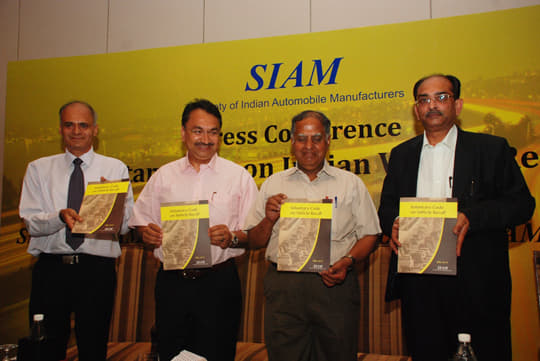
The Society of Indian Automobile Manufacturers has launched a voluntary code on vehicle recall, enforceable from July 1, 2012, in an effort to increase road safety standards in India. The code puts the responsibility of recalling a defective vehicle, be it a two-wheeler, passenger car or a commercial vehicle, in the hands of the manufacturer. For CBU imports, the concerned importers will be responsible for the enforcement.
The voluntary code on vehicle recall will address potential issues that exist in a motor vehicle that do not meet safety requirements due to a manufacturing defect as well as remedial actions taken to set it right. The vehicle will be covered under safety recall for a period of seven years and will target the first buyer.
Examples of safety-related defects which fall under the code, according to SIAM, are:
• Malfunction of steering components that cause complete loss of vehicle control.
• Defects in the braking system, which causes significant loss of braking function.
• Malfunction in fuel system-related components that result in unintended fuel leakage or unintended acceleration.
• Cracked or broken wheels that result in loss of vehicle control.
• Failure/malfunction of seats, seat backs, seatbelt mechanism or head restraint system that exposes the occupants to immediate danger.
• Problems in the wiring system that result in loss of complete lighting.
According to the voluntary code, the manufacturer will have to display the recall information on its company’s website and the communication will also be sent to the vehicle owners. Besides, SIAM and the concerned government ministries like Heavy Industries will also display the information of the recall.
The defective vehicle, on the other hand, will be rectified by the manufacturer through its dealers free of cost for the customer. Importantly, the responsibility for the defective component lies not with the component manufacturer but the vehicle manufacturer, and does not affect the aftermarket.
In case the vehicle manufacturer fails to announce, recall or rectify the damaged part where clear evidence of a material or design defect is visible, the Union Government will have the prerogative to initiate punitive action against the defaulting company that could include imposing financial fines or penalising the OEM further in case of deaths due to accident.
Among OEMs in India, Maruti has had eight to nine recalls since the 1990s. This includes about 1,00,000 units of the A-star hatchback being recalled due to a fuel tank issue in 2010. Tata Motors had also offered a free fix on over 70,000 units of the Nano following instances of fire, but abstained from calling it a recall. Toyota had recalled about 40,000 Etios models for defective parts in India as well.

 Viraaj Bhatnagar
 Dipan Sur
 Dhruv Dhaka
 Saptarshi Mondal