

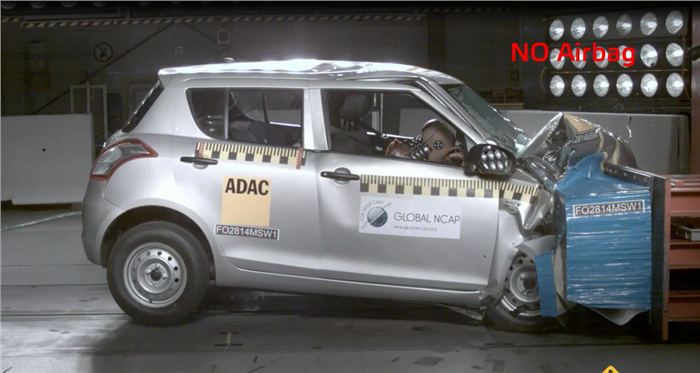
In a development that is bound to help the cause of safer cars for India, the government and the authorities concerned have been studying a way to adapt global crash tests to Indian requirements. Tentatively called the Bharat New Vehicle Safety Assessment Programme (BNVSAP), the proposed program will be modeled on the New Car Assessment Programme (or NCAP) and will be implemented in a phased manner. ‘Phase 0’ starting March 2015, will centre around the commencement of crash test facilities at the Automotive Research Authority of India in Pune, International Centre for Automotive Technology at Manesar, and the Global Automotive Research Centre in Chennai. The plan is for vehicles to be rated on the basis of their performance in frontal offset, side impact, pedestrian protection and child safety tests.
October 2016 will mark the start of the voluntary part of Phase 1, where carmakers will be at liberty to choose if and which of their cars should be assessed. However, come October 2017, new car assessment will become mandatory with the choice of car to assess testing with the BNVSAP’s administrative body. In addition to this, carmakers will also be allowed to voluntarily send new and existing cars for crash testing. Interestingly, in Phase 1, cars will be tested as per the United Nation’s Vehicle Safety Regulations. That means the crucial 40 percent front offset test will be conducted at 56kph.
 Rivan RS
 Viraaj Bhatnagar
 Uday Singh

 Suraj Viswanathan