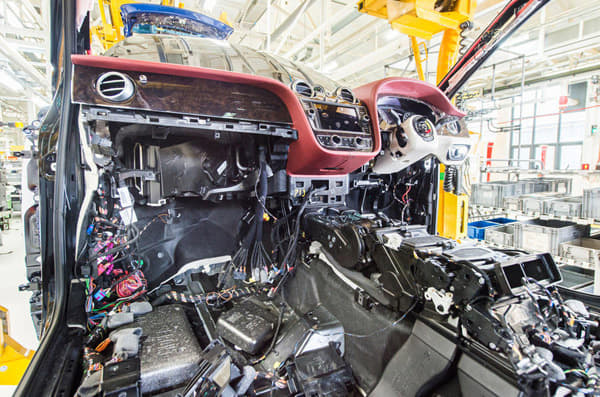
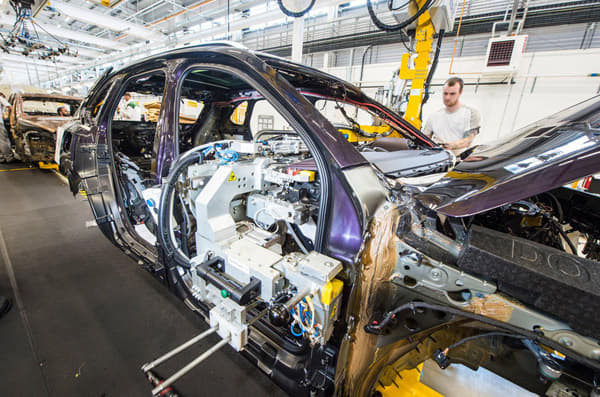
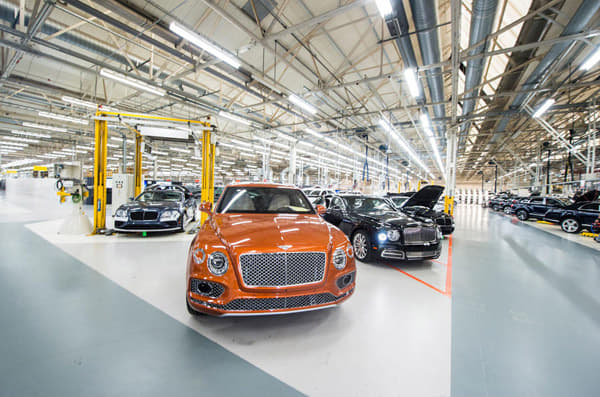



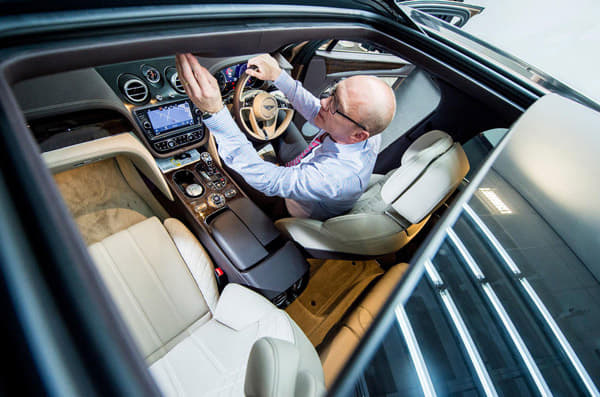

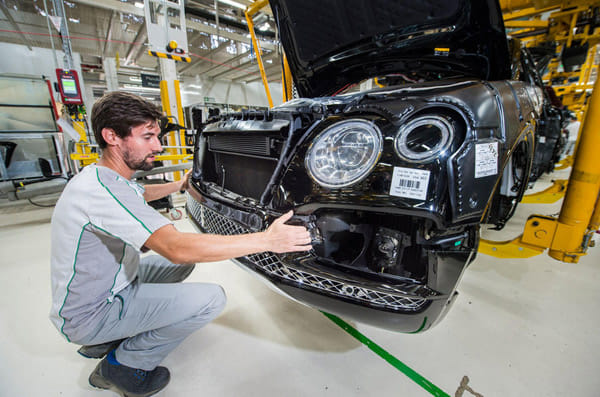
In a Bentley Bentayga, there are more than 90 electronic control units secreted within, besides the powertrain, the air suspension and its anti-roll systems and a cooling pack that can cope with a W12 and four fat wheels threshing through sand in 40deg C temperatures.
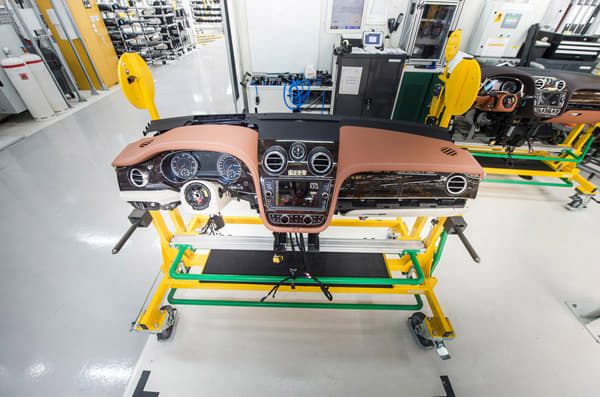
Clips, conduits and clamps, ducts, sound dampers and seals – these are just some of the myriad parts that locate, cement, energise and cool the clusters of components that make up the unseen innards of your car.
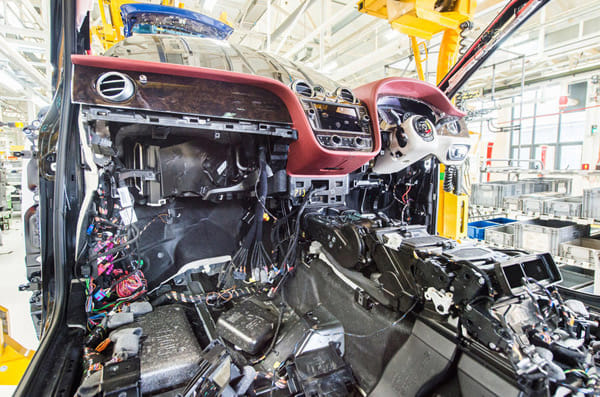
In a designer’s world, these components are the car’s ‘B-side’, the flipside of the panels that clothe it to provide a visual character. Designing the A-side is challenging enough. A car’s shape does much to determine its likely success, which is why the design process is invested with so much time, effort, agonising and inspiration.
The B-side is all about realising the car’s function and the engineering of everything from a draught excluder to a differential. There are aerodynamics, crash performance and passenger packaging to consider, besides the reams of rules around light location, bumper heights, internal projections and pretty much every other aspect of a car’s essence.
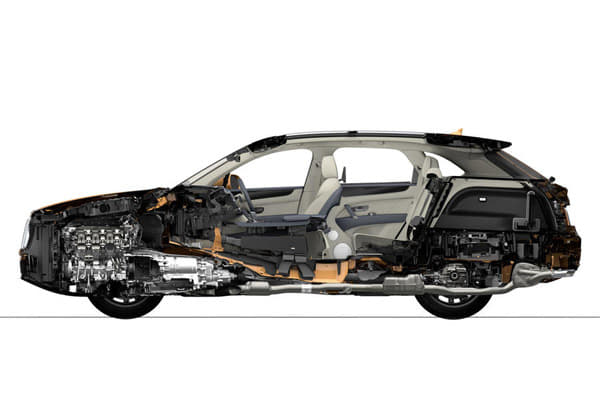
At least as difficult is to plan the three-dimensional world beneath the car’s skin. The Bentayga may be big, but you only have to glance at the cutaway below to see that every nook, cranny, crevice and orifice that isn’t given over to occupants and their belongings is ram-packed with stuff. Fitting them all in so they live a reliable, interference-free life within an envelope largely dictated by the design department is a massive challenge. How it’s done is what we’re here to discover.
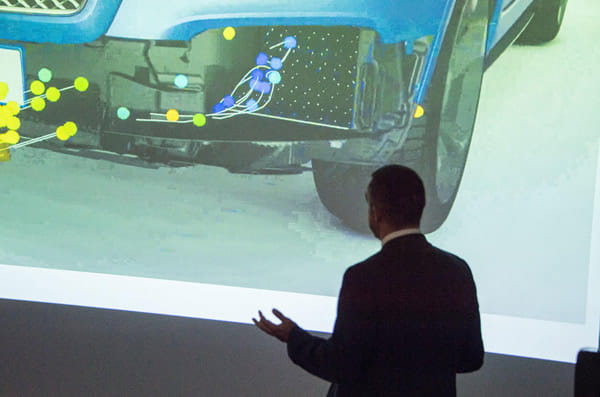
All the cutaways you see here are stills taken from a session in what Bentley calls the visualisation room. Simon Blake, Bentley’s director of body and trim engineering, explains that during a car’s development there are meetings here “every Wednesday afternoon for two and a half hours”. There were no fewer than 79 sessions during the Bentayga’s gestation, besides what he calls the “drumbeat” of collective development and minor reviews.
They’re called forums, and the room in which they’re held is indeed quite Roman in some of its arrangements, the rising rows of seats creating an amphitheatre. What the Romans wouldn’t have had, of course, was a projection screen big enough to turn a headlight into an object taller than a human.
The screen is 28 metres square and projects a staggering 8.8 million pixels of image that require a still more staggering three billion bytes of data. Around 15,000 metres of cable and 10,000 watts are required to bring it to life, with astounding resolution and accuracy.
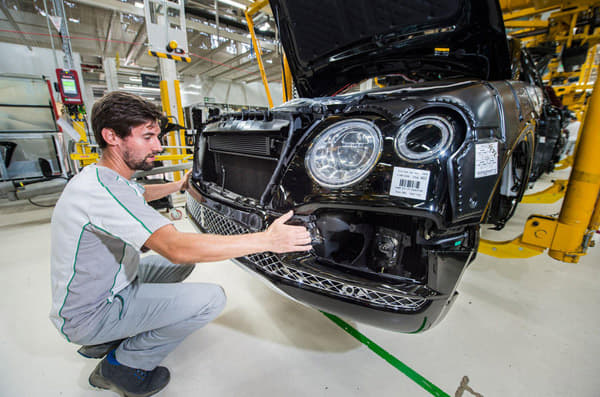
You might think that designing a radiator grille for any car, Bentley included, would be relatively simple. It needs to ingest air, of course, and in this case its traditional decorative mesh is framed by a body-coloured shell bearing the winged Bentley badge.
But there’s a lot more to a grille than the harvesting of air for cooling and boldly announcing the car’s identity. There is, as Nick Game, Bentley’s functional manager for bumper systems, explains, “legislation input”, namely regulation R127, which defines pedestrian protection requirements for the head and legs of adults and children.
“Certain zones must comply,” he says. “We take the digital surface, define the zone layout test area [the impact areas of bumper and bonnet] and find the hard points. It affects many components, including the powertrain.”
In this case, that means part of the cooling system. CAD models that simulate pedestrian head and leg impacts reveal the need for a change that could affect the car’s styling. Which is where the weekly forums — and the visualisation screen — come into their own. The vast power of this technology allows the designers and engineers to plunge below the Bentley’s surface and see an air intake and the confined space it occupies behind the grille. The intake bears part of the impact of a pedestrian and needs to crush in a way that both absorbs energy and prevents serious damage to legs.
“There’s a maximum allowable bending of the leg to protect the knee joint, and it was being exceeded,” explains Game.
The suggested solution was to redesign a horizontal plastic air intake duct located at the top of the grille behind the mesh and the radiator shell, in order to “provide more structure and suppress the upper leg”. There’s a lot of energy to suppress, too, the average leg delivering a concentrated 13kg impact at 25mph. “It’s a change that can alter the look of the car,” says Game.

 Viraaj Bhatnagar
 Dipan Sur
 Dhruv Dhaka