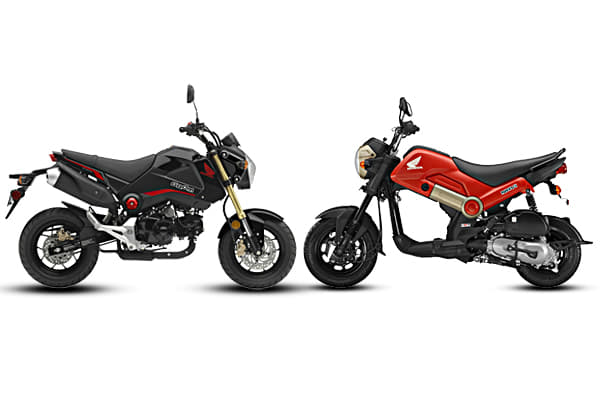
Let me just clarify that this is not a direct comparison. However, ever since Honda showed off the Navi at Auto Expo 2016, a lot of people have been comparing it to the Grom – the company's Monkey bike that’s quite popular across Southeast Asia, Europe and even the United States. While the Grom and Navi share some visual similarities, they’re really as different as chalk and cheese. So a quick rundown on what sets them apart should explain what each bike is about and, contrary to popular belief, getting the Grom to India in place of the Navi isn’t as sensible or easy.
Core and Cogs
Both the Grom and Navi borrow their drivetrains from other two-wheelers in Thailand and India respectively. The Grom’s 124.9cc single-cylinder, air-cooled, fuel-injected motor along with its 4-speed manual gearbox comes from the Honda Wave, a popular step-through in South East Asia. This motor makes 9.8hp of maximum power and 10.9Nm of maximum torque. And much like a conventional motorcycle, you have a chain driving the rear wheel. In comparison, the Navi gets the motor-gearbox combo from the Honda Activa, the highest-selling scooter in India. This motor is a 109.19cc single-cylinder, air-cooled motor that relies on a carburettor for breathing and develops 7.9hp of peak power and 8.96Nm of peak torque. The Navi drives its rear wheel through a scooter-standard variomatic transmission. So the Grom has fuel injection, proper gears and more power; that would definitely make it more exciting to ride for the enthusiasts, however, this would also drive up costs. More importantly, many new riders will find it easier to ride the Navi because of the CVT transmission, and of course the convenience it offers in city traffic.
Under that cute skin
Just like the engines and transmissions, which are very different in design, so are the chassis. The Grom’s motor might be from the Wave, but its steel mono-backbone frame is a completely different affair from the step-through’s underbone chassis. It gets a motorcycle-like single-tube spine chassis with 31mm inverted forks at the front and a box section swingarm with a monoshock at the back. The Navi’s frame, as dictated by the engine, is a scooter-like underbone type design. The suspension too is scooter-derived, with inverted (albeit much thinner than the Grom’s) forks at the front, while a spring-loaded hydraulic unit connects to the swingarm/drivetrain unit. On the whole, the Grom weighs in at a fairly light 101.7kg and surprisingly, the Navi is almost identical at 101kg.
 Ved Janve
 Vishal Venugopal
 Dinshaw Magol