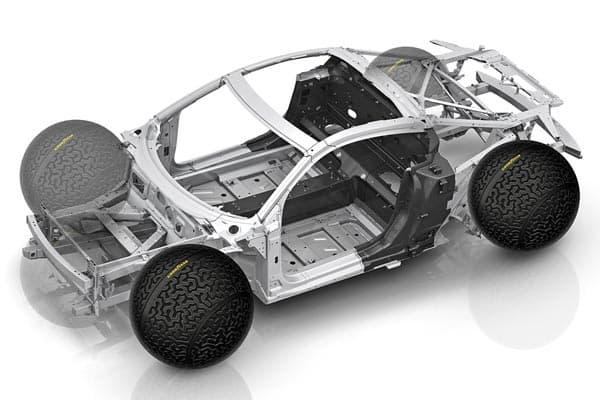
Of all the clichés in a motoring writer’s repertoire, the term ‘reinventing the wheel’ has to be one of the worst. This time, however, it’s true: Goodyear’s 360 concept, a spherical wheel and tyre combination, literally reinvents the wheel. Even more radical is the fact that there is no mechanical connection between the wheels and the car at all. Instead, the body is supported over the wheels by magnetic levitation.
So is this an inspired idea, a moment of genius or maybe just plain bonkers? Far-fetched though it may sound, there’s certainly a serious element to it. Like many emerging technologies, this one was prompted by the rapid approach of autonomous vehicles.
“We envision that by 2030 most vehicles will be autonomous,” says Goodyear Dunlop’s director of consumer tyre technology, Percy Lemaire. “Capturing information will have to be done in a different way. We believe the tyre will not only connect the road to the vehicle but inform the vehicle too.”
Why a sphere? “Because the tyre can roll in any direction, providing incredible manoeuvrability and allowing a vehicle to move in any direction,” explains Lemaire. This applies not only to highway driving but to parking as well, so an autonomous vehicle could move sideways at 90deg to its centreline if necessary.
Each 360 comprises a spherical core, which forms the wheel, and an outer casing, specifically the tyre. The core contains the powertrain, which consists of an electric drive motor, battery and sensors. The internal components, including the motor and battery pack, are suspended in a chassis within the wheel, with the electric motor driving the sphere via a number of small wheels. The core is stabilised by a gyro enabling it to hold station as the sphere rotates, while the battery is recharged using wireless induction charging via pads beneath the car.
The sphere can rotate through any angle, in order to even out wear or perhaps use a different area of the tread to suit different conditions. The outer casing can be removed and changed when worn, or to switch to a different type of tread – much like switching from conventional summer tyres to winters. Taking data from sensors in each wheel, computer algorithms work out what the road conditions are like, whether they are wet, dry or icy, and adapt the car’s speed and cornering rate accordingly. The car can then transmit details of those conditions to other vehicles on the road via car-to-car networking.

 Uday Singh

 Glenn Noronha
 Dipan Sur