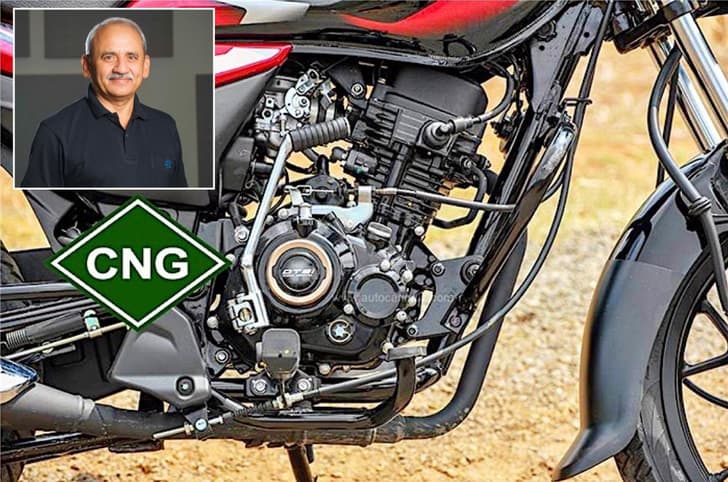
Bajaj Auto plans to leverage multiple alternative powertrains to address the cost challenges faced by customers and emissions challenges faced by the country, with a renewed focus on CNG. Compressed Natural Gas is considered a cleaner alternative to traditional fuels like petrol and diesel, and it has the potential to contribute to the reduction of carbon emissions.
In an interview with our sister publication Autocar Professional, Rakesh Sharma, executive director, Bajaj Auto, speaks about the virtues of CNG, how it can be further democratised and how the government can help in promoting this cleaner fuel even more.
How do you see CNG as an alternative in the coming decade?
Let me begin by saying that CNG is a cleaner fuel than diesel because of negligible particulate matter emission, but it is not a zero-emission fuel. Most likely, the country’s progress towards lower emission fuels, self-dependency and reduction in forex outflow will be driven by a combination of options like CNG, ethanol blending and EVs.
To that extent, we are fortunate as a country to have all these options open to us. However, each one of those options requires long-range thinking, co-option of users and the building of an ecosystem. For example, in the case of CNG, it is not just about pumps but also about a much bigger network of certifying agencies to ensure high safety standards.
What could the government's role be in popularising CNG as an alternative fuel?
Through the Ministry of Petroleum and Natural Gas, the government has played a pivotal role over the decades to develop CNG as a credible option for multiple uses including transportation. The CNG network of pumps and sub-stations have come up with remarkable speed and have been instrumental in shifting users from diesel to CNG. Almost 5,000 CNG pumps now cover 47 percent of our districts and the Government of India has a stated objective of doubling this network, which will make CNG very widely available.
What is your assessment of the penetration of CNG fuel in the 2-wheeler, 3-wheeler and quadricycle segment in the coming decade?
Currently, almost 60 percent of ICE three-wheelers in India are powered by CNG. Both Quadricycles and 2ws can also be powered by CNG. As the CNG network expands and becomes easily as well as widely available, more and more vehicles can shift to CNG. OEMs like us will also be encouraged to develop all types of vehicles which use CNG as a fuel. This becomes a unique opportunity where all stakeholders, the government, the consumers, the society at large and the OEMs all stand to win. Therefore, a strong case can be made for the reduction of GST for CNG-based vehicles, this will hasten the adoption and the development of newer vehicles as well as use cases.
What is your view on the customer behaviours in each of the fuel segments and how can customers find value in CNG as an alternative?
Consumer behaviour is driven by economic reasons. CNG offers at least 10 percent better operating efficiencies than diesel besides being a cleaner fuel. For commercial users this operating advantage is sizable and that is why we see a wholesale shift from diesel to CNG wherever the network is put in place.
What are Bajaj Auto's aspirations to grow in this critical space?
We have been closely aligned to this infrastructure development and over the years have invested in building very good three-wheeler products based on CNG. These have been received very well by customers rewarding us with an 80 percent or so market share of the CNG segment in three-wheelers. Looking at the government’s commitment to expand usage of CNG, we are developing other vehicle options too. We intend to remain on the forefront of this development and application.
Also See:
Bajaj Auto's Rakesh Sharma talks about CNG in two wheelers and more
 Vishal Venugopal
 Ved Janve
 Stephen Raj Antony