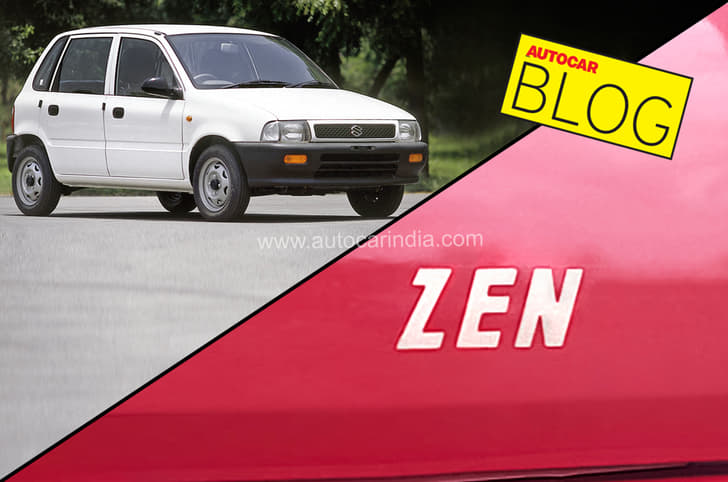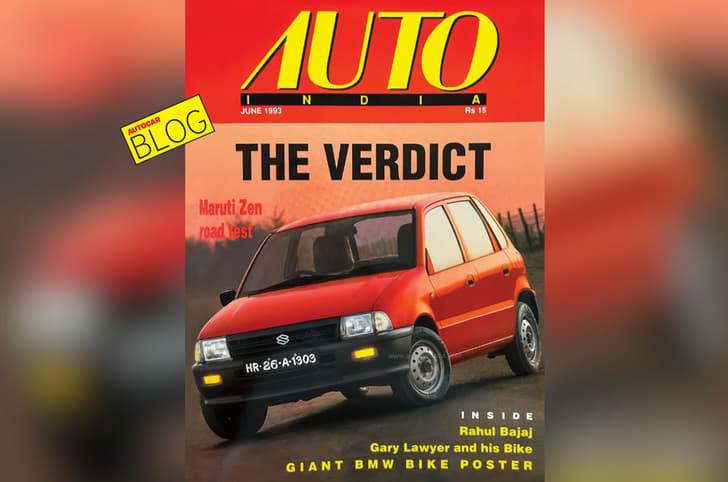
It's been 30 years since Maruti launched the Zen, and it’s also been 30 years since I launched Auto India magazine alongside my colleague Gautam Sen, who was the editor at the time. The best way to launch a new magazine is with a mega exclusive. Just like we did with the inaugural issue of Autocar India in September 1999 – featuring a world exclusive of the Ford Ikon on the cover – Auto India was also launched with a bang back in June 1993, with an exclusive road test of the Zen.
Although both the Zen and Auto India are long gone now, my memories of that cover shoot at Bandra-Kurla Complex (BKC) in Mumbai are still vivid. Three decades ago, BKC was a marshy, secluded and undeveloped area infested with mosquitoes. I vividly remember being feasted upon by those mosquitoes on a hot and humid May morning as I waited for the sun to rise in the east. This shoot was particularly important because Auto India was, believe it or not, the first-ever all-colour automotive magazine in India, and we wanted to make the most of it with exceptional photography. That cover propelled Auto India to become India's best-selling auto magazine, with a peak circulation figure of 1,02,000 as per the Audit Bureau of Circulations (ABC). The January 1998 issue was the zenith for Auto India, featuring another exclusive gem on the cover – the Indica!
In contrast, the Zen had a rocky start due to its "eye-watering" price of Rs 2.8 lakh. Yes, "eye-watering" indeed, especially when you consider that the Maruti 800 cost half as much. The Zen was undeniably expensive, but it felt like a European car, offering a level of quality that was light years ahead of anything else available in India at the time. I still recall being gobsmacked by the Zen's exquisitely finished dashboard, featuring soft-touch plastics and finely textured grain. It was a stark contrast to the 800 – India's staple car against which every car was measured – which had a dashboard that felt like it was made of cardboard.
The knobs, the buttons and the steering wheel felt utterly premium for a car born in the early 1990s and the Zen oozed a ‘foreign car’ experience right down to its smell. Of course, the Zen soon found a fan following and went on to become a cult car and it’s not hard to understand why. The zippy performance (faster than any other Indian car at the time) and cheeky ‘jelly-bean’ styling made the Zen a lovable little hatch anyone with money aspired to own. The 1.0-litre engine made of all-aluminium (another first) was a rev-happy little jewel and the five-speed gearbox was slick and smooth. Who would have thought that with all of 51hp, the Zen would be crowned by fans and followers as India’s first hot hatch? Power and performance was not the point. The Zen was a bundle of fun and the only true driver’s car of the day. But was it?
To be honest, I was never a big fan of the original Zen and thought it was a bit overrated after having driven one extensively. Maybe it’s because I was too much of a fanboy of the Maruti 800, which I raced and rallied (and even rolled!). For me, the ‘People’s Car’ was actually better than its celebrity brother in many ways. Firstly, the Zen’s massively oversquare 1-litre engine had no bottom end and you had to rev the socks off the motor to get the most out of it. It lacked the perky and immediate throttle response of the 800’s three-cylinder 796cc motor, which felt more effortless to drive in the real world.
It was fashionable to say the Zen had brilliant handling, but the truth is, the steering lacked an on-centre feel and wasn’t as quick or accurate as the 800’s brilliant rack-and-pinion. Also, the Zen was too nose-heavy, the result of a bigger 1-litre engine being shoehorned into a car originally designed for 660cc (the Zen was a derivative of the Cervo mode) and sitting ahead of the front-axle line. It was a suspicion I had confirmed at the 1999 Tokyo Motor Show when, at the Suzuki stall, I got chatting with one of the engineers who had actually worked on the YE2, or the Indian Zen. He admitted as much that the four-cylinder G10B engine shoehorned into the Zen’s tiny engine bay originally designed for a 660cc engine with one cylinder less, wasn’t a perfect marriage. Besides, the G10 was, dimensionally, a big engine because the aluminium block, which has a lower strength-to-weight ratio than cast iron, needs to have larger dimensions to achieve the necessary structural strength.
But not many saw these flaws, and the Zen's ability to inject thrills into a mundane everyday commute is what made it an icon.
 Rishaad Mody
 Avik Chattopadhyay