What’s new?
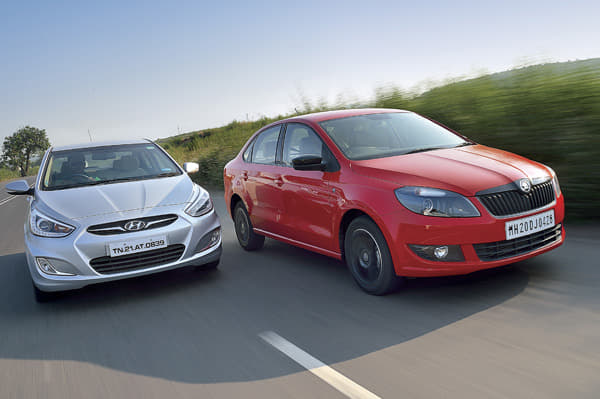
There is nothing more convenient than using an automatic gearbox equipped car in day-to-day driving. Traditionally, the mid-size sedan segment in India has been dominated by petrol automatics which also meant buyers shied away because of the higher running costs. Automatics are not as fuel efficient as manuals but if you have a diesel engine under the hood, you won’t go bankrupt. The point here is that automatics are better suited to diesels than petrol motors and it makes you wonder why the Hyundai Verna diesel automatic was the only option for buyers till date. Now, Skoda and VW have seen the potential in this segment and launched the diesel Rapid and the Vento with automatic transmissions. Between the Vento and Rapid, we decided to include only one car in this test as both of them are mechanically identical with similar cabins. The Rapid diesel automatic has a lot going for it. Its strong 103bhp diesel engine is coupled with a modern seven-speed dual clutch automatic transmission, which should ensure great performance without hampering fuel economy. Other strong Rapid credentials remain, like the solid build, spacious cabin and sorted driving dynamics. The Verna, on the other hand, is already an accomplished product. It may have an old school four-speed torque converter automatic gearbox but the engine makes much more power. Like all Hyundais, it’s packed with features and looks great too. But while the Verna is better equipped, it is Rs 80,000 more expensive than the Rapid. So which one should you go for?
What are they like inside?
Step into the Rapid and quality-wise, it is hard to fault. Everything from the well contoured seats, the switchgear and the upholstery is well made. In terms of the quality of materials in the cabin, the Rapid is the better of the two and the attention to detail is also very good. But all this is somewhat negated by the rather plain-jane dashboard. It comes finished in dull grey and simply looks boring. The front seats are well contoured, and the long seat travel and the steering that adjusts for reach and rake makes finding an ideal driving position very easy. The rear seat of the Rapid is also a good place to be in. There’s plenty of legroom, the seat is wide and you get a nice airy feel. And the seat is reasonably comfortable too. But on the downside, you sit quite low and the huge tunnel in the centre of the cabin makes it difficult to get in and out if you are the third passenger. The Verna is pretty attractive on the inside. It was recently refreshed, but the changes to the inside are very subtle. It isn’t as easy to use as the Rapid’s dash, but the fit and finish and overall quality are impressive. Also, the front seats have good bolstering and the Verna’s dash is quite low, unlike the Rapid, making it easy to see out of. The big seats also really give you a feeling of space. Like the Rapid, passengers will also have to contend with the Verna’s low stance – getting in and out could be an issue for some. The generous width and flat floor offer enough space for a fifth passenger but the seat contours make the rear bench best suited for two. Legroom, though less than the Rapid, is more than adequate and the backrest is at a good angle.

 Viraaj Bhatnagar
 Dipan Sur
 Dhruv Dhaka
 Saptarshi Mondal