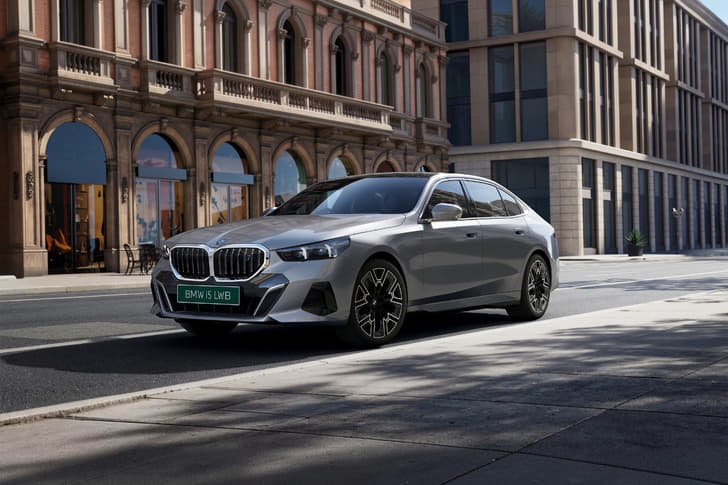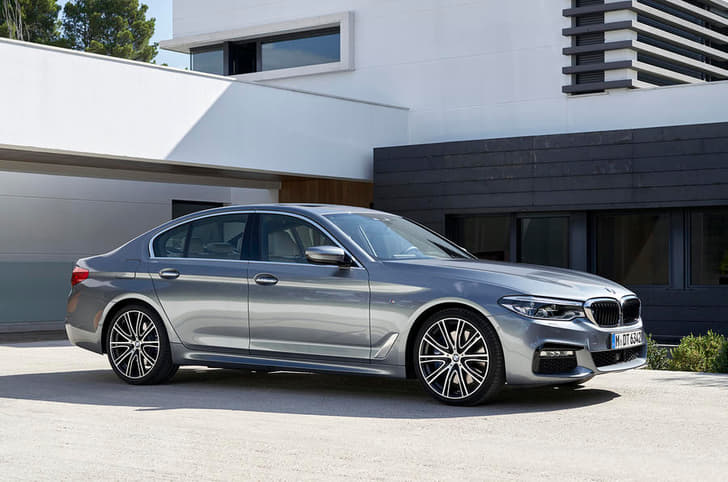
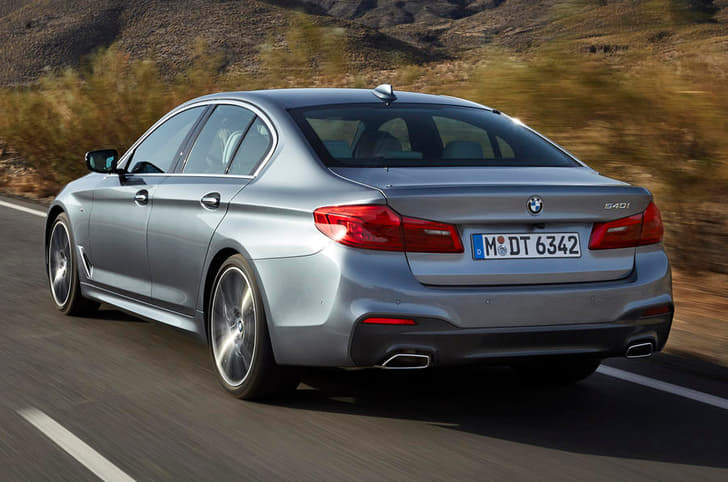
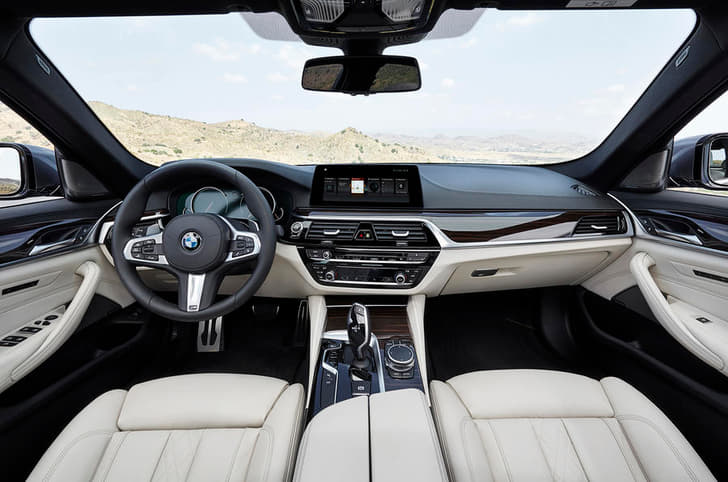
The seventh-generation BMW 5 Series sedan has been revealed, featuring an evolutionary exterior design, an updated interior, a broadened engine line-up and semi-autonomous driving functions. The car will get its first public debut at the 2017 Detroit motor show.
Globally headlined by a rapid M550i xDrive M Performance model, the latest incarnation of the 5 Series sports an appearance that's not as removed visually from that of its predecessor as previous new 5 Series models have been.
The car takes influence from the new 7 Series, adopting a subtly sharper form than that of the old 5 Series with tauter surfacing and more finely honed crease lines along the flanks, including an additional feature line running along the top of the front and rear doors.
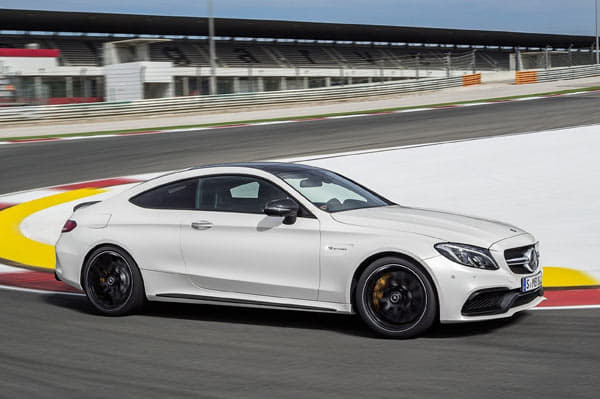
The new 5 Series has grown in size, but only slightly. Length has increased by 36mm to 4935mm, width grows by 6mm to 1868mm and height increases by 2mm to 1466mm. The wheelbase is 7mm longer than that of its predecessor at 2975mm, while the track widths of the 520d are up by 5mm at the front and 3mm at rear at 1605mm and 1630mm respectively. For context, the next-gen Mercedes-Benz E-class stretches to 4880mm in length, 1850mm in width and 1470mm in height. Mercedes will launch the new E-Class in India by the end of this year.
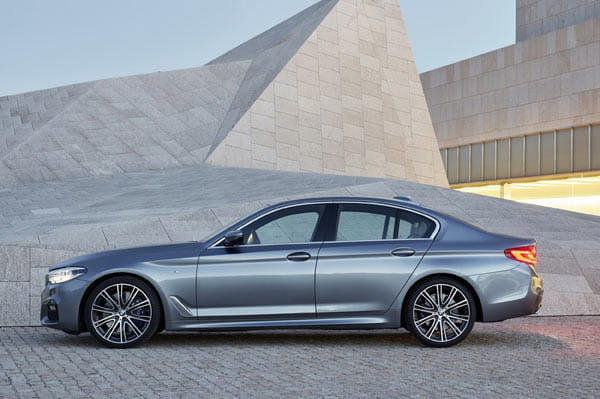
Thanks to the increases, the 5 Series' interior space is improved, notably rear leg, shoulder and head room. There’s sufficient space for five adults on newly developed seats front and back. Crucially, the rear bench has been reshaped to provide a more defined centre seat, rather than being shaped primarily for the two outer seats, although a wide centre tunnel continues to rob foot space at the base of the centre rear seat. Boot capacity is also up, by 10 litres to 530 litres, although that's still 10 litres shy of the next-gen Mercedes-Benz E-class sedan.
The new 5 Series adopts BMW’s new Cluster Architecture (CLAR) platform structure underneath its predominantly aluminium body. The structure incorporates more aluminium, magnesium and titanium within its floorplan, bulkheads and connecting nodes than the platform of the previous 5 Series. BMW says CLAR, along with other weight-saving measures, such as a lighter wiring loom, have resulted in a reduction of the 5 Series's kerb weight by up to 100kg, depending on the exact variant.
Among the confirmed petrol engines for the global range is a turbocharged 2.0-litre four with 191hp in the 520i and a turbocharged 3.0-litre six making 251hp in the 530i and 340hp in the 340i. They will be joined later by an updated version of BMW’s turbocharged 4.4-litre V8 in the initial flagship 550d xDrive M Performance model. Set to rival the Mercedes-AMG E 43 and Audi S6, this M Performance model has 461hp 649Nm, giving it a 0-100kph time of just 4.0sec and a 250kph top speed. For the diesel line-up, the 518d, 520d, 520d Efficient Dynamics and 525d models will receive BMW’s turbocharged 2.0-litre four-cylinder unit.
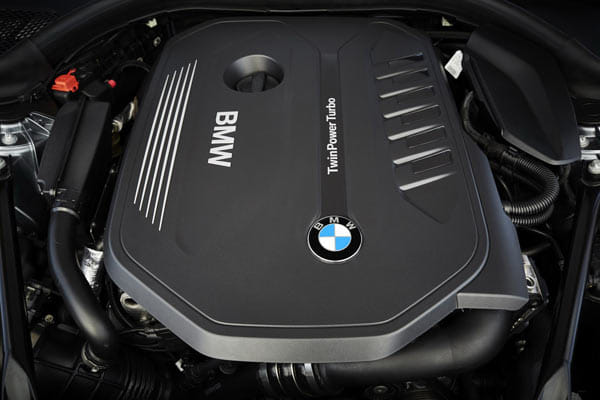
Ranged above these traditional volume-selling diesels is the 530d, which uses a 265hp version of BMW’s turbocharged 3.0-litre six-cylinder diesel engine. It will be complemented later on by the 535d-replacing 540d, which uses the same engine tuned to 320hp for the international markets. Sitting atop the diesel line-up is a new all-wheel-drive 550d xDrive M Performance model powered by a 400hp quad-turbo iteration of the six-cylinder engine.
At the top of the range is the new M5. Expected to make its debut at the 2017 Frankfurt motor show, it will challenge the likes of the Audi RS6, Jaguar XF R and Mercedes-Benz E63 with a lightly revised version of the outgoing model’s twin-turbocharged 4.4-litre V8 petrol engine developing a similar 611hp as the recently announced M5 Competition Edition model, which acts as a swansong model for the sixth-generation 5 Series.
 Viraaj Bhatnagar
 Dipan Sur
 Dhruv Dhaka
 Saptarshi Mondal