

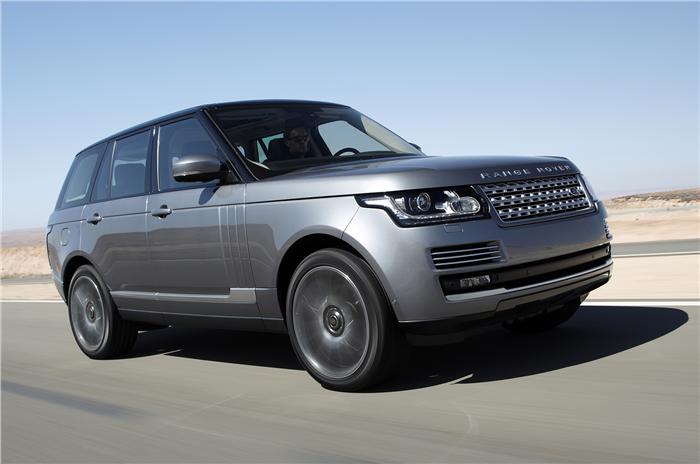
Jaguar Land Rover group engineering director Wolfgang Ziebart recently hinted at a battery-powered Range Rover model while discussing JLR's view on electric vehicles (EV). He said that currently the market for EVs is restricted to city runabout vehicles and as an alternative second or third car for a wealthy family.
Zeibart suggested that the latter segment had potential for JLR and that any EV would be the size of a “Jaguar XJ” and aimed at the US and China.
Land Rover design chief Gerry McGovern also strongly hinted in the press recently that the company was working on expanding the Range Rover brand with “incredibly luxurious, low-slung” Range Rovers. Such a model would be more biased to on-road performance but still capable of cross-country driving thanks to height-adjustable air suspension.
It seems that this crossover model could be sold in conventional petrol and diesel-powered forms, as well as a purely battery-powered guise.
Building a car with a much smaller frontal area would be key to making the battery-powered concept work. Any future electric Range Rover model would have to match the Tesla Model S’s official range of 265 miles to be regarded as competitive, something that would be difficult using a similarly aerodynamically blunt profile to the current car’s.
If the new model gets the go-ahead, it will be based on a version of Range Rover’s aluminium monocoque architecture, modified to accommodate a substantial battery pack. All-wheel drive, delivered by using motors on both the front and rear axles, also seems a certainty.
It is possible that this proposed crossover could share its basic suspension system with the upcoming Jaguar CX-17 crossover, which is likely to have less extreme travel than that which is used on today’s Range Rover and Range Rover Sport.
A more road-biased set-up with air springs would allow the Range Rover EV to run a low ride height at motorway speeds, which would improve aerodynamic performance and stretch the maximum range from a battery pack.
Investing in an electric crossover model could be a significant risk for JLR, but Land Rover bosses clearly have to take the premium EV market seriously, partly as a result of the rise and rise of Tesla.
The Model S has already become the best-selling luxury model in some of the US’s most affluent postcodes and the car has recently started to outsell established models, such as the Audi A8 and the BMW 7-series, in Europe.
China is also expected to become a significant market for battery-powered luxury vehicles over the next few years, as the Chinese government pushes hard for the adoption of EVs to help combat the country’s serious air pollution problems.
 Lenny D'sa
 Saptarshi Mondal
 Uday Singh
 Viraaj Bhatnagar