What’s new?
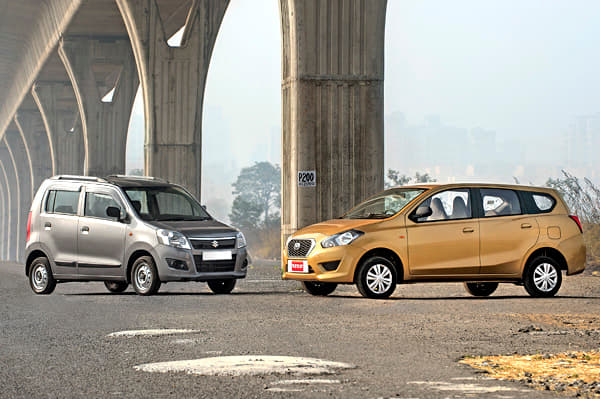
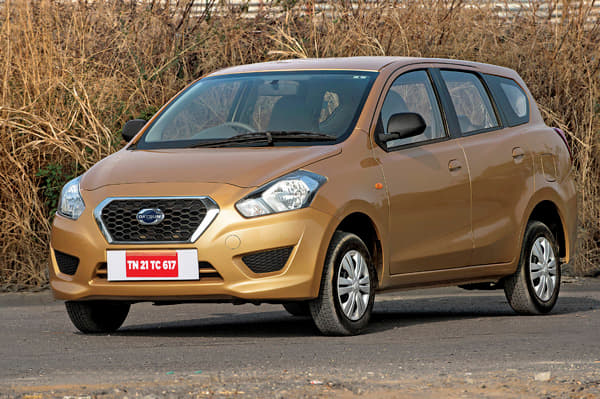
The Datsun Go+ is a very interesting car. It seats seven, is about the same length as a compact sedan and costs as much as a budget hatchback.
So, on the face of it, this car offers amazing value and can potentially stir up things amongst its ‘lesser’ five-seat rivals. After all, more seats is better right? Well, it’s not that easy. That’s because, to come out on top, the Go+ will have to lock horns with the WagonR – the go-to budget option for folks looking for a spacious, efficient and comfortable hatchback. And additionally, it’s backed up by the country’s best aftersales network.
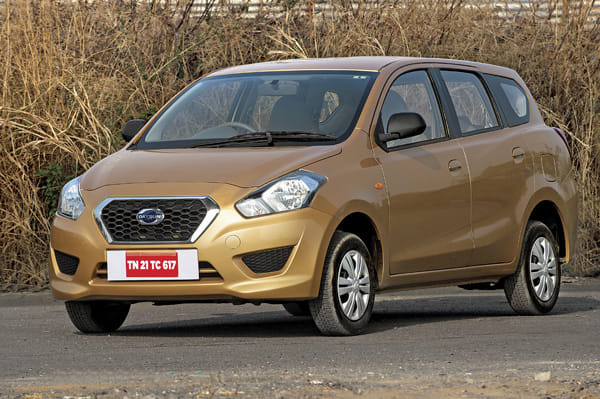
The top-spec Go+ is priced at Rs 4.61 lakh, which is just about Rs 8,000 more than the range-topping WagonR VXi. And while two more seats for the same price looks like a no brainer, it isn’t that straightforward.
What are they like inside?
This is where both cars fundamentally differ. The Go+ has an extra row of seats over the WagonR and this is the car’s biggest USP. Before we get into the rest of the cabin, lets look at this last row. Though the Go+ is technically an MPV, unfortunately, the extremely cramped third row makes it almost impossible to fit an adult here comfortably. In fact, space here is so tight that even tall children may find themselves unable to sit in the seat. That said, this row can be quite useful for younger children who otherwise, would find themselves in the laps of some passengers. The back seat flips forward and folds up and while access is restricted, it isn’t so bad if you kids are under five feet tall.
Apart from the third row, everything else is pretty much the same as the Go hatchback. So, it gets the same grey dash that’s well screwed together but looks a bit too bland and built to a cost.
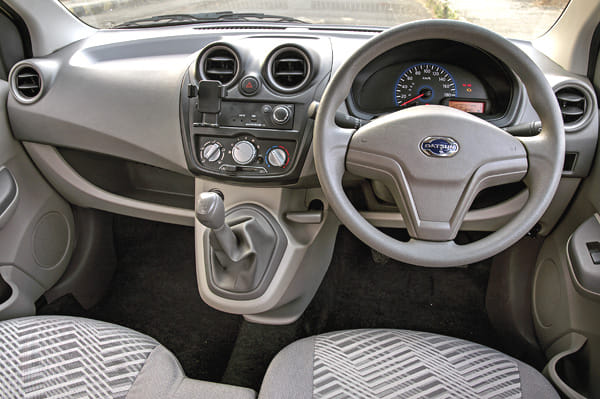
Just like in the Go, the front seats resemble a bench and this frees up extra space to store your belongings. Finding a good driving position can get a bit tricky as the steering wheel isn’t adjustable and neither is the seat height.
The front seats are fairly comfortable but the second row lack under thigh support although knee room is adaquate. Between the two, the Go+’s wider cabin means it is possible to seat three abreast (in the second row), something that’s quite difficult in the narrower Wagon R.
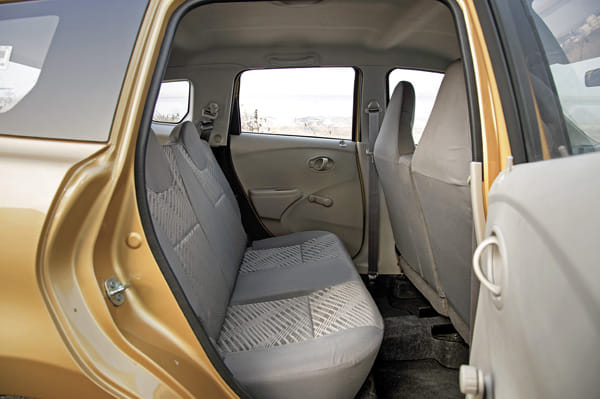
What we didn’t like about the Datsun’s cabin is that it lacks closed storage spaces; even the glovebox doesn’t have a lid. Also, the mirrors can’t be internally adjusted and the driver has to reach over to use the passenger side power window switch because there’s no master console on the driver’s side.
The WagonR may be down on two seats but the cabin scores well in terms of space and practicality. There are a fair number of closed storage spaces in the form of twin-gloveboxes and a hidden tray that sits under the front passenger seat to stow expensive items out of sight and two cupholders that pop out of the dashboard. That said, the doorpockets are too slim to be really useful.

The doors open wide and the high seating means you slide into the WagonR’s front seat without any effort; especially useful for elderly folk. Inside, you are faced with a vertical dashboard and the silver-finished centre console adds a bit of style to what’s otherwise a pretty plain cabin.
You sit much higher up in the Maruti and the adjustable steering allows for a nicer driving position. Additionally, the large glass area gives the driver a good view of his/her surroundings, taking some of the stress out of city driving. The front seats feel quite flat and lack a bit of support and between the two, the WagonR’s rear seat feels more airy and comfortable. Despite it’s slightly shorter wheelbase, the upright seating position frees up a fair bit of knee room and by deftly adjusting the front seats, it’s possible to comfortably seat taller people in the rear.
The 180-litre boot however is just about half the size of the Datsun’s big 350-litre cargo area, which rivals many compact sedans.

 Viraaj Bhatnagar
 Dipan Sur
 Dhruv Dhaka
 Saptarshi Mondal