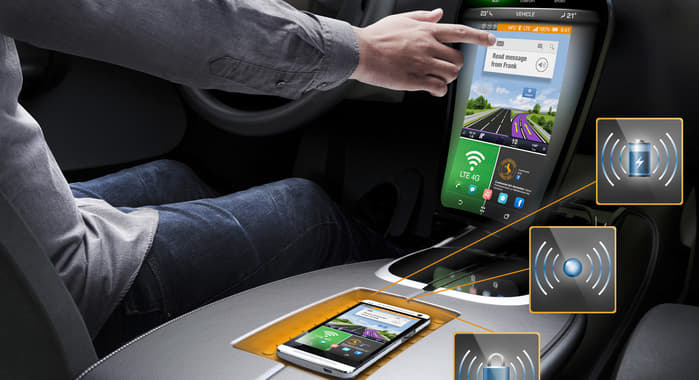
International automotive supplier Continental has come up with a multifunctional smartphone terminal (MFST) technology for car manufacturers. It allows car drivers to use the smartphone functions easily, conveniently and safely in their vehicle.
Andreas Wolf, head of the Body & Security business unit, said, “The multifunctional smartphone terminal puts an end to tangled phone cables once and for all. All the driver has to do is place the smartphone in the box in the cockpit. He or she can then use the car's controls to access all the relevant features during the journey. At the same time, the phone is charged wirelessly.”
The new terminal is to go into production in 2015. This new technology combines wireless charging of the smartphone battery, wireless antenna coupling, and near field communications (NFC). One key innovation is that these three features do not require a cable connecting the phone to the vehicle. Moreover, the modular design allows vehicle manufacturers to decide which features they want to offer in their models.
Wireless charging
Compatible smartphones can be charged in the terminal, saving space and without any tangled cables. The wireless charging system meets the ‘Qi’ standard specified by the Wireless Power Consortium (WPC). Continental believes this standard is ideal for use in vehicles. For example, it offers similar charging currents to standard USB charging connections and has similar charging times to those of cable charging systems. Many smartphones, such as the Samsung Galaxy S5, S4 and S3, the LG G2, and the Nokia Lumia 1020, 925, 820 and 720, can easily be equipped for wireless charging by simply replacing their back covers with a Qi-compatible one. Qi-compatible cases are also available for the Apple iPhone 5S, 5, 4S, and 4. Some models support the Qi standard right out of the box, without a special back cover. These include the Nokia Lumia 1520, 930 and 920, the Google Nexus 5 and 4, and the LG Optimus G Pro. Behind the supposedly simple inductive charging process lies an ingenious technology, Continental's reliable heat management system, which is essential for wireless charging. It ensures that neither the smartphone nor the vehicle's components exceed their specified maximum temperatures during charging. Furthermore, foreign object detection ensures that inductive charging stops immediately if keys, coins or chewing gum with metal foil packaging are placed in the smartphone terminal by mistake. The clever cell phone box also meets all the electromagnetic compatibility (EMC) requirements specified by the vehicle manufacturers. Alongside the Qi-standard supported by Continental, there are other wireless charging technologies such as PMA (Power Matter Alliance) or A4WP (Alliance for Wireless Power) on the market. Continental is already working on supporting these standards.
Wireless antenna coupling
To use a smartphone in a car, you need a power supply and the best possible connection to the driver's phone network. The best solution is to connect the smartphone to an antenna mounted on the outside of the vehicle. This enhances the quality of the phone signal for receiving and transmitting, particularly where network coverage is poor. An external antenna reduces the electromagnetic load on the people inside the vehicle and also spares the smartphone's battery. This is because the poorer the reception is, the more power a cell phone needs to send and receive. The smartphone terminal from Continental also uses wireless technology to connect to an external phone antenna on the vehicle. The multifunctional smartphone terminal has so-called passive antenna coupling technology, developed by the well-known antenna specialists Kathrein Automotive. To increase the quality of the network connection to a maximum level, the system is usually equipped with an additional compenser from Kathrein Automotive. The compenser compensates the losses of passive antenna coupler and losses in the cable to the external phone antenna (roof-mounted antenna). The benefits for the smartphone user at the wheel include more stable downloads, more reliable streaming and improved voice quality during calls. At the same time it prevents unnecessary electromagnetic loads.
Near field communication (NFC)
The Continental terminal also connects the smartphone to the vehicle architecture via near field communication (NFC). NFC is a comparably recent wireless standard in smartphones. With NFC, smartphones can be used to authorize coupling processes or as a digital vehicle key. The multifunctional smartphone terminal from Continental makes it easier to connect the smartphone to the vehicle’s systems thanks to NFC. This can be used to activate personal presets in the vehicle via smartphone – from favorite radio stations to preferred air conditioning settings to seat positions and mirror settings. This means the Continental terminal offers manufacturers a wide range of features and makes it much easier for drivers to use their smartphones safely in their cars.
 Dipan Sur
 Viraaj Bhatnagar