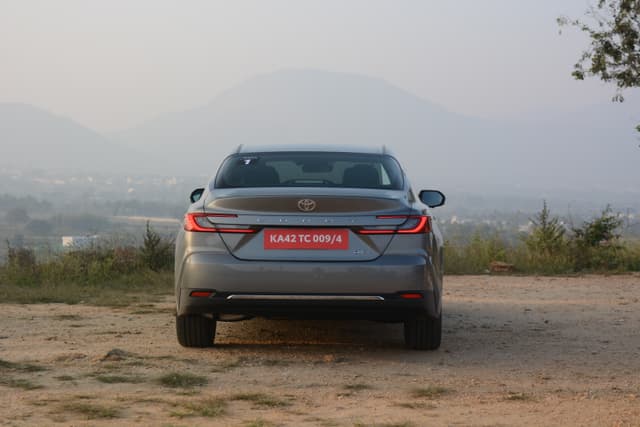
Toyota Sedan Cars in India (1)
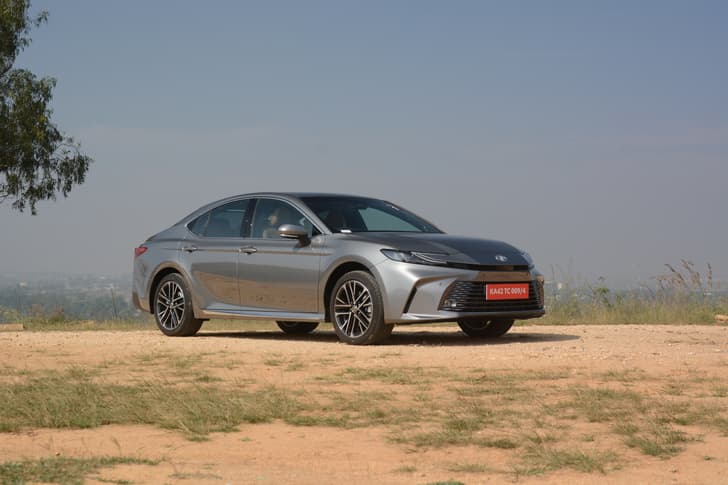
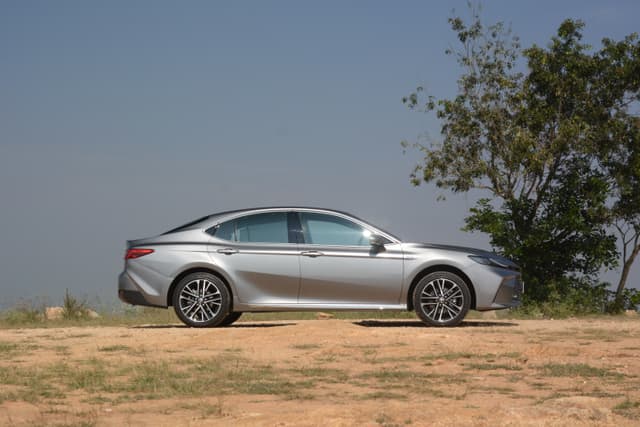
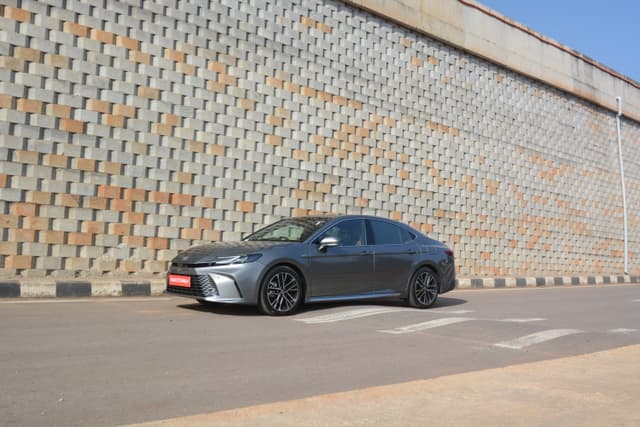
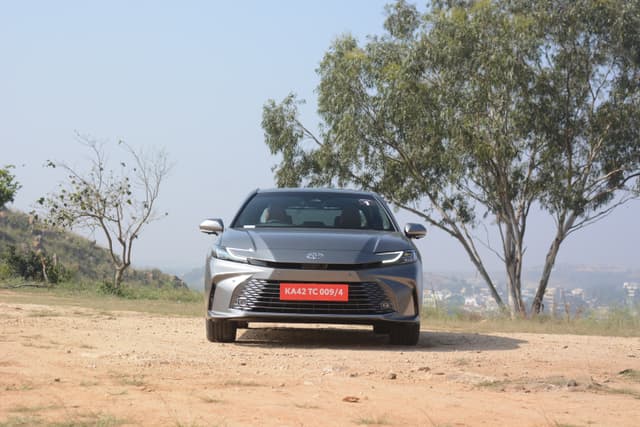
In August 2026, the Toyota sedan car lineup in India includes a single premium offering - the Toyota Camry. The Toyota sedan car price, the Camry, is available at ₹47.48 lakh (ex-showroom). This executive sedan is a strong choice for buyers who want comfort, efficiency and advanced technology in one package.
The Camry is a self-charging hybrid automatic sedan with a 5-seater layout and front-wheel drive (FWD). It delivers an impressive mileage of 25.5 kmpl, making it one of the most fuel-efficient premium sedans in its class.
On the safety front, it comes equipped with more than 8 airbags, ABS with EBD, parking sensors, a reverse camera and a 360° camera. Comfort and convenience are equally impressive with features like a sunroof, ventilated seats, wireless phone charging, central locking and Android Auto/Apple CarPlay connectivity.
Toyota Sedan Cars prices (on-road) in August 2026
The Toyota sedan price on-road varies depending on the city due to differences in RTO charges, insurance and local taxes. In major cities like Delhi, Mumbai, Hyderabad, Chennai and Kolkata, the Toyota sedan price ranges between ₹55 lakh and ₹59.75 lakh. Buyers should always check the exact on-road price in their city for a more accurate estimate.
City | On-Road Price (₹) |
Delhi | ₹55.00 lakh |
Mumbai | ₹56.42 lakh |
Hyderabad | ₹58.80 lakh |
Chennai | ₹59.75 lakh |
Kolkata | ₹55.00 lakh |
Toyota Sedan Cars - FAQs
Currently, the only model in the Toyota sedan lineup in India is the Toyota Camry, which is a premium hybrid sedan.
The Toyota sedan car price for the Camry is ₹47.48 lakh (ex-showroom).
The Toyota sedan price on-road in Delhi is approximately ₹55.00 lakh.
The Toyota sedan in India, the Camry, is a self-charging hybrid automatic sedan.
In Mumbai, the Toyota sedan price on-road is around ₹56.42 lakh.
The Toyota sedan car (Camry) delivers a claimed mileage of 25.5 kmpl, making it fuel-efficient for a premium segment model.
The on-road Toyota sedan price in Hyderabad is about ₹58.80 lakh.
Toyota sedan cars, specifically the Camry, come with more than 8 airbags, ABS with EBD, parking sensors, reverse camera and a 360° camera for enhanced safety.
Trending Questions on Toyota Cars - Answered by Autocar Experts
I am currently using my dad's Maruti Ritz and wish to upgrade to a more premium sedan or SUV. My current shortlist includes the Toyota Hyryder Strong Hybrid, Skoda Slavia, and Honda City e:HEV. Several thoughts and concerns keep coming to mind regarding each vehicle. The Hyryder is not a proper SUV, and its 3-cylinder engine has more vibration than 4-cylinder engines. The Slavia's 4-cylinder engine is giving single-digit fuel efficiency, especially with the E20 fuel concerns. I am also worried about the long-term maintenance of its turbo engine. The City e:HEV is priced above Rs. 20 lakh, attracting luxury tax, and its on-road price goes beyond Rs. 25 lakh. I am not sure whether the cost-benefit equation will work in favour of the City. The Slavia facelift is also around the corner. I wish to keep my next car for at least 10 years.
Based on your requirements, the Toyota Urban Cruiser Hyryder Strong Hybrid is the most sensible upgrade. Your concerns about the 3-cylinder engine are understandable, but in the hybrid, the petrol engine is assisted by the electric motor, which smooths out the power delivery and reduces the typical 3-cylinder vibrations. This Toyota car also delivers excellent fuel efficiency, especially in city driving, which will make a significant difference over a 10-year ownership period. While it may not be a "proper" SUV in the traditional sense, it offers a higher seating position, good ground clearance and a comfortable ride, making it a practical and premium upgrade from the Ritz.The Honda City e: HEV is a strong alternative, but the higher price pushes it into a different budget bracket, and the cost-benefit equation becomes harder to justify. The Skoda Slavia is a great driver's car with a smooth 4-cylinder engine, an extremely practical cabin and strong performance, but if efficiency is a high priority, it is best to stick to the strong hybrid. The Slavia will receive an update soon, which will also feature a new gearbox which replaces the earlier Aisin-sourced 6-speed torque converter (AQ250) with a newer Aisin 8-speed torque converter (AQ300). This will be exclusive to the 1.0-litre engine and will be a bit more efficient too. However, in comparison to a strong hybrid, nothing really comes close. Overall, the Hyryder Strong Hybrid offers the best balance of efficiency, reliability and ownership experience for your needs.
Hi Autocar team, I am looking to buy car in range between 50-55. I am preferring sedan but open to good SUV. I am thinking to go with audi A4, but its new generation A5 and Q3 both are due in india. I have also seen XUV diesel as my running 12-15k max 20k in year. Also explored Camery. Can you please suggest an options. I am looking for fun to drive car.
I have a Volkswagen Polo and a Jeep Compass Petrol, and I'm looking for a luxurious sedan with a budget of Rs 40 lakh (before taxes) from a good brand. Please give me a few recommendations.
Sadly, there is no luxury sedan car within this price bracket. You will have to stretch your budget by at least Rs 10 lakh to get a BMW 2-Series or even a Toyota Camry Hybrid. If you're lucky, you might find a dealer selling an unsold Audi A4 at a heavy discount. However, chances are, you will certainly have to pay more than Rs 40 lakh for it.
Dear sir, I have been watching your Deep Drive podcast every Saturday. It is always very informative, and the timing of your recent episode couldn't have been better. I am planning to buy a Toyota Camry in the next 2-3 months. As we know, the Camry is currently tuned for E20 fuel, but if the government introduces E25 or E27, it may not perform as intended. Should I wait for a few more months before buying it and see if Toyota introduces an E25/E27-compliant version? Your suggestion would be much appreciated.
Thank you for watching the Deep Drive podcast so regularly. Your concern about buying an E20 compliant car today, with the possibility of E25 or E27 becoming the base fuel, is understandable as there is a lot of noise of its ill effects on social media. Our view is that you should go ahead with your purchase and not worry too much about a higher ethanol blend in the near term. A move to E25 or beyond cannot happen overnight. Before any such decision, the impact of higher ethanol blends on vehicles not certified for them has to be evaluated and validated by a government notified agency like ARAI. This takes time and involves testing a wide range of existing cars, not just new models.While the government is pushing hard to increase the ethanol percentage in fuel, there is likely to be strong pushback from the auto industry because a sudden jump to E25 and beyond would affect millions of older vehicles on the road. Any technical assessment from agencies like ARAI is also likely to highlight the risks of moving too fast.Even if a higher blend is eventually mandated, it will most likely be in the E25 to E27 band. Modern cars like the Toyota Camry are engineered with a reasonable buffer in materials and component specifications, so they can tolerate slightly higher blends than what is officially certified.So, for your planned purchase in the next few months, you can confidently buy the Camry Hybrid now. Just stick to reputed fuel stations and ensure you use the recommended E20 fuel as far as possible.
Hi, I am Omkar from Pune. My monthly running is around 2,500 km, and I currently drive a BS4 Maruti Suzuki Swift Diesel Automatic. It offers excellent fuel efficiency and has been very economical to maintain. I am planning to upgrade to the Toyota Camry Elegant variant in the next 2-3 months. However, since the Camry is currently E20-compliant, I am concerned about the possibility of higher ethanol fuel blends being introduced in the future. Should I go ahead and purchase the Camry now, or would it be better to wait for a potential E25 or E30-compliant version? Also, is Toyota planning to introduce an E25 or E30-compatible variant of the Camry in the future? Kindly suggest.
You can go ahead with the Toyota Camry purchase and we wouldn't recommend delaying it because of concerns around future ethanol blends.While there is a lot of discussion around E25, E27 or even E30 fuels, there is currently no official roadmap confirming when or if these blends will be introduced nationwide. More importantly, modern E20-compliant cars like the Camry have been engineered with a degree of tolerance beyond the mandated fuel standard. In practical terms, the car is unlikely to face any immediate issues even if ethanol content gradually increases over time.At worst, over a very long ownership period, certain fuel-system components such as hoses or seals may experience slightly accelerated wear and need replacement a little earlier. These are generally not expensive items and are unlikely to affect the overall ownership experience. The bigger impact of higher ethanol blends is usually a small reduction in fuel efficiency rather than reliability.As for Toyota introducing an E25 or E30-specific Camry, there is currently no indication of such a model being planned. Even if future regulations require it, manufacturers typically update their entire powertrain range rather than launch a separate variant.Also, remember that you're moving from a BS IV Swift diesel to a strong-hybrid Camry. The gains in refinement, comfort, performance, safety and overall ownership experience will be enormous. The Camry's hybrid powertrain is already among the most efficient and well-proven systems on sale today.
Last Updated on: 6 Aug 2026