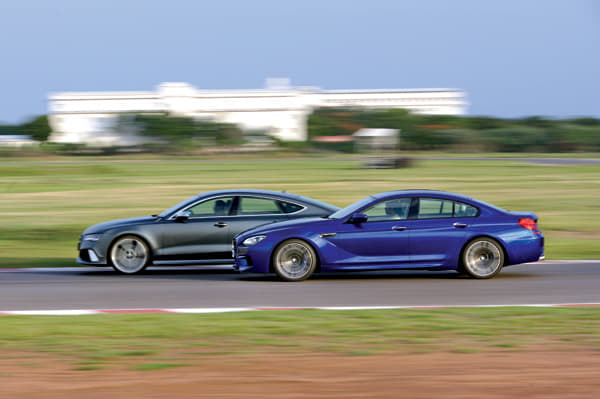
An over-simplified description of the two cars that you see on these pages will suggest that there isn’t much separating them. The BMW 6-series Gran Coupé and the Audi A7 both wear plunging rooflines with pride, yet boast the practicality of four doors and the luxury quotient of their elder limousine siblings. The reason for this test, however, is the extensive and powerful makeover that has resulted in the Gran Coupé and A7 being anointed with the M plaque and the RS badge, respectively. Intriguingly, despite the long list of differences under the skin, these two rivals are only one bhp and one millimetre apart in terms of power and overall length. Even when you look closer, picking between these two is a bit perplexing. Will a few laps at the Madras Motor Race Track and an exhaustive day (and night) on the NH-4 spring a clear winner?
Big blue vs Svelte stealth
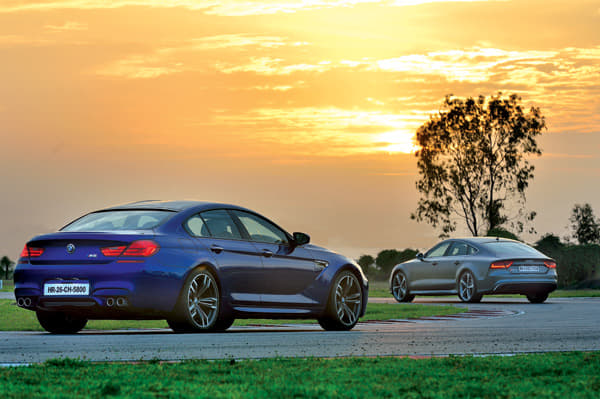
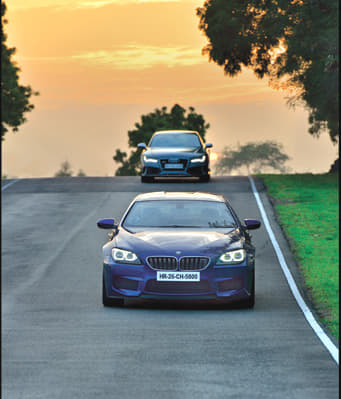
The sun is slipping towards the horizon, bathing the cars in a warm golden hue as they run shoulder to shoulder for the camera. Despite being just over 5 metres long and a bit under 2 metres wide, both cars are ready to dart off at a tangent with the slightest tug of the steering wheel. In the driver’s seat of the RS7, I try to nudge closer to the M6 as smoothly as possible. I keep peeking out of the passenger window to get a “visual” on the BMW’s position to avoid trading paint. From the driver’s seat, I am glad for the low and flat dash that gives a clear view of the corners ahead. As we slow down to get back in formation, for the nth time, I stare appreciatively at the M6 as it fills the rear-view mirror. The Gran Coupé is drop-dead gorgeous. It is quite easily the prettiest BMW today with its taut sheet metal and strong stance. Its long and low nose, the sweptback passenger cell, stubby boot and its stout haunches endow it with delicious proportions. It is unlikely that this BMW will slip under the radar anywhere it goes and the shimmering shade of blue makes doubly sure of that.
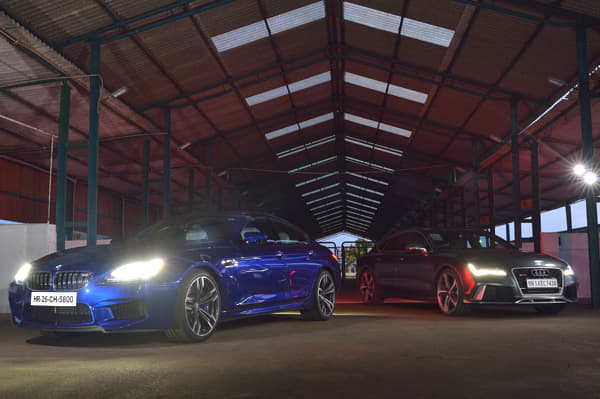
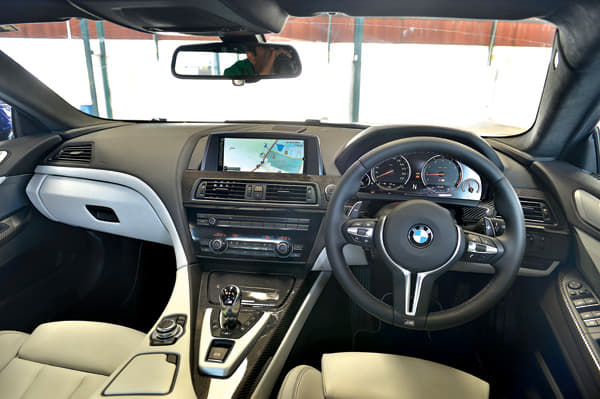
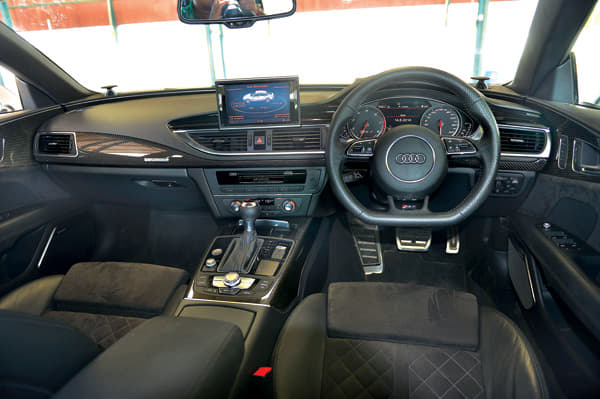
The Audi, meanwhile, seems to be trying very hard to slip under the radar, the top-notch matte- black paint suggests it has stealth mode activated. However, in our experience, the stealth mode was absolutely useless as the RS7 managed to attract attention even when it was being driven calmly at night on the highway! In my mind, the matte paint serves to highlight the simple elegance of the design, emphasising its crisp, sharp and elegant lines. On the inside, the Audi isn’t poorly equipped and has the must-have materials expected in cars such as this. Alcantara, carbonfibre and leather are either stitched or bonded at just the right places. However, overall, the cabin feels a bit sombre for a luxury car. A few runs later, I swap my way into the M6. Immediately, the BMW’s lower and more intent driving position is apparent; however, the high dash and window line leave me feeling a bit sunken in. As I take in the cabin, the impression of the M6 being richer only grows stronger. Use of lighter and contrasting colours for the seats liven up the cabin. A brief stint in the back seat also shows that the BMW’s is more welcoming as it offers more creature comforts, its longer wheelbase offers a bit more space and the seat is also more supportive. However, it’s strictly a two-passenger affair here as the transmission tunnel and air-con vents sit too close to the seat.
Push for fireworks
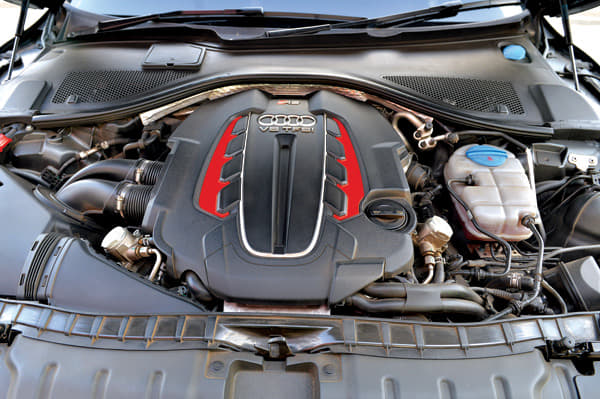
In a moderately fast car, a lap of the MMRT with its engaging mix of straights, tight corners and long sweepers, is a lip-smacking experience. In the Audi, you end up gritting your teeth as the RS7’s size and speed seem to shrink the track width and shorten the straights. The engine, a 4.0-litre V8 with twin-turbos and direct injection, has the edge over the BMW in power and torque, despite having less displacement! Performance is even more impressive than the numbers suggest. The RS7 will accelerate from standstill to 100kph in a company claimed 3.9 seconds, which is three-tenths faster than the 45kg lighter BMW. This can be credited to the RS7’s 71.38kgm of torque and the Quattro all-wheel-drive system that puts it all down so effectively. When required, the standard 40:60 torque split can be varied so that as much as 70 percent can be sent to the front axle and a maximum of 85 percent to the rear wheels. Poking the accelerator with irreverence will send this large sedan hurtling forward with shocking rapidity. Keeping your foot planted will reveal that there is no let-up in the wave of torque even as the tacho hits the 6800rpm redline. The ZF eight-speed gearbox is quick and allows the momentum to build with barely any interruption.
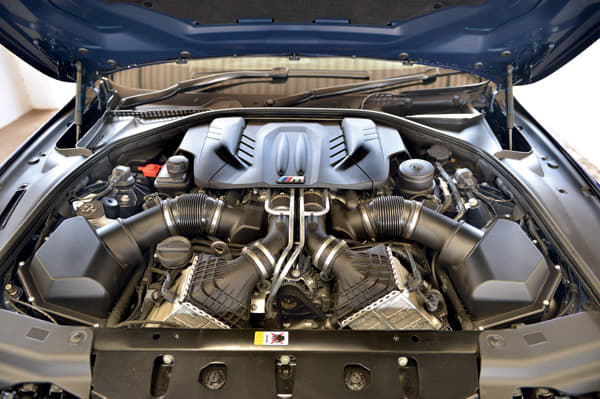
But the engine in the M6 is no wallflower either. The 4.4-litre 552bhp V8 twin-turbo direct injection engine is the same unit that we sampled in the M5, and quite frankly, felt a bit raw and savage there. However, in the M6, it seems to have been tamed as the M6’s wider rear tracks channelise the torrents of power to the tarmac with more manageable helpings of silliness. The engine’s track-bred character is ever apparent, the motor sounds intent as power builds progressively. Once the tacho needle swings past the 5500rpm mark, an added dose of adrenaline is injected right up to the 7200rpm limiter. The seven-speed dual-clutch transmission, while expectedly smooth, was all the more impressive as it downshifted aggressively when required. However, despite the strong power delivery, the M6’s performance, when compared to the RS7, feels a bit tame. But bear in mind, making use of all the power needs some care as all of it goes to the rear wheels only, which are more than eager to step out of line.
 Viraaj Bhatnagar
 Dipan Sur
 Dhruv Dhaka
 Saptarshi Mondal