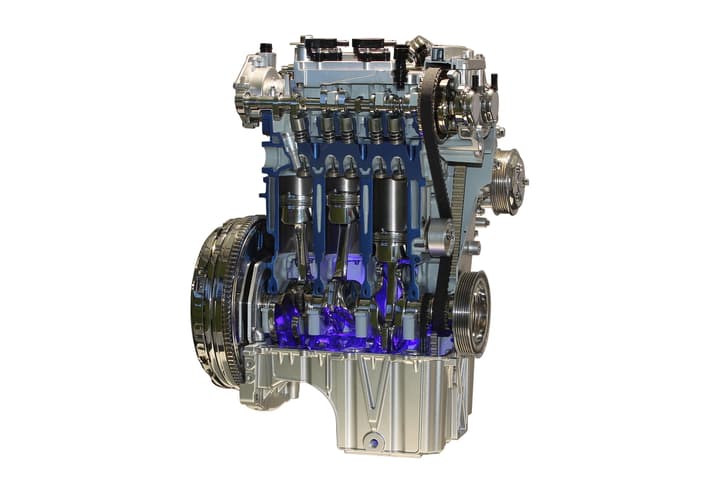
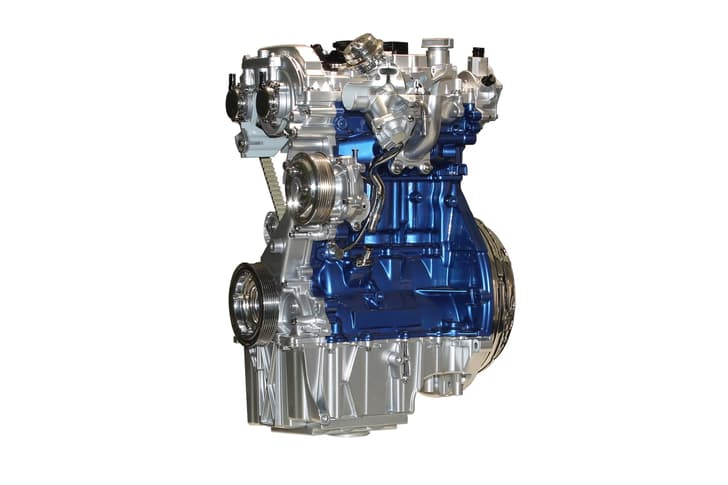
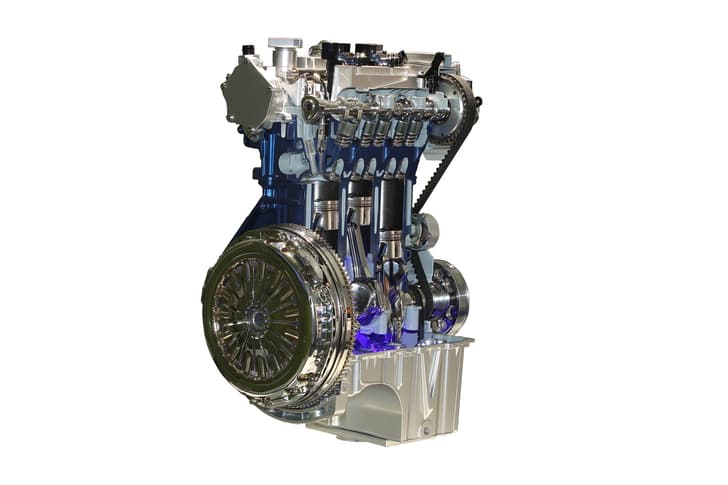
Ford is proud of the EcoBoost engine under the hood of the new EcoSport and rightly so. This pint-sized 1.0-litre engine is so good, it won the 2012 International Engine of the Year award and joins past winners that include BMW’s legendary V10 in the old M5 and Volkswagen’s complex but effective 1.4-litre twin-charger unit.
In addition to this, the EcoBoost set 16 land speed records at a racetrack in France last year, and was awarded the Popular Mechanics Breakthrough award among others.
Here’s a quick look at why it won these awards.
The EcoBoost engine, despite its small displacement, makes 123bhp and 17.3kgm of torque (from as low as 1400rpm), which is roughly what you would previously get from a relatively bigger engine. The EcoBoost, in line with the global trend of downsizing engines, is a three-cylinder unit that runs on petrol, uses a cast iron block, direct-injection technology and a turbo-charger. It’s a twin-cam design that’s variable valve timing enabled on both camshafts and breathes through a four-valve head. So, while there’s nothing spectacular in these basic specs, it’s special in how compact it is and how Ford has found clever ways to smoothen out the naturally unbalanced three-cylinder engine.
Most three-cylinder units use a counter rotating balancing shaft (that rotates in the opposite direction of the crankshaft) to cancel vibrations, but this adds to the weight and extra internal friction of the engine. So, the NVH team at the Ford Technical Center in Dunton, England decided not to use a balancer shaft and focus on two other areas – the engine’s front pulley and the rear flywheel. Both are unbalanced with carefully placed weights that counteract the natural vibrations of the engine. The cast iron block and the interated engine mounting bracket also help smoothen it out and absorb engine noise.

 Viraaj Bhatnagar
 Dipan Sur
 Dhruv Dhaka