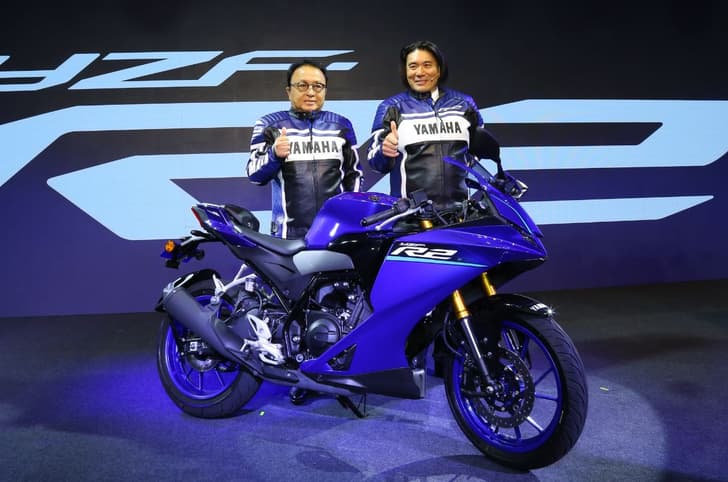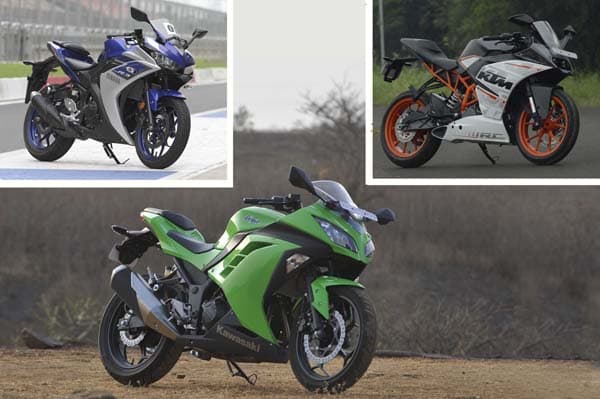
Yamaha has long missed out on the action in the lightweight sportsbike segment, where other motorcycle manufacturers including Kawasaki and KTM have made their presence felt. With Yamaha having launched the much anticipated R3 from its YZF family earlier this month, things have changed, cranking up the heat in the segment that wee bit more.
When we rode the Yamaha YZF-R3 at the Buddh International Circuit, BIC, we loved what the motorcycle felt like. Let’s find out how the best-in-its-class fare against each other on paper.
On the engine front, the Kawasaki and the Yamaha both feature parallel-twin cylinder equipped units. However, the YZF-R3 is tuned to make a healthier 41.4bhp at 10,750rpm from its 321cc heart, compared to the Ninja 300, which makes 38.8bhp at 11,000rpm. Even torque made by the R3 is higher at 3kgm at 9,000rpm, as compared to the Ninja 300's 2.75kgm at 10,000rpm. The orange-blooded KTM RC 390 impresses here despite its handicap of having a cylinder less, making maximum power of 43.5bhp at 9,000rpm and maximum torque of 3.5kgm from its 373.2cc single-cylinder engine. There’s little to choose among the bikes in terms of engine equipment levels, with all offering liquid-cooling, four-valve per cylinder heads and fuel-injection systems.
All three come equipped with six-speed transmission systems. Slipper clutches are missing on the bikes, although the RC 390 is expected to gain this soon, considering that its street variant, the 390 Duke already has.
When it comes to size of the motorcycles, the Yamaha YZF-R3 comes closest to a full-blown sportsbike. It measures the longest at 2,090mm, followed by the Kawasaki Ninja 300 at 2,015mm. The KTM RC 390 is more compact at 1,978mm. The R3 is also the tallest, measuring 1,135mm, where the Ninja 300 stands tall at 1,100mm, and RC 390 at 1,098mm. The KTM is wider than both twins, measuring 748mm. The R3 is 720mm wide and the Kawasaki, 715mm. The RC 390 is the lightest at 166kg – always a solid advantage, especially on sporty bikes such as these. The Yamaha YZF-R3 tips the scales at 169kg, where the Ninja is the heaviest bike of these at 172kg.
In terms of frames, the RC 390 uses a steel trellis unit, a typical on KTM bikes, while the Kawasaki and Yamaha come with tubular steel, diamond-type frames.
Suspension on the KTM RC 390 is provided by top spec upside-down forks at the front, and a monoshock at the rear, with an alloy swingarm. The other two motorcycles come with standard telescopic fork units in the front. The Ninja 300 and YZF-R3 have a monoshock each at the rear.
 Vishal Venugopal
 Ved Janve
 Stephen Raj Antony