

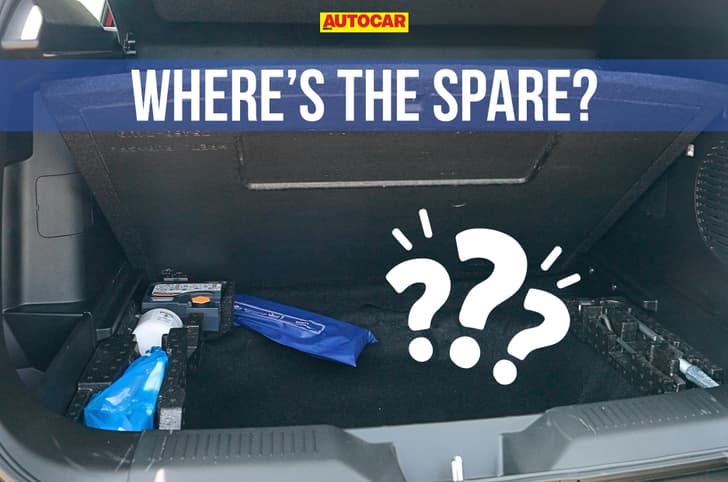
Back in 2020, the government amended the Central Motor Vehicles Rules (CMVR) to state that passenger vehicles would not be required to be sold with a spare tyre, provided the vehicle uses tubeless tyres, and is fitted with a tyre pressure monitoring system (TPMS) and a puncture repair kit.
While it sounded ambitious at the time, in the five years since, it has slowly gained acceptance, not just in premium vehicles, but mainstream ones too. It has been the norm in European markets for years now, and with TPMS proliferating across more vehicles, it’s becoming accepted here too.
Tata Motors began implementing this on its smaller electric cars like the Punch EV and Tiago EV, as well as its flagship Harrier and Safari, and so did Maruti on certain variants of the Fronx and Grand Vitara. The latest recipient of spare tyre deletion from all its variants is the Maruti Suzuki Victoris, which got me thinking – can Indian road users finally (and safely) wave goodbye to the spare tyre altogether?
Why are they removing spare tyres from cars?
The reason is simple: because it’s becoming less of a necessity and more of a convenience item. There are several factors that contribute to this, such as:
- Road conditions are improving on the whole
- Car owners are more conscious of maintenance
- Tyres are of higher quality and last longer
- Improved tech like TPMS and puncture repair kits
- Tyre repair shops are easily available
- Tyre repair is easy to do on your own
- The space and cost saved can be used for other things
There would obviously be resistance from more traditional car owners for whom the safety net of a spare tyre is a quintessential part of motoring, but as manufacturers are no doubt discovering, the insistence on a spare tyre by buyers is on the decline. And I think a lot of that has to do with how far things have come.
Though road conditions are still far from ideal (especially post monsoon), there’s no doubt that highways in particular are in better shape than they’ve ever been. Combine that with better-quality tyres and tyre-pressure monitoring systems (TPMS) that alert you of pressure loss well in advance, and you’re never really taken by surprise.
Besides, even when you do get a punctured tyre, it’s relatively easy to fix yourself (you don’t even have to take the wheel off), and if not, these days on most highways, you’re never too far away from a friendly puncture repair shop.
Is it just a cost cutting measure?
Sure, there are some who will quickly dismiss this as a cost-saving measure from the carmaker, but is that such a bad thing? Demand for feel-good features like sunroofs, seat ventilation and superior sound systems is higher than ever, not to mention enhancing performance, comfort and safety, so why not spend that money on that instead?
As you’ll see below as well, while spare tyres have many advantages to a car owner, there are some downsides too, such as their weight, which will impact fuel economy, even if only incrementally. Plus, getting rid of the spare tyre frees up space that can be used to provide even more storage in the car.
So yes, just as Porsche enthusiasts took time to accept that the 911 would be water cooled, I think Indian motorists will eventually come around to the idea of not having a spare tyre in the back of their car. Apart from the fact that the impact on their daily usage is minimal, the benefits that come with it are too good to ignore. There’s a reason it has become the norm elsewhere in the world, and as with any kind of progress, it will take time.
Pros and cons of spare tyres:
Spare tyre pros:
A spare tyre is familiar: For older car owners in particular, the fifth tyre, or spare wheel feels like an integral component of a car, and without it, things just feel incomplete. Whether or not a puncture takes place at all, owners have peace of mind that they have a replacement ready to go at any given time, especially when going on a long journey away from urban areas.
Changing a spare tyre is easy: It’s a quick an easy procedure to change a tyre, one that many drivers and car owners are already familiar with. The car has to be jacked up, bolts removed, flat tyre replaced with the spare, bolts re-fastened and car jacked down. The damaged tyre can then be taken for repair or replacement to a professional workshop at the owner’s convenience.
One more tyre for rotation: Tyre rotation, which periodically moving the tyres from one position on the car to another, is a good habit to ensure even wear and longer life, and ultimately greater safety. With a spare tyre, you’re not just rotating four tyres, but five, which extends their life even further. Of course, in order to do this, it must be a full-size spare tyre, and the tyres used should not be directional or of staggered sizes.
Spare tyre cons:
Space and weight: Spare tyres take up space in the boot of the car, or when they are located under the car, they can impact ground clearance. In European cars especially, where spare tyres are already a thing of the past, this space is increasingly being used to accommodate ancillaries like batteries in hybrids and EVs. They are also quite heavy, impacting fuel economy, and requiring some effort to remove and install.
Spare tyre cost: It may not seem like much but a spare tyre impacts the overall price of the vehicle. You have to consider the cost of the tyre itself and the wheel it is mounted on, as well as the tools supplied with the car to perform tyre changes. The cost saving of not offering a spare tyre, however small it may seem, can be leveraged to offer other features of greater value to buyers.
Speed limit: While rarely an issue with full-size spare tyres, the more common space-saver spare tyres come with a speed limit – usually 80 or 60kph – that puts a restrictor on high-speed highway driving. Depending on how close or far you are from your destination, this can prolong your journey considerably, and you might want to repair your puncture early just to avoid the inconvenience.
One-time use: While a spare tyre is quick and convenient when you get a puncture, what happens if you get a second puncture on the same journey? You have already used your spare tyre, so you will be forced to repair the damaged tyre, or get the car towed. It’s an unlikely situation, but not an impossible one, given the terrible state of roads in India.
Pros and cons of tyre repair kits:
Tyre repair kit pros:
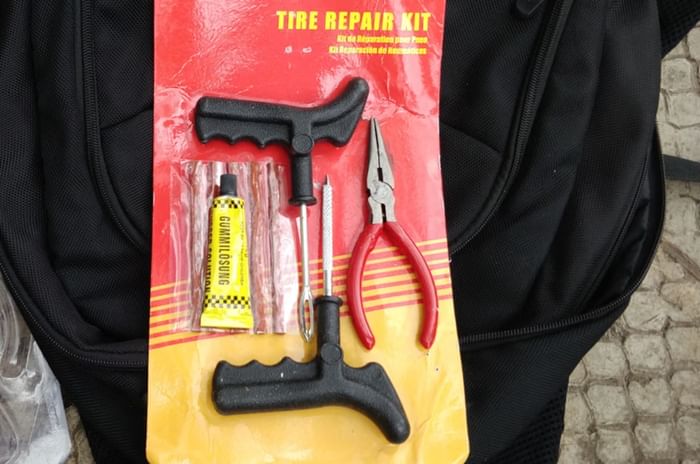
They are compact: A tyre repair kit is comprised of the sealant device – either rubber stops or a sealant gel – a few small tools to implement it, and in most cases, an electric tyre inflator compressor as well. These all fit within a small corner of the boot and take up about a fifth of the space required for a spare tyre.
Tyre never leaves the car: Except for in some extreme cases, the tyre can remain on the vehicle while you find and repair the puncture. This means you don’t have to worry about undoing the lug nuts and lifting off the big wheel and tyre, which in large SUVs, can be quite a challenge for a single person on their own. In fact, if the puncture is within easy reach, the car doesn’t even necessarily need to be jacked up.
You can keep repairing it: Once the tyre is repaired, you can simply continue driving as if nothing happened. Should another puncture appear further down the line, you simply repair it too and keep going. However, this isn’t indefinite, and if multiple punctures occur in close proximity of one another, it is recommended to change the tyre.
Tyre repair kit cons:
Requires some skill: Using a puncture repair kit is not as easy as simply removing a tyre and fitting another one. There’s a knack to identifying the puncture, safely and cleanly removing the intruding object, and repairing it without causing further damage to the tyre. Some may not get it on the first try, but with time and effort, it will become as natural as changing a tyre.
Not all punctures can be fixed: Tyre repair is limited to the tread of the tyre, i.e. the section that makes contact with the road. While that should account for a majority of punctures, there are certain cases where the sidewall gets damaged, like when making hard contact with a sharp pothole. In such a case, the tyre cannot be fixed, certainly not by a puncture repair kit, and must be replaced.

 Hormazd Sorabjee
 Rishaad Mody

 Avik Chattopadhyay
 Shapur Kotwal