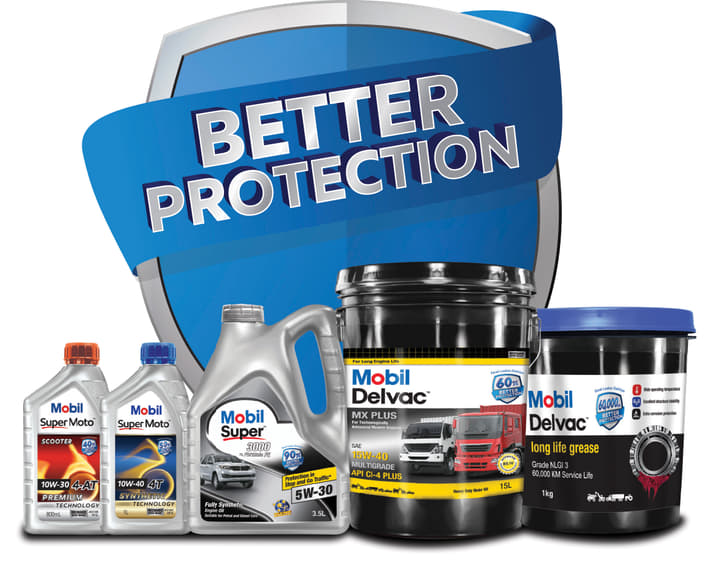
The right engine oil does more than you think
We all know what engine oils do – lubricate the numerous moving parts that function under a range of temperatures and stresses and protect the motor against a variety of threats, including corrosion, wear, and the accumulation of dirt and deposits. As importantly, it also directly impacts performance, fuel consumption, and emissions. In short, lubricants such as engine oils are vital in ensuring the longevity of your engine.
The importance of the right formulation
To do all the above, an engine oil needs to have the right characteristics. It should have sufficiently high viscosity to isolate the moving components in the engine under a range of conditions related to speed, load and temperature. And, at low temperatures, it should possess a sufficiently low viscosity to be directed towards important engine components on start-up.
Synthetic versus conventional
Both synthetic and conventional oils are made from crude, but there are several key differences. Synthetic oils are purer compared to conventional mineral oils, and are made from a more advanced refining process. Synthetic oils are more free-flowing than conventional mineral oils, and the result is enhanced protection for the engine. For example, unlike conventional oils that take time to circulate through the engine on start-up, a synthetic lubricant starts circulating faster and, thus, protects moving parts within the motor. The reason synthetic oils are considered superior to conventional oils is because they contain more highly refined base oils, which play a role in offering you better protection and performance. Synthetic oils also positively impact fuel economy, since they help engines reach peak operating efficiency sooner. They are also more eco-friendly, as they help slash engine emissions compared to conventional mineral oils. The latter also contain more impurities – sulfur, for instance – that cannot be filtered out by conventional refining.
Understanding the labels and reading the signs
First things first – always ensure you use a motor oil of the recommended grade. Now, see that ‘5W-30’ on the label? That’s the viscosity grade which tells you how the oil operates at various temperatures. (Viscosity is the measure of any liquid’s resistance to flow.) So, 5W-30 refers to the viscosity of the oil at 0 degrees F, or -17.8 degrees C. ‘W’ signifies ‘winter’, and a 5W-30 oil would be more fluid in the cold than a 10W-30 oil. The number after the ‘W’ indicates the oil’s viscosity at 212 degrees Fahrenheit or 100 degrees C. This indicates the oil’s resistance to thinning at high temperatures. Today, many modern car manufacturers recommend thinner oils such as 5W-30. The reason is that tighter component clearances in modern engines need thinner oils, and such oils are also capable of providing better fuel economy due to their less resistance to flow at all temperature extremes.

What kind of engine oil should you be using?
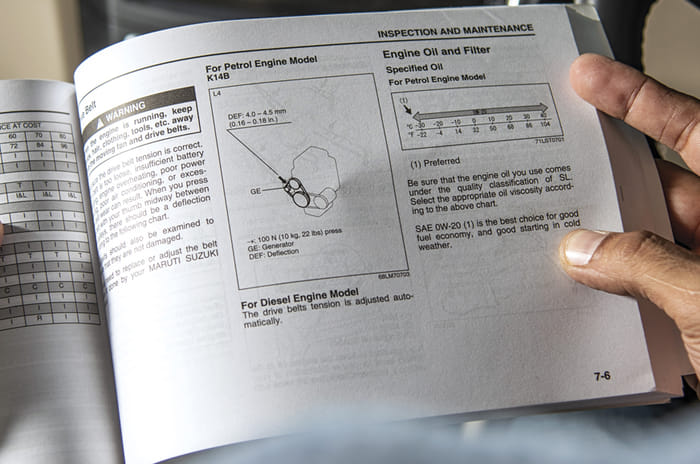
You’ll find the answer to that in the owner’s manual. If it says semi-synthetic oil, you could reap benefits from using a synthetic oil for improved performance and protection.
See that icon? If it lights up or flashes constantly, you’ve got to pay prompt attention. Stop your car and check the oil. The reason the light comes on is because it indicates low pressure in the engine, which means, there isn’t enough oil, or the oil pump is not doing its job right.

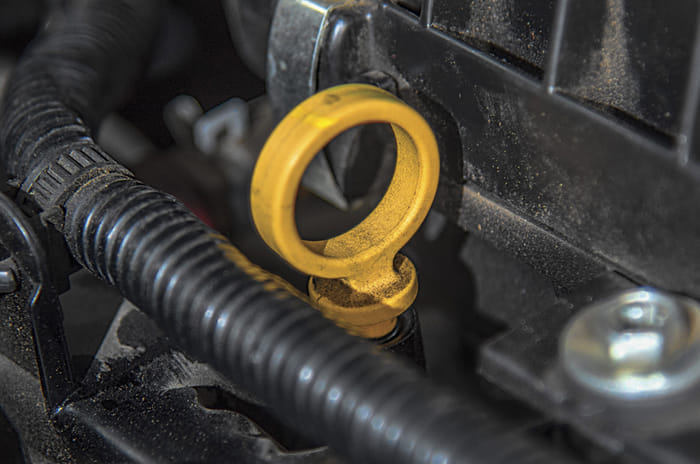
Open your car’s hood, and locate the dipstick. Use the dipstick to check the engine oil level. (The dip stick is usually of a bright colour, and sports a T-shaped or round handle.) Remove the dipstick and wipe it clean, and insert it back into the engine. Now, remove it again to check the oil level. If the level is not at an optimum – it should be between two marks indicated on the dipstick – you should top up your engine oil pronto.

 Uday Singh

 Dipan Sur


 Glenn Noronha